Subscribe to the 100% free rdnewsNOW daily newsletter!
sponsored

Market Watch – Dec. 19, 2025

Dec 22, 2025 | 4:51 PM

This week’s highlights

  • Late-week rebound anchored by tech and softer U.S. CPI
  • Global curves diverge amid inflation surprises, labour data and central bank moves
  • Canada’s inflation rate unchanged at 2.2% in November
  • U.S. added more jobs than expected in November; unemployment rate at 4.6%
  • Eurozone industry extends gains for the second consecutive month

Week in review

Late-week rebound anchored by tech and softer U.S. CPI

U.S. equities opened the week on a cautious note, with declines accelerating Tuesday after labour data revealed job losses and rising unemployment despite resilient retail sales and Purchasing Manager Indices (PMIs). Sentiment rebounded Thursday as November CPI undershot expectations, though concerns lingered over its reliability given October’s missing survey data, which was backfilled using “nonsurvey data sources”. Tech outperformed, with Micron’s upbeat guidance driving a semiconductor-led rally into week’s end. Canadian equities tracked U.S. moves, with markets supported by lower-than-expected inflation but later weighed by a surprise retail sales contraction. In Europe, stocks were mixed as PMIs signaled slowing momentum; the European Central Bank (ECB) held rates steady while the Bank of England (BoE) cut 25bps following a sharp inflation slowdown. Chinese and Emerging Markets faced pressure from weak domestic data and property-sector stress, partially offset by tech headlines and firm external demand.

Highlights:

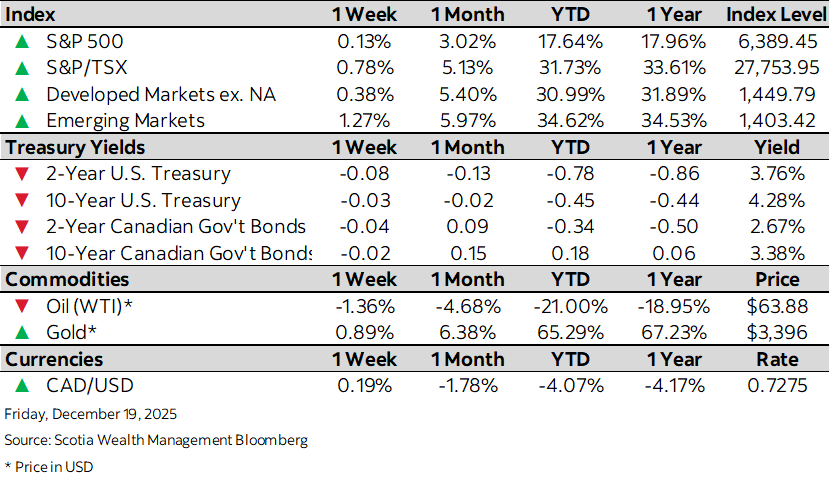
  • U.S. equities returned 0.13%1 as markets swung on mixed signals. Job losses and rising unemployment weighed early, but softer CPI and Micron’s strong outlook revived risk appetite. CPI accuracy concerns due to October’s missing data added nuance to the inflation narrative.
  • Canadian equities were up 0.78%2, subdued through Thursday despite softer inflation, then rallied into week’s end alongside U.S. markets as tech strength and improved global sentiment outweighed earlier pressure from weak retail sales.
  • European stocks rose 0.38%3 despite PMIs undershooting expectations, signaling fading growth. The ECB held rates steady, while the BoE’s 25bps cut and dovish tone boosted U.K. financials midweek, though broader sentiment stayed muted amid lingering inflation risks.
  • Emerging markets were 1.27%4 higher as equity markets faced some selling pressure due to weaker retail sales and deepening investment contraction, partly offset by industrial strength and tech headlines. Broader EM markets tracked global risk appetite, recovering modestly late in the week as commodity prices stabilized.

Global curves diverge amid inflation surprises, labour data and central bank moves

U.S. yields began the week slightly lower on risk-on positioning but shifted as labour data released Tuesday showed job losses and rising unemployment, prompting front-end declines before reversing midweek. Thursday’s softer CPI print drove a bull flattening, reinforcing expectations for Fed easing despite lingering doubts over data accuracy given half of October’s missing survey data. Canadian rates tracked U.S. moves, dipping early on soft inflation before edging higher as weak retail sales and growth concerns tempered conviction around near-term Bank of Canada (BoC) action. In Europe, curves were mixed ahead of central bank decisions; the ECB held steady while the BoE’s 25 bps cut and dovish tone drove gilt out performance midweek before yields rose modestly into Friday. Japanese yields climbed after the Bank of Japan (BoJ) delivered a widely expected 25 bps rate hike, pushing that country’s long-end rates to multi-decade highs.

Highlights:

  • The 2- and 10-year U.S. Treasury yields fell 8 basis points (bps) and 3 bps, respectively. In Canada, the 2- and 10-year yields were down 4 bps and up 2 bps, respectively. Bond yields and prices move inversely to one another.
  • Global sovereign curves saw mixed moves—U.S. yields bull-flattened after a softer CPI print, gilts rallied on a BoE rate cut, while JGBs surged to multi-decade highs following the BoJ’s widely expected hike.
  • Investment-grade spreads tightened late in the week as risk appetite improved on easing inflation signals, while high-yield outperformed on tech-driven equity strength and reduced near-term recession fears despite lingering macro uncertainty.

Weekly dashboard

Canada’s inflation rate unchanged at 2.2% in November

Canada’s annual inflation rate was 2.2% in November, unchanged from the previous month, driven primarily by an increase in food prices which rose at their fastest pace in more than two years, Statistics Canada (StatCan) reported. A year-on-year drop in the costs of gasoline and shelter partially offset the rise in food prices, the statistics agency said. It was the first month since March that core measures of inflation, which strip out volatile items, came in below 3%, the upper end of the Bank of Canada’s control range. Analysts had forecast annual inflation of 2.3%.

Highlights:

  • StatCan’s data showed that the price of gasoline was up 1.8% in November when compared with October, but on an annual basis it was 7.8% lower. Without the effect of gasoline, November’s consumer price index (CPI) was 2.6%.
  • Food prices overall rose by 4.2% on a yearly basis in November, the biggest increase since December 2023, spurred by a 4.7% rise in grocery prices and a 3.3% increase in the cost of food purchased from restaurants.
  • CPI-median, the centermost component of the CPI basket, edged down to 2.8% in November from 3% in the prior month. CPI-trim, which excludes the most extreme price changes, was also at 2.8% last month from 3% in October.

U.S. added more jobs than expected in November; unemployment rate at 4.6%

The United States gained 64,000 jobs in November but lost 105,000 in October as federal workers departed after cutbacks by the Trump administration, the government said in delayed reports. The unemployment rate rose to 4.6%, highest since 2021. Both the October and November job creation numbers, released this week by the U.S. Labor Department, came in late because of the 43-day federal government shutdown.

Highlights:

  • The November job gains came in higher than the 40,000 economists had forecast. The October job losses were caused by a 162,000 drop in federal workers. Labor Department revisions also knocked 33,000 jobs off August and September payrolls.
  • The unemployment rate, though still modest by historical standards, has risen since bottoming out at a 54-year low of 3.4% in April 2023.
  • Adding to the uncertainty is the growing use of artificial intelligence and other technologies that can reduce demand for workers.

1 S&P 500 Index USD
2 S&P/TSX Composite Index USD
3 Bloomberg Developed Markets ex N. America Large & Mid Cap Price Return Index USD
4 Bloomberg EM Large & Mid Cap Price Return Index USD

This publication has been prepared by The Bank of Nova Scotia for Scotia Wealth Management clients. It is for general information purposes only and should not be considered or relied upon as personal and/or specific financial, tax, pension, insurance, legal or investment advice. We are not tax or legal advisors, and we recommend that individuals consult with their qualified advisors, including tax and legal advisors, before taking any action based upon the information contained in this publication. The opinions and projections contained in this publication are our own as of the date hereof and are subject to change without notice. Scotia Wealth Management is under no obligation to update this publication, and readers should assume the information contained herein will not be updated. While care and attention has been taken to ensure the accuracy and reliability of the material in this publication, neither The Bank of Nova Scotia nor any of its affiliates or any of their respective directors, officers or employees make any representations or warranties, express or implied, as to the accuracy or completeness of such material and disclaim any liability resulting from any direct or consequential loss arising from any use of this publication or the information contained herein. This publication may contain forward-looking statements based on current expectations and projections about future general economic factors. Forward-looking statements are subject to inherent risks and uncertainties which may be unforeseeable and such expectations and projections may be incorrect in the future. Forward-looking statements are not guarantees of future performance and you should avoid placing undue reliance upon them. This publication and all the information, opinions and conclusions contained herein are protected by copyright. This publication may not be reproduced in whole or in part without the prior express consent of The Bank of Nova Scotia.

® Registered trademark of The Bank of Nova Scotia, used under licence. ™ Trademark of The Bank of Nova Scotia, used under licence. Scotia Wealth Management® in Canada consists of a range of financial services provided by The Bank of Nova Scotia (Scotiabank®); The Bank of Nova Scotia Trust Company (Scotiatrust®); Private Investment Counsel, a service of 1832 Asset Management L.P.; 1832 Asset Management U.S. Inc.; Scotia Wealth Insurance Services Inc.; and ScotiaMcLeod®, a division of Scotia Capital Inc. Private banking services are provided by Scotiabank. Estate and trust services are provided by The Bank of Nova Scotia Trust Company. Portfolio management is provided by 1832 Asset Management L.P. and 1832 Asset Management U.S. Inc. Insurance services are provided by Scotia Wealth Insurance Services Inc. Wealth advisory and brokerage services are provided by ScotiaMcLeod, a division of Scotia Capital Inc. International investment advisory services are provided by Scotia Capital Inc. Financial planning services are provided by Scotiabank and ScotiaMcLeod. Scotia Capital Inc. is a member of the Canadian Investor Protection Fund and regulated by the Canadian Investment Regulatory Organization. Scotia Wealth Insurance Services Inc. is the insurance subsidiary of Scotia Capital Inc., a member of the Scotiabank group of companies. When discussing life insurance products, ScotiaMcLeod advisors are acting as Life Insurance Agents (Financial Security Advisors in Quebec) representing Scotia Wealth Insurance Services Inc.

Scotia Wealth Management® in The Bahamas consists of a range of financial services provided by Scotiabank (Bahamas) Limited and The Bank of Nova Scotia Trust Company (Bahamas) Limited, which are entities licensed to operate within The Bahamas. International private banking and international investment advisory services are provided by Scotiabank (Bahamas) Limited. International wealth structuring solutions are provided by The Bank of Nova Scotia Trust Company (Bahamas) Limited. ® Registered trademark of The Bank of Nova Scotia, used under licence.

Scotia Wealth Management® in the Cayman Islands consists of a range of financial services provided by Scotiabank & Trust (Cayman) Ltd. International private banking services, international investment advisory services, and international wealth structuring solutions are provided by Scotiabank & Trust (Cayman) Ltd., an entity licensed by the Cayman Islands Monetary Authority. ® Registered trademark of The Bank of Nova Scotia, used under license.

Scotia Wealth Management® in Jamaica consists of a range of Private Banking services provided by the Scotiabank Group of companies (Scotiabank®). ®Registered trademark of The Bank of Nova Scotia, used under licence.