LOCAL NEWS THAT MATTERS, SENT TO YOU DIRECTLY. SUBSCRIBE FOR FREE!
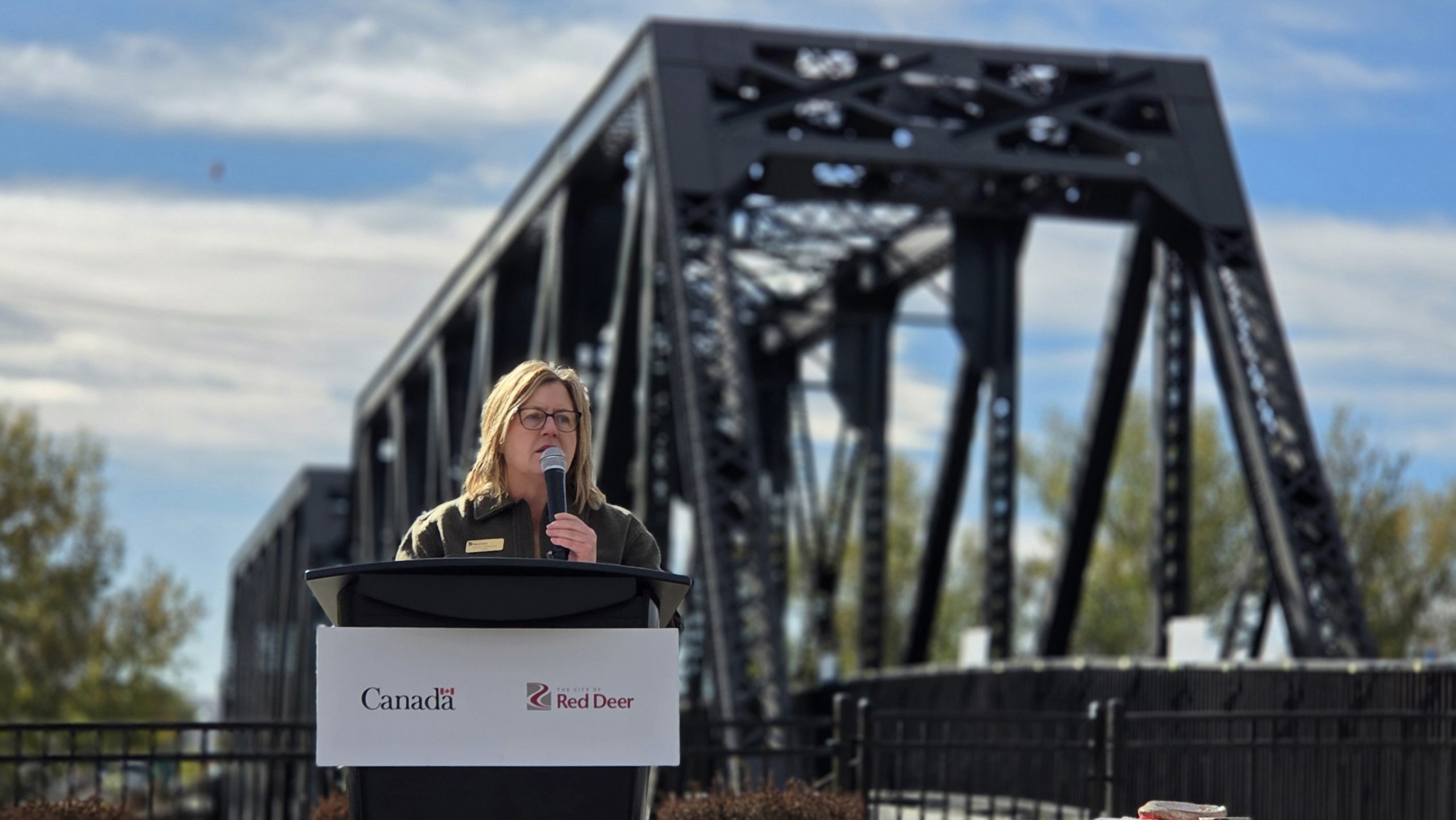
Mayor Cindy Jefferies speaks at the bridge's grand reopening event on Monday, Sept. 28, 2026. (Image Credit: rdnewsNOW/Josh Hall)
preserving a century-old landmark

Now we’re walkin’: Red Deer’s historic CPR Pedestrian Bridge finally reopens

Sep 28, 2026 | 1:57 PM

The day has come for Red Deerians to once again walk across the CPR Pedestrian Bridge.

A ribbon was cut Monday morning, putting a bow on many months of work to preserve the legacy of a structure that has stood since 1908.

At the end of the day, $22.3 million was spent to literally lift and move the very heavy bridge, give it some much-needed TLC, and create a new public gathering space on the north end.

Half the cost was provided by the federal government through its Active Transportation Fund.

That supported not just the bridge’s rehabilitation, but the removal of contaminated soil and the addition of lighting along the bridge.

“For generations, the CPR Bridge has been woven into Red Deer’s story. Its very existence helped spur the development that was fundamental to the growth of our community, but over time it has become much more than a transportation link,” said Mayor Cindy Jefferies.

“It has been the backdrop for countless family photos, graduations, weddings and beautiful walks along the river. Preserving this bridge means preserving an important piece of our community’s history while making sure it can continue to connect Red Deerians for generations to come.”

When city council decided to move forward with the project in 2024, there was significant pushback from the community, which questioned the use of the money.

The city explained at the time that the federal funding, combined with the fact it would’ve also cost many millions to get rid of the aging bridge, meant that it made financial sense to undertake its preservation.

Some questions remain today, with a homeless shelter just a hop, skip, and a jump from the south end of the bridge, and another a few blocks away from the north end.

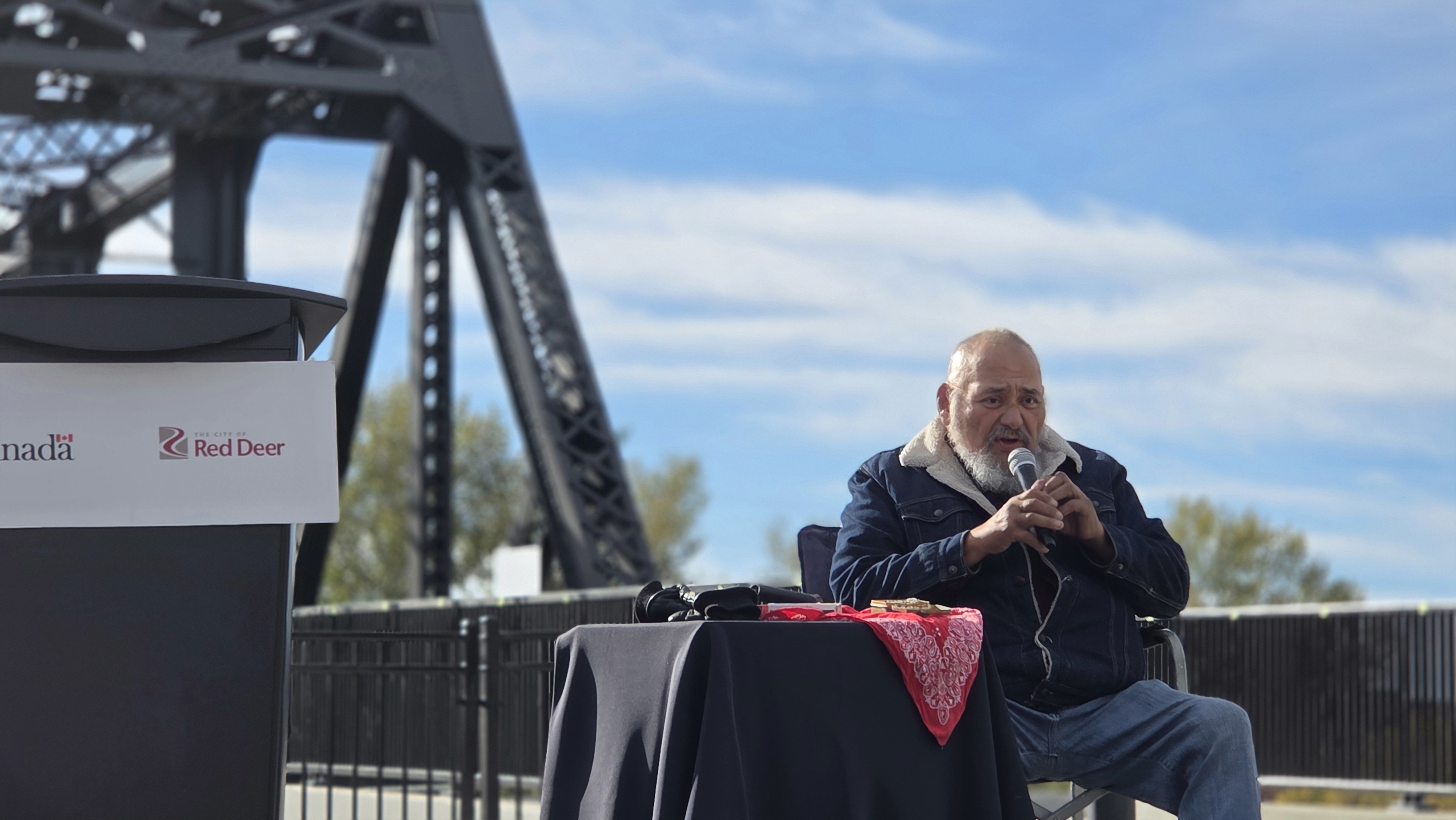
Elder Lyle Keewatin Richards, who is also with the Saving the Children Society, gave a blessing at the grand reopening, but made note of the many people who are unhoused who use the bridge on a daily basis.

Elder Lyle Keewatin Richards gave an Indigenous blessing at the ceremony, but also talked about the history of the bridge and how it was part of the path kids were taken on to Red Deer's notorious residential school. Richards is head of the Saving the Children Society.
Elder Lyle Keewatin Richards gave an Indigenous blessing at the ceremony, but also talked about the history of the bridge and how it was part of the path kids were taken on to Red Deer’s notorious residential school. Richards is head of the Saving the Children Society. (Image Credit: rdnewsNOW/Josh Hall)

“You get mixed feelings because, on one hand, for 11 years, back at the turn of the century, they transported kids from all over western Canada, over this bridge to one of the most notorious residential schools there was,” he explained.

“Now, we’re sitting here at the opening ceremony having dropped millions, and just across the way, people are sleeping in the parking lot.”

Mayor Jefferies said she heard and understood Richards’ point loud and clear.

“We can’t lose focus on the need for housing in our community, and for the services [they need]. We continue to work on that; we’ve been working hard with the federal and provincial governments on that front,” she said.

“The federal grant was designated funds, so we weren’t able to transfer the use of it to anything related to homelessness, other than knowing that this bridge is an important connecting piece for homeless people.”

Though there are other vehicle bridges nearby, it was noted that this footbridge is an important connector between the lands of Treaty 6 and Treaty 7, which are separated by the very Red Deer River that runs underneath it.

The bridge was first built as a CPR crossing in 1908 and used until 1990, when the rail line was relocated. It was slated for demolition until citizens intervened and advocated for its repurposing as an active transportation structure. In 1991, city council designated the structure as a Municipal Historic Resource.

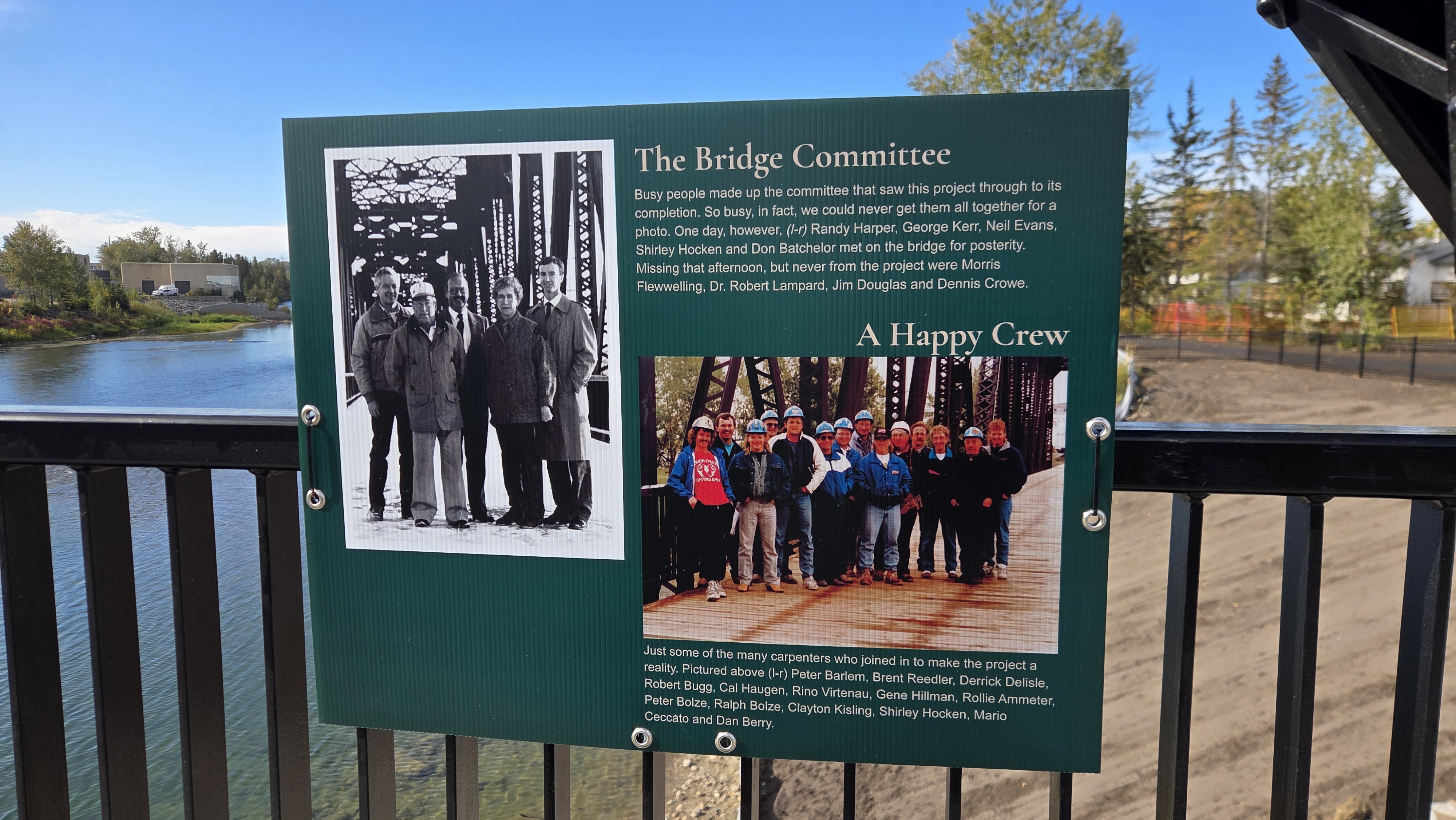
One of the instigators in those efforts was Shirley Hocken, who was invited to be part of Monday’s festivities.

Hocken said a group of citizens that she led 36 years ago raised more than a million dollars to save the bridge, while many other labours were given in-kind.

A temporary art installation along the bridge displayed archival images related to the bridge's history, plus photos of people's weddings, engagements, photoshoots, and other special memories.
A temporary art installation along the bridge displayed archival images related to the bridge’s history, plus photos of people’s weddings, engagements, photoshoots, and other special memories.

“It would’ve been devastating,” she said of the possibility that the city had opted not to take on this project, restoring life to the bridge for another 100 years.

“I was part of the Waskasoo Recreation Board, and when they passed the Waskasoo Master Plan, part of it was this bridge being an integral path. If they had to take it out, they’d be going against [that plan].”

A special brick bench they had installed in the early 90s remains as part of the redone public gathering space.

Mayor Jefferies noted that the city has certain activations planned for the public gathering space, and hopes people will take advantage of the bridge’s new life to come down and use it.

According to the city, one of the most significant milestones of this project occurred in February 2026, when the bridge’s two steel trusses, each weighing more than 200 metric tonnes, were lifted and moved to new foundations following months of engineering, planning and site preparation.

More than 60 new trees and 900 plants are in the process of being planted.

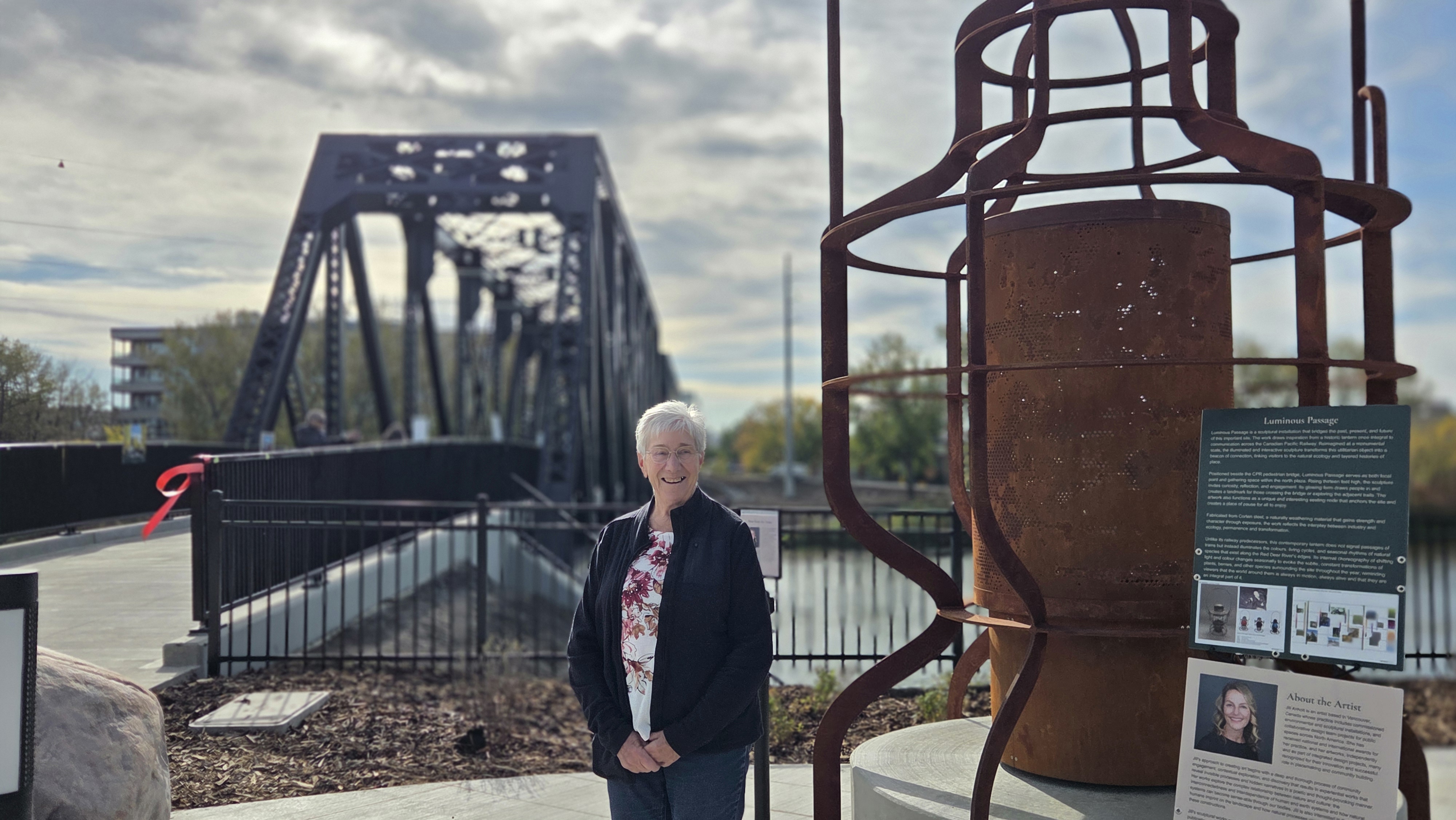
Meanwhile, the plaza also features a new permanent public art piece called Luminous Passage.

Per the city:

“This 13-foot sculptural installation draws inspiration from the historic lantern that was once integral to Canadian Pacific Railway. The steel sculpture is illuminated from within, and the changing light is inspired by the colours and seasonal cycles of the plants and other species found along the Red Deer River.”

Shirley Hocken stands in front of 'Luminous Passage,' the new art installation at the bridge's north end. Hocken led the bridge's saving in 1990/91. The art piece will illuminate after dark each night.
Shirley Hocken stands in front of ‘Luminous Passage,’ the new art installation at the bridge’s north end. Hocken led the bridge’s saving in 1990/91. The art piece will illuminate after dark each night. (Image Credit: rdnewsNOW/Josh Hall)

Vancouver-based artist Jill Anholt created the sculpture.

“Today we celebrate the re-opening of an irreplaceable part of Red Deer’s heritage,“ said Eleanor Olszewski, Minister of Emergency Management and Community Resilience, and Minister responsible for Prairies Economic Development Canada (PrairiesCan).

“For over a century, the CPR bridge has connected people across the river, and its rehabilitation reflects a commitment to honour that legacy and the stories that have built so many Alberta communities. As an active transportation link for pedestrians and cyclists, we are preserving an important part of Red Deer’s history, while creating a safe and accessible connection for residents and visitors for generations to come.”

The City of Red Deer will be sharing highlights of the bridge reopening at www.reddeer.ca/CPRBridge.