LOCAL NEWS THAT MATTERS, SENT TO YOU DIRECTLY. SUBSCRIBE FOR FREE!
Sponsored

Market Watch — Sept. 4, 2026

Sep 8, 2026 | 9:36 AM

This week’s highlights

  • Equity markets whipsawed by central bank signals and payrolls surprise
  • Warsh sets the tone, payrolls have the final say
  • Bank of Canada holds rates steady as labour market cools
  • U.S. hiring rebounds as August job growth tops expectations
  • Eurozone inflation heats up as factory activity gains momentum

Week in review

Equity markets whipsawed by central bank signals and payrolls surprise

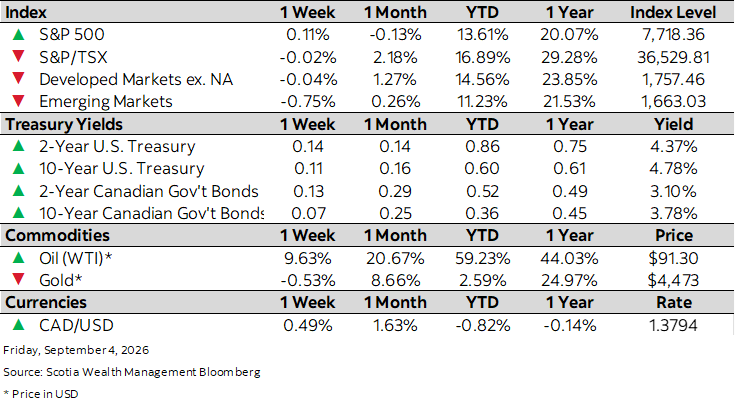
U.S. equities opened the week on the defensive as Federal Reserve (Fed) Chair Warsh’s hawkish Jackson Hole debut lifted yields and renewed U.S.–Iran hostilities pushed crude higher, before softer ADP and JOLTS prints and more dovish remarks from Williams and Waller sparked a Thursday rebound that Friday’s far stronger-than-expected payrolls partially unwound. Canadian equities lagged throughout, weighed by energy-sector volatility and a hawkish Bank of Canada (BoC) hold that firmed the Loonie, with August’s employment decline closing out the week. European bourses were pressured by an energy-led acceleration in August inflation, climbing regional natural gas prices, and Joachim Nagel, President of Germany’s Bundesbank, confirming that the European Central Bank (ECB) will hike in September. In Asia, sub-50 Chinese Purchasing Manager Indexes (PMIs), Taiwanese labour disruption reports and hawkish Bank of Japan (BoJ) commentary drove midweek losses before a yen-led carry unwind supported a late recovery.

Highlights:

  • U.S. equities closed 0.11%1 as a hawkish Jackson Hole messaging and climbing Treasury yields kept risk appetite subdued until Fed speakers softened the tone, though an outsized August payrolls print revived tightening bets into Friday.
  • Canadian markets trailed their southern neighbours finishing 0.02%² lower as oil-driven swings in energy names and a rate backdrop that turned less friendly after BoC flagged rising inflation risks compounded a soft August labour report.
  • European equities struggled, returning -0.04%3 as August inflation reaccelerated on energy costs and natural gas prices pushing higher, while confirmation that the ECB will move in September weighed on rate-sensitive sectors.
  • Emerging market equities ended the period -0.75%⁴ lower, as Chinese markets contended with manufacturing and services stuck in contraction territory, while regional technology names bore the brunt of Taiwan supply concerns and a hawkish BoJ signal before sentiment steadied.

Warsh sets the tone, payrolls have the final say

The fallout from Warsh’s Jackson Hole remarks dominated U.S. rates early, flattening the curve as the front end partially retraced while duration stayed pressured, and Tuesday’s session carried global yields to their highest since 2008 amid Hormuz supply risk and firmer commodity prices. Treasuries staged a brief Wednesday reprieve and drifted through Thursday on Federal Reserve Bank of New York John Williams’ more dovish tone before Friday’s payrolls beat repriced the front end higher. Canadian yields were lower into Wednesday’s BoC decision, then underperformed once the Bank dropped its “appropriate” language and warned of increased upside inflation risks. In Europe, August’s inflation acceleration and Nagel’s confirmation of a September move drove a sell-off led by France and Italy, with gilts reaching multi-decade highs. Japan’s long-dormant curve reset on comments from BoJ’s Hajime Takata, one of the Policy Board’s most hawkish members, before markets converged on a smaller September hike.

Highlights:

  • The 2- and 10-Year U.S. Treasury yields rose 14 basis points (bps) and 11 bps, respectively. In Canada, the 2- and 10-year sovereign yields were 13 bps and 7 bps higher, respectively. Bond yields and prices move inversely to one another.
  • Friday’s U.S. payrolls beat did the heavy lifting at the front end of the Treasury’s curve, lifting September hike odds above 60% just as the Fed entered its communications blackout ahead of the September 16 meeting.
  • Policy signals drove the non-U.S. repricing, with the Bank of Canada cracking the door open to an October hike, Nagel confirming the ECB will move on September 10, and markets settling on a 25bps BoJ increase on September 18.

Weekly dashboard

Supplied
Supplied

Bank of Canada holds rates steady as labour market cools

The Bank of Canada (BoC) left its benchmark overnight interest rate unchanged at 2.25%, opting to remain on the sidelines as policymakers weigh signs of economic recovery against mounting inflation risks and trade uncertainty. The decision marked the 11th consecutive month that the central bank has held rates steady, with Governor Tiff Macklem emphasizing that while Canada’s economy has regained momentum, risks remain elevated. On Friday, Statistics Canada reported that the Canadian economy shed approximately 42,000 jobs in August, reversing part of the strong employment gains recorded earlier in the summer. Despite the decline, the national unemployment rate held steady at 6.4%, as slower labour force growth helped offset weaker hiring.

Highlights:

  • While the central bank noted that economic growth strengthened in the second quarter, policymakers pointed to rising oil prices stemming from ongoing geopolitical tensions in the Middle East and the potential effects of new U.S. tariffs and Canadian countermeasures as factors that could keep inflation pressures elevated.
  • Employment losses were concentrated in business support services, public administration and natural resources, while manufacturing posted an unexpected gain despite ongoing trade-related pressures. Wage growth also cooled, with average hourly earnings rising 2.0% year-over-year, down from 2.8% in July.
  • The combination of resilient economic growth, sticky inflation and a softer labour market reinforce the BoC’s wait-and-see approach. While policymakers signalled that interest rates could rise if inflation remains persistently above target, for now they appear content to monitor how higher energy prices, tariffs and slowing employment growth shape the outlook in the months ahead.

U.S. hiring rebounds as August job growth tops expectations

The U.S. labour market showed renewed strength in August, with employers adding 162,000 jobs while the unemployment rate held steady at 4.1%, according to the latest Employment Situation report released by the U.S. Bureau of Labor Statistics. The gain marked a notable improvement from the softer pace of hiring seen earlier in the summer and exceeded many economists’ expectations. The report suggested that labour market conditions remain resilient despite concerns that economic growth has been slowing in recent months.

Highlights:

  • Payroll gains were led by food services and drinking places, which added 59,000 positions, while local government education employment increased by 42,000. Manufacturing also contributed to job growth, adding 16,000 jobs during the month. Meanwhile, employment declined in the information sector, continuing a broader trend of weakness in that industry.
  • The number of unemployed Americans was little changed at roughly 7.0 million, while the labour force participation rate edged up to 61.6%. Employment in the household survey increased sharply, reflecting continued demand for workers despite a backdrop of elevated interest rates and lingering economic uncertainty.
  • The number of people working part-time for economic reasons fell from 414,000 to 4.4 million, while a broader measure of unemployment that includes discouraged workers and those employed part-time for economic reasons declined to 7.7%.

Eurozone inflation heats up as factory activity gains momentum
Eurozone inflation accelerated in August, while the region’s manufacturing sector showed its strongest growth in more than four years, highlighting the complex backdrop facing European Central Bank (ECB) policymakers ahead of their September 10 meeting. According to a flash estimate released Tuesday by Eurostat, annual consumer price inflation in the euro area rose to 3.3% in August, up from 2.9% in July. At the same time, the S&P Global Eurozone Manufacturing Purchasing Managers’ Index (PMI) rose to 52.7 in August from 51.9 in July, reaching its highest level since May 2022.

Highlights:

  • The inflation increase was driven primarily by higher energy costs, which surged to 14.3% year-over-year, compared with 10.3% the previous month. By contrast, underlying price pressures remained more subdued. Services inflation eased to 3.0% from 3.3%, while core inflation, which excludes volatile energy and food prices, edged down to 2.4% from 2.5%.
  • Factory output grew at the fastest pace in four and a half years, supported by the strongest increase in new orders since early 2022. Export demand also improved, with overseas orders rising for only the second time in more than four years. Germany led the advance, posting its strongest manufacturing performance in more than four years.
  • Together, the two reports suggest the eurozone economy is gaining momentum after a prolonged manufacturing downturn, while inflation remains above the ECB’s target. The combination of stronger economic activity and renewed energy-driven price pressures is likely to keep policymakers cautious in the months ahead.