Sign up for our free daily newsletter!
(Image Credit: Supplied)
Sponsored

Market Watch — May 15, 2026

May 19, 2026 | 11:47 AM

This week’s highlights

  • Tech strength supported U.S. markets as oil prices pressure cyclicals
  • Global rates move higher on persistent geopolitical risks, rising inflation
  • Canada’s wholesale sales climb in March, driven by machinery and equipment gains
  • U.S. inflation rises to 3.8% in April, driven by energy prices
  • Eurozone growth stalls as latest GDP data shows fragile recovery

Week in review

Tech strength supported U.S. markets as oil prices pressure cyclicals

U.S. markets advanced, supported by continued strength in mega‑cap technology and AI‑infrastructure names, with several large cloud, semiconductor and data center-oriented companies posting better‑than‑expected earnings and outlooks. Investors largely looked past softer results in consumer-oriented and cyclical industries, where higher energy costs and lingering inflationary pressures kept margin expansion constrained. Canadian equities followed a similar pattern, though sector dynamics were more pronounced. Energy names benefited from firmer crude prices, helped by tightening supply expectations and ongoing geopolitical uncertainty.

European and Asian markets were pressured by rising oil prices, geopolitical tensions and sector-specific weaknesses; luxury and defence in Europe, and tech in Asia. In Europe, investors contended with deteriorating economic indicators, including softening PMIs and renewed inflation concerns as higher energy costs filtered through the economy. This created a cautious backdrop that weighed on consumer-facing sectors and amplified volatility in rate-sensitive industries. Meanwhile, Asia grappled with sharp tech-driven swings, particularly in markets heavily concentrated in semiconductor and hardware names such as South Korea. Geopolitical uncertainty surrounding the Trump–Xi summit added another layer of fragility, with investors wary of escalating rhetoric around Taiwan and trade.

Highlights:

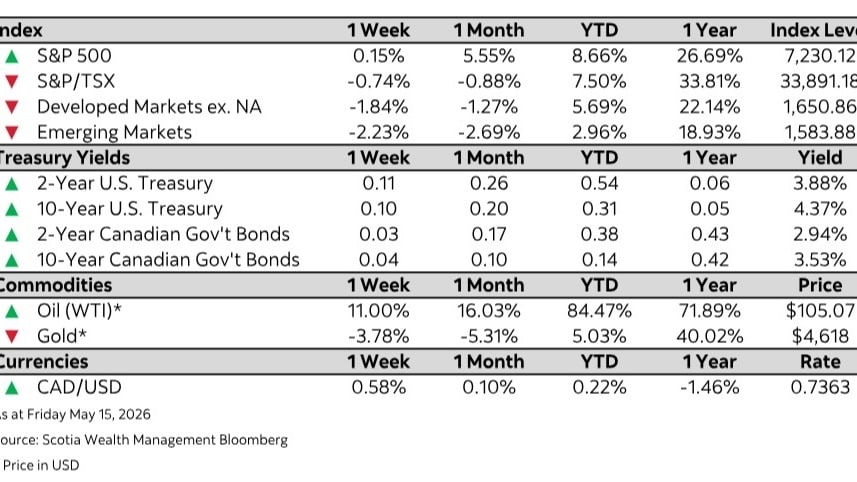
  • U.S. equities returned 0.15%1, supported by strong performance in technology and AI‑linked names. Higher oil prices added to inflation concerns and weighed on consumer and industrial segments, but robust earnings from semiconductor and cloud‑infrastructure companies helped offset the drag.
  • Canadian equities returned -0.74%2, with the TSX supported by energy strength as crude prices climbed on tightening supply expectations.
  • European stocks returned -1.84%3, pressured by mixed bank and industrial earnings and stubborn inflation readings that kept expectations for European Central Bank easing subdued. Growth concerns and weaker corporate guidance weighed on sentiment, particularly in Germany and France, where industrial production data disappointed. In the U.K., markets also grappled with the potential for another change in Prime Minister.
  • Emerging markets rose -2.23%4, with China and Hong Kong drifting lower amid soft domestic demand indicators and renewed concerns about the durability of the recovery. Select pockets of strength in India and Southeast Asia were not enough to offset broader weakness.

Global rates move higher on persistent geopolitical risks, rising inflation

Rates were up this week across the board as persistent and elevated geopolitical uncertainty continues to impact markets. With no positive news out of the Middle-East or President Trump’s visit with China, rates were left to drift higher as both U.S. consumers and producers saw cost increases in April. Canada saw limited news this week, with rates moving higher in line with global peers. U.K. Glits are seeing an added layer of geopolitical uncertainty as UK Prime Minister Kier Starmer is facing growing pressure to step down. Despite better-than-expected GDP, UK rates have reached their highest levels since 2008.

Highlights:

  • The 2- and 10-year U.S. Treasury yields were up 11 basis points (bps) and 10 bps, respectively. In Canada, the 2- and 10-year yields were down 2 bps and 4 bps. Bond yields and prices move inversely to one another.
  • Developed-market sovereign bonds were cushioned slightly by positive economic news but drifted higher for the week as geopolitics and inflation risks continue to be top of mind.
  • Investment-grade and high-yield credit mirrored their sovereign counterparts, drifting higher in response to the overall macro environment.

Weekly dashboard


(Image Credit: Supplied)

Canada’s wholesale sales climb in March, driven by machinery and equipment gains

Canada’s wholesale trade sector posted solid gains in March 2026, with national wholesale sales rising 1.9% to $89.0 billion, according to newly released data from Statistics Canada (StatCan). The increase, which excludes petroleum, petroleum products, other hydrocarbons, oilseed, and grain, was driven largely by strength in machinery, equipment and supplies subsector, which led growth across five of the seven major wholesale categories.

Highlights:

  • The latest figures show that wholesale sales were 3.3% higher than a year ago, reflecting continued resilience in Canada’s goods‑distribution network despite ongoing global supply chain pressures. In volume terms, sales rose 1.7%, suggesting that growth was not solely the result of price effects.
  • Provincial performance varied. Ontario recorded an increase of 3.5% to $46.35 billion, supported by robust demand in industrial and commercial equipment. Alberta was up 3.2%, reaching $9.68 billion in sales, while Saskatchewan saw a 2.5% rise. In contrast, several Atlantic provinces experienced declines, including Nova Scotia (‑3.5%) and New Brunswick (‑1.8%).
  • March’s broad‑based gains suggest continued momentum heading into the second quarter, though analysts caution that regional disparities and global uncertainties could influence performance going forward.

U.S. inflation rises to 3.8% in April, driven by energy prices

U.S. consumer prices rose sharply in April, underscoring persistent inflationary pressures that continue to challenge policymakers and financial markets. According to the U.S. Bureau of Labor Statistics, the Consumer Price Index (CPI) increased 0.6% month‑over‑month, matching forecasts and marking a notable acceleration from March’s 0.9% surge. On an annual basis, inflation climbed to 3.8%, exceeding expectations of 3.7% and reaching its highest year‑over‑year pace since May 2023.

Highlights:

  • The latest data showed broad‑based price increases, with energy costs playing an outsized role. The energy index jumped 3.8% in April, driven by a 5.6% rise in gasoline and fuel oil, reflecting ongoing geopolitical tensions and elevated crude prices.  Shelter and gasoline were key contributors to the monthly gain.
  • Core inflation, which excludes food and energy, also surprised to the upside. Core CPI rose 0.4% month‑over‑month and 2.8% year‑over‑year, both above expectations. These figures suggest that underlying price pressures remain sticky.
  • With inflation still running well above the Fed’s 2% target, the April report reinforces expectations that policymakers may need to maintain restrictive monetary policy longer than previously anticipated. The next CPI update, covering May, is scheduled for release on June 10.

Eurozone growth stalls as latest GDP data shows fragile recovery
Eurozone economic growth remained subdued in the first quarter of 2026, with fresh data released this week confirming that the bloc continues to struggle for momentum. According to Eurostat’s latest estimate, gross domestic product (GDP) in the euro area expanded 0.1% quarter‑on‑quarter, matching preliminary readings and underscoring a slowdown from the 0.2% growth recorded at the end of 2025. On an annual basis, output rose 0.8%, down sharply from 1.3% in the previous quarter, reflecting weakening demand and rising cost pressures across the region.

Highlights:

  • While overall growth stagnated, several member states outperformed. Finland (0.9%) led quarter‑on‑quarter expansion followed by Hungary (0.8%) and Bulgaria (0.7%) . Year‑on‑year, Cyprus (3.0%) topped the charts, followed by Bulgaria (2.9%) and Spain (2.7%). At the other end of the spectrum, Ireland posted a contraction of 2.0% quarter‑on‑quarter and 6.3% year‑on‑year.
  • The broader economic backdrop remains challenging. Rising energy prices have begun to erode household purchasing power and weigh on business sentiment. Analysts warn that these pressures could intensify into the second quarter, especially in manufacturing.
  • Industrial production data for March showed only a 0.2% monthly increase, missing expectations, while annual output fell 2.1%.