Subscribe to the 100% free rdnewsNOW daily newsletter!
sponsored

Market Watch – Jan. 16, 2026

Jan 16, 2026 | 7:06 PM

This week’s highlights

  • AI strength once again offsets geopolitical and policy uncertainty
  • Yields rise as U.S. data remains firm, Fed independence comes into spotlight
  • Canadian manufacturing sales decline on auto sector weakness
  • Pace of U.S. inflation held steady in December, consumer prices up 2.7% on year
  • China’s annual trade surplus hits a record US$1.2 trillion

Week in review

AI strength once again offsets geopolitical and policy uncertainty

Markets started the week on the defensive as headlines regarding a Department of Justice (DoJ) probe into Chair Powell and questions over Federal Reserve (Fed) independence weighed on sentiment. Trading turned volatile mid-week as investors balanced cooling inflation data against a mixed start to the corporate earnings season. Geopolitical tension around Iran and potential tariff actions further unsettled markets before late‑week strength in AI‑linked semiconductors helped stabilize risk appetite. In Canada, equities were comparatively steadier, supported by firmer commodities – particularly gold early in the week – and resilient oil prices before global macro swings moderated momentum. European markets fluctuated amid shifting rate expectations, stronger U.K. GDP, and weakness in core benchmarks, while Chinese and broader EM equities were mixed as strong Chinese export data contrasted with softer domestic demand and ongoing geopolitical uncertainty.

Highlights:

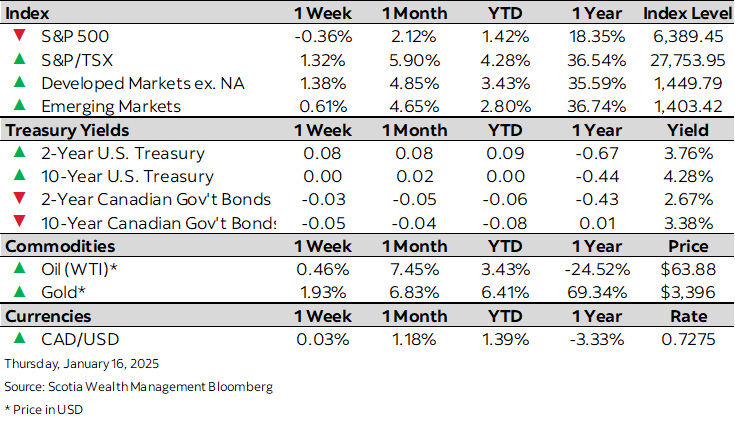
  • U.S. equities returned -0.36%1 as Fed‑independence concerns, CPI and PPI releases, geopolitical risks involving Iran, and mixed bank earnings pressured markets until a late‑week rebound driven by strong AI‑related semiconductor results improved sentiment.
  • Canadian equities returned 1.32%2, initially buoyed by strength in gold and supported later by firm crude prices, while broader global rate volatility, U.S. data releases, and shifting risk appetite produced a more muted but generally constructive equity backdrop.
  • European stocks rose 1.38%3 with investors balanced tariff uncertainty, rising long‑end yields, stronger‑than‑expected U.K. GDP, and sector‑specific weakness across major benchmarks, with sentiment further influenced by global tech momentum and shifting expectations for ECB and BoE policy paths.
  • Emerging markets returned 0.61%4 with Chinese export strength countered by ongoing domestic softness, while regional markets reacted to geopolitical risks, shifting commodity prices, Japanese political developments, and selective strength in technology and semiconductor‑linked names.

Yields rise as U.S. data remains firm, Fed independence comes into spotlight

U.S. rates traded range-bound most of the week but sold off Friday to close slightly higher. Canadian yields generally drifter lower for the week, outperforming their U.S. counterpart. European sovereigns were mixed, with early‑week safe‑haven flows into Swiss debt giving way to weakness after stronger U.K. GDP and higher Gilts, while European Central Bank (ECB) related rate expectations steadied. In Asia and broader EM, Japanese bonds sold off on rising odds of a snap election and expectations of looser fiscal policy, while Chinese debt markets absorbed strong export data without shifting the broader policy outlook.

Highlights:

  • The 2-year U.S. Treasury yields rose 8 basis points (bps) while the 10-year was flat. In Canada, the 2- and 10-year yields were down 3 bps and up 5 bps, respectively. Bond yields and prices move inversely to one another.
  • Sovereign markets were mixed as U.S. yields climbed on resilient data and Fed‑independence concerns, Europe weakened after a strong U.K. GDP print, and Japanese bonds sold off on rising snap‑election expectations and looser fiscal assumptions.
  • IG and HY credit held firm with spreads near multidecade lows, supported by strong demand and constructive fundamentals, even as robust U.S. data and shifting rate‑cut expectations tempered enthusiasm at the margin.

Weekly dashboard


Canadian manufacturing sales decline on auto sector weakness

Statistics Canada (StatCan) reported that total manufacturing sales fell 1.2% to $70.8 billion in November, weighed down by a decline in the auto sector. In real terms, manufacturing sales fell 2.3% in November. The agency said sales of motor vehicles fell 15.9%, while the motor vehicle parts group dropped 6.3%. The machinery subsector lost 3.2%.

Highlights:

  • The declines were partially offset by a 6.8% increase in sales of petroleum and coal products, helped by both higher prices and volumes.
  • In a separate report, StatCan said wholesale sales, excluding petroleum, petroleum products, and other hydrocarbons and excluding oilseed and grain, fell 1.8% in November to $84.4 billion.
  • Wholesale sales, excluding those same items, fell 2.3% in volume terms.

Pace of U.S. inflation held steady in December, consumer prices up 2.7% on year

Prices for goods and services in the United States rose 2.7% in December, holding steady from a month earlier and in line with economists’ expectations. The consumer-price index report showed the impact of tariffs is still relatively muted and offers a measure of relief to U.S. Federal Reserve officials who lowered rates last month. Stripping out volatile food and energy costs, the core measure of consumer prices increased 2.6% over the year. That was also unchanged from November. Economists had expected the consumer-price index to increase 2.7% over the year in December, and the core measure to rise 2.8%.

Highlights:

  • The report was the first clear measure of inflation since September due to the six-week government shutdown last fall which suspended the collection of price data, and the government didn’t issue a report in October and November’s figures were partially distorted by the impact of the closure.
  • Prices rose a seasonally adjusted 0.3% on the month in December, in line with economists’ expectations, while core prices rose 0.2% over the month in December. Economists had expected a 0.3% rise.
  • A number of key household line items saw large price increases over the month, like groceries and restaurant meals. Housing costs, transportation services and medical care also accelerated in December, while, gasoline costs and used car and truck prices declined.

China’s annual trade surplus hits a record US$1.2 trillion
China’s exports growth in December sharply beat expectations, raising the annual trade surplus to a record high, while imports rose at their fastest pace in three months. According to Chinese customs data, exports surged 6.6% in U.S. dollar terms last month from a year earlier, topping analysts’ median estimate for a 3% growth and accelerating from a 5.9% jump in November. China’s exports for the full year grew 5.5% while imports stayed flat, taking Beijing’s trade surplus to US$1.19 trillion, up 20% from 2024.

Highlights:

  • Imports rose 5.7% in December from a year earlier, topping expectations for a 0.9% growth, the strongest since September last year when they climbed 7.4%.
  • Shipments to the U.S. plunged 30% in December from a year ago, declining for a ninth straight month, while imports from the country dropped 29%, customs data showed.
  • China’s exports to the European Union and the Association of Southeast Asian Nations rose 12% and 11%, respectively, in December, while imports from the European nations expanded 18% and fell 5% from Southeast Asian countries.

1  S&P 500 Index USD

2 S&P/TSX Composite Index USD

3 Bloomberg Developed Markets ex N. America Large & Mid Cap Price Return Index USD

4 Bloomberg EM Large & Mid Cap Price Return Index USD