Subscribe to the 100% free rdnewsNOW daily newsletter!
Sponsored

Market Watch: February 16

Feb 20, 2024 | 5:24 PM

This week’s highlights

  • U.S., international markets diverge on a recalibration of expectations
  • Bond yields move higher following inflation readings
  • Canadian building permits dropped 14% in December from November
  • U.S. consumer prices rose more than expected in January
  • Eurozone industrial production unexpectedly expands amid signs of recovery for sector
  • In the news: Airbus extends lead over Boeing amid fallout over safety incidents

Week in review

U.S., international markets diverge on a recalibration of expectations

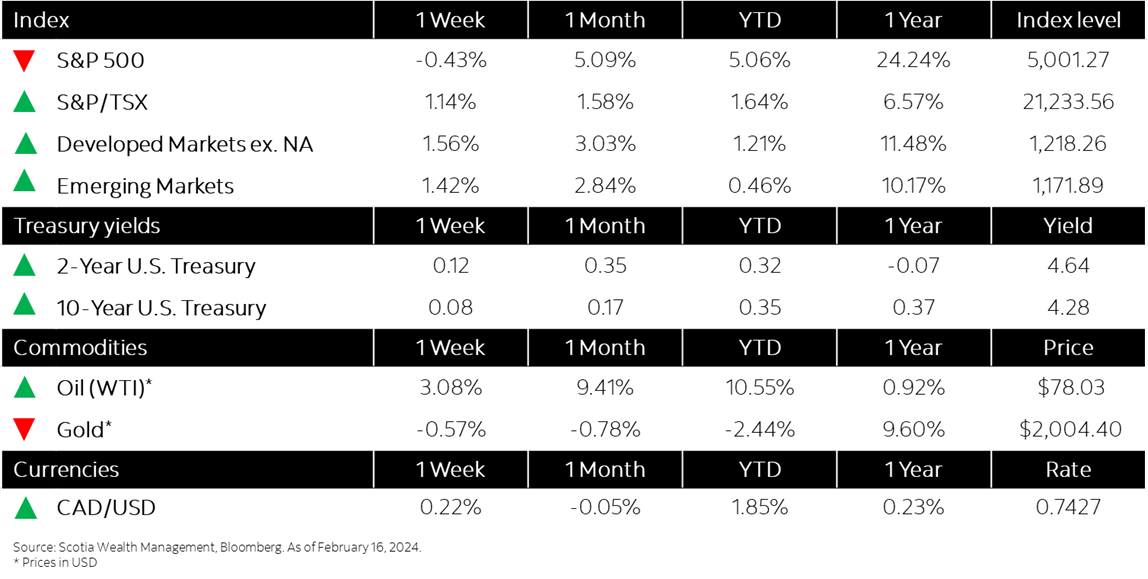
While most major indices advanced for the week, U.S. equity markets saw a resurgence of volatility in large part due to investors recalibrating their expectations for interest rate cuts in response to new inflation data. On Tuesday markets posted one of their largest declines of the year after the release of U.S. Consumer Price Index (CPI) data that came in slightly above economists’ expectations. Investors moved past this reading for the next few days which saw the main U.S. indices rebound to a new all-time high. However, Friday’s release of Producer Price Index (PPI) data that also came in higher-than-expected reignited concerns that the Fed may have to hold rates higher for longer.

Highlights:

  • U.S. markets moved -0.43%1 lower for the week after the release of higher than expected CPI and PPI data.
  • Canadian markets were up 1.14%2 for the week as most sectors save for info tech were in the black. Energy was the largest contributor to weekly returns as oil prices rose 3.08%.
  • European markets closed 1.56%3 higher following a data-packed week of strong earnings that buoyed investor sentiment and encouraged a more risk-on sentiment.
  • Despite the turbulence from a recalibration of U.S. rate forecasts, emerging markets advanced for five straight sessions, their best winning streak so far this year, closing 1.42%4 higher for the week.

Bond yields move higher following inflation readings

U.S. Treasury yields moved higher for the week following the release of U.S. CPI and PPI data for January. The 2-year Treasury yield spiked to its highest level since mid-December while the benchmark 10-year yield was 4.32%, in line with the level observed late Wednesday. Looking ahead, investors are keenly waiting for the upcoming Federal Open Market Committee (FOMC) minutes that are set to be released this coming Wednesday and may offer insight into the future path of interest rates. The year-to-date rally in credit continued this week, with investment grade cash spreads tighter as of Friday’s close. With U.S. investment grade spreads now around 2-year lows, the room for further spread compression seems relatively limited.

Highlights:

  • The 2-year U.S. Treasury yield rose 12 basis points (bps) while the 10-year yield was up 8 bps. In Canada, the 2-year yield was up 6 bps while the 10-year yield was down 1 bps.
  • The primary market remains active, with about $37bn USD priced this week. Intel and British American Tobacco headlined a six-tranche offering, with issuers paying minimal concessions, reflecting the high demand for fixed income instruments.
  • The coming week could potentially be very active with some possible acquisition-related bond deals to boost volume, according to Bloomberg.

Weekly dashboard

Canadian building permits dropped 14% in December from November

Canadian building permit issuance slumped in the final month of 2023 to the lowest level in more than three years as worries remain over pent-up demand for housing. According to Statistics Canada (StatCan), the total value of building permits fell 14% from the month before to a seasonally adjusted $9.25 billion. The sharp retreat was considerably weaker than the 2% rise expected by economists. StatCan said the drop in permits to the lowest level since October 2020 was driven by weakness in both residential and non-residential sectors.

Highlights:

  • The fall in permits comes despite possible signs of life in Canada’s housing market. Canadian Real Estate Association data showed existing home sales rose 8.7% in December from the previous month, though for the year, sales were down 11%.
  • StatCan said that construction intentions in the residential sector were down sharply from the previous month, with permits 17.9% lower at $5.66 billion. Permits for non-residential buildings fell 7.0% to $3.59 billion.
  • Permits to build multifamily dwellings sank 31.1%, while intentions for single-family homes were up 0.8% month-over-month. A decline in the value of multi-unit permits in Ontario helped drive weakness for the month, falling 45.2%.

U.S. consumer prices rose more than expected in January

U.S. consumer prices increased more than expected in January amid rises in the costs of shelter and health care. The consumer price index (CPI) increased 0.3% last month after gaining 0.2% in December, the U.S. Labor Department’s Bureau of Labor Statistics reported. Annual revisions to the CPI data published last week were mixed but generally showed inflation was on a downward trend after surging in 2022.

Highlights:

  • In the 12 months through January, the CPI increased 3.1%. That followed a 3.4% advance in December. Economists had forecast a gain of 0.2% on the month and 2.9% year-on-year.
  • Excluding volatile food and energy components, the CPI rose 0.4% last month after increasing 0.3% in December. In addition to rents, the beginning of the year price increases also likely accounted for the rise in the so-called core CPI. Core CPI advanced 3.9% year-on-year in January, matching December’s increase.
  • January’s hotter-than-expected inflation reading (and robust labour market reports) has reduced the likelihood of imminent policy rate cuts. The odds of a May rate cut have been pared back to ~33% from ~50%. June odds have also been reduced to 68% from ~80%.

Eurozone industrial production unexpectedly expands amid signs of recovery for sector

Eurozone manufacturing is showing signs of life again after industrial production jumped unexpectedly in December, further signalling that the recent slump in manufacturing in the bloc may be ending. Amid low demand and steep interest rates, industrial production had fallen in four of the five months prior to November. But purchasing managers’ survey data has shown that manufacturing sentiment has improved in each of November, December and January, indicating that there could have been some bottoming out of weakness in the sector.

Highlights:

  • Total production rose 2.6% in December, according to European Union statistics agency Eurostat, the second-straight rise after a revised 0.4% increase in November. Compared with December 2022, output grew 1.2%, the first time it has risen on year since February 2023.
  • The rise in production was driven by a 20.5% increase in capital goods, which incorporate assets like machinery, equipment and vehicles that are used to make consumer goods. Meanwhile, energy output climbed 0.3%, production of durable consumer goods rose 0.5%, while nondurable goods ticked up 0.2%.
  • Growth in production was driven by an outsized 23.5% surge in Ireland. In Germany, traditionally the workhorse of European industry, the environment was still weak, with production falling 1.2%. In Spain dipped 0.4%, while output grew 1.1% in both France and Italy.

In the news: Airbus extends lead over Boeing amid fallout over safety incidents

Following a string of major safety incidents that occurred over the past several years, European aerospace giant Airbus seems poised to pull further ahead of its American rival Boeing, bolstering its position as the largest plane maker in the world. Airbus’ push to increase production is intended to address burgeoning demand for their popular A320neo model – the main competitor to Boeing’s 737 Max – from India and other rapidly growing countries amid a sharp rebound in demand for air travel. Supply chain dislocations continue to be the largest impediment to increased deliveries for both companies who have seen their backlogs soar on increased demand for their single-aisle, narrow-body and midsize jets.

Behind the headline:

  • Throughout 2023, Airbus pulled in a record 2,094 commercial aircraft orders while Boeing netted 1,576 orders. During the same period, Airbus delivered 735 aircraft while Boeing delivered 528.
  • Both companies have seen their backlog of orders grow to record highs, with Airbus’ backlog sitting at 8,598 and Boeing’s at 6,216.
  • Airbus has announced plans to increase production of its flagship A320neo single-aisle aircraft to 75 per month by 2026, while Boeing had previously planned to increase production of its flagship 737 Max to 50 planes per month by 2025 but has since suspended its forecast as it addresses quality control issues.

1 S&P 500 Index CAD
2 S&P/TSX Composite Index CAD
3 Bloomberg Developed Markets ex N. America Large & Mid Cap Price Return Index CAD
4 Bloomberg EM Large & Mid Cap Price Return Index CAD

Download the rdnewsNOW mobile app on Google Play and the Apple App Store for all the latest updates on this and other stories.