Subscribe to the 100% free rdnewsNOW daily newsletter!
Sponsored

Market Watch: July 21

Jul 21, 2023 | 4:10 PM

WEEK IN REVIEW

GLOBAL MARKETS GIVE UP SOME GAINS LATE IN THE WEEK

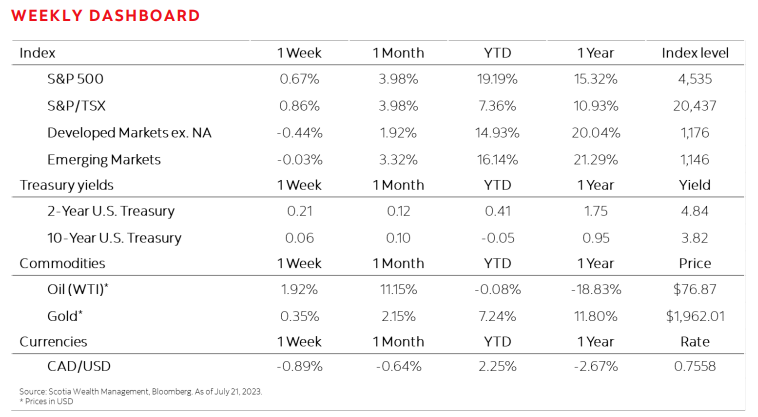
U.S. equities managed to stay in the black, returning 0.67%1 , after posting relatively strong gains for the first half of the week but giving a large portion of it up following post-earnings declines from Netflix and Tesla. Canadian markets traded within a narrow band, managing to return 0.86%2, held up by rate-sensitive sectors. European markets were -0.44%3 lower for the week with gains in the health care sector being offset by declines in chip stocks. Emerging markets were also -0.03%4 lower amid an ongoing slump in Chinese economic growth, with pledges for further support from policymakers failing to assuage investors’ concerns.

Highlights:

• In the U.S., Johnson & Johnson beat analysts’ estimates for quarterly results and hiked its full-year guidance, pushing markets higher early in the week. Subsequently, Netflix and Tesla brought the index lower after the former posted revenue that fell short of analysts’ expectations, and the latter said vehicle production would slow during the third quarter.

• In Canada, market sentiment turned for the better, pushing the S&P/TSX to a two-month high as signs of easing price pressures following June’s inflation reading led to a rally in financials and other rate-sensitive sectors such as utilities and real estate.

• European pharmaceuticals such as MedTronic, Sanofi, and Novartis pushed markets higher following better than expected earnings, but this wasn’t enough to offset losses from major chip makers such as ASML Holdings and NXP Semiconductors which sold off in large part due to weak demand in key categories such as smartphones despite a boom in artificial intelligence (AI) development.

SOVEREIGN BOND YIELDS MOVE HIGHER ON U.S. LABOUR MARKET DATA

On Friday, U.S. Treasury yields were steady near a two-week high after the release of data showing that the labour market remains strong. Credit spreads were little changed, holding their gains since May. With the economic schedule being relatively light for the week, all eyes were on the upcoming Federal Open Market (FOMC) rate decision, with primary activity typically slowing down just ahead of the Fed statement and press conference.

Highlights:

• In North America, sovereign yields remained high across most maturities. Two-year yields were trading anywhere from 6 basis points (bps) to 21 bps higher, while 10-year yields were anywhere from 9 bps to 15 bps higher.

• Yields moved higher Thursday after data showed that U.S. jobless benefit claims fell more than expected to 228,000. In addition, the Philadelphia Federal Reserve’s manufacturing expectation index moved to a 23-month high but remains negative. Investors continue to closely monitor various inflation indicators ahead of the Fed’s July 26 rate decision.

• Bond ETFs and mutual funds have seen a pickup in inflow momentum for July in both high yield (HY) and investment grade (IG) credit. IG flows have been steady this year while HY bond flows are still net negative YTD despite the positive reversal in the second quarter.

ECONOMIC SNAPSHOT

CANADA’S INFLATION RATE FALLS TO 2.8%, LOWEST SINCE EARLY 2021

The annual inflation rate in Canada has eased to its lowest level since early 2021, but there are ample signs that restoring price stability will be a slow process in the coming months. With this latest deceleration, the annual change in the Consumer Price Index (CPI) has fallen within the Bank of Canada’s target range of 1% to 3% for the first time in more than two years.

While inflation has subsided from peak levels of more than 8% last year, the Bank of Canada (BoC) raised its policy rate in June and July over concerns that inflation could get stuck well above 2%. The central bank says it will take longer to tame inflation than it once thought. Alongside its rate decision, the BoC projected that inflation would return to its 2% target by the middle of 2025, about six months later than its previous forecast. The central bank also expects inflation of around 3% over the next year.

Highlights:

• Statistics Canada (StatCan) reported that CPI rose 2.8% in June from a year earlier, down from May’s 3.4% pace, the lowest inflation rate since March 2021.

• StatCan said the results were once again heavily influenced by favourable comparisons to a year ago.

• Gasoline prices fell 21.6% in June from peak levels a year earlier. Excluding gas, the annual inflation rate would have been 4%, down from 4.4% in May.

• Groceries continue to present a challenge as costs rose 9.1% on an annual basis in June. Fresh fruit prices rose 10.4%.

U.S. PAY RAISES NOW BEATING INFLATION AFTER TWO YEARS OF FALLING BEHIND

Americans’ growing paychecks surpassed inflation for the first time in two years, providing some financial relief to workers, while complicating the U.S. Federal Reserve’s (the Fed) efforts to tame price increases. The Fed has lifted its benchmark interest rate 10 times since March 2022, to a range of 5% to 5.25%, and is on track to do so again. Those interest-rate hikes have contributed to a cooling in the U.S. economy, but the labour market and wage growth remain on solid footing.

Highlights:

• According to the U.S. Labor Department, inflation-adjusted average hourly wages rose 1.2% in June from a year earlier.

• If the trend persists, it gives Americans leeway to propel the economy through increased spending, which could help the U.S. skirt a recession.

• Raises for lower-income workers have been particularly strong in early 2023. While leisure and hospitality employment gains have slowed in recent months, workers in the industry saw their hourly pay rise faster than overall wage growth and inflation.

• Wages for manufacturing and business-services workers are also outpacing inflation.

CHINA’S ECONOMY BARELY GROWS AS RECOVERY FADES

China’s economy barely grew in the second quarter from the first quarter and youth unemployment hit a record high in June, providing evidence of a fading recovery that risks leaving the global economy underpowered. The sluggish pace of growth in 2023 is piling pressure on Beijing to reignite an expansion that is in danger of fizzling out as consumers refrain from spending and exports slump. A drawn-out real estate crunch and shaky local-government finances are compounding the gloom.

Highlights:

• China’s economy grew just 0.8% in the second quarter compared with the first three months of the year, and more than a fifth of Chinese aged 16 to 24 are out of work.

• Growth in the second quarter was less than half the 2.2% quarterly pace recorded in the January-to-March period.

• The result reflected weak retail sales, subdued private-sector investment and a reversal in exports, which had propelled growth throughout the pandemic but are suffering now as major central banks ratchet up interest rates.

IN THE NEWS: EARNINGS SPOTLIGHT – AIRLINES

Three of the U.S.’ largest carriers – American, Delta and United – reported record second-quarter revenue, more than doubling their profits over the same period the prior year. All three have raised their earnings projections for 2023. The strong results highlight the durability of consumer spending coming out of the pandemic. While domestic demand has been strong, much of the revenue gains have come from an increase in international travel. Also helping to boost the carriers’ bottom lines has been the correction in jet fuel prices which have slowly stabilized following the Russian invasion of Ukraine.

Behind the headline:

• Financials: American beat EPS expectations by 20.43% ($1.92 vs. $1.59) and revenue by 2.35% ($14.06bn vs. $13.73bn); Delta beat EPS expectations by 11.93% ($2.68 vs. $2.39) and revenue by 0.77% ($15.58bn vs. $15.46bn); United beat EPS expectations by 24.3% ($5.03 vs. $4.05) and revenue by 1.8% ($14.2bn vs. $13.9bn)

• Both domestic and international demand remains strong. TSA reported screening 2.9m travellers on the Friday before July 4, an increase of 15% over the prior year.

• The cost of a round-trip international flight, on average, has risen 24% from 2019 helping to boost revenue.

• Even though more people than ever since the beginning of the pandemic are flying, American has reported spending ~30% less on jet fuel in the second quarter of 2023, saving the carrier $1.3bn USD

DISCLAIMER

This publication has been prepared by The Bank of Nova Scotia for Scotia Wealth Management clients and may not be redistributed. It is for general information purposes only and should not be considered or relied upon as personal and/or specific financial, tax, pension, insurance, legal or investment advice. We are not tax or legal advisors and we recommend that individuals consult with their qualified advisors, including tax and legal advisors, before taking any action based upon the information contained in this publication. Opinions and projections contained in this publication are our own as of the date hereof and are subject to change without notice. Scotia Wealth Management is under no obligation to update this commentary and readers should assume the information contained herein will not be updated. While care and attention has been taken to ensure the accuracy and reliability of the material in this publication, neither The Bank of Nova Scotia nor any of its affiliates or any of their respective directors, officers or employees make any representations or warranties, express or implied, as to the accuracy or completeness of such material and disclaim any liability resulting from any direct or consequential loss arising from any use of this publication or the information contained herein. This commentary may contain forward-looking statements based on current expectations and projections about future general economic factors. Forward-looking statements are subject to inherent risks and uncertainties which may be unforeseeable and such expectations and projections may be incorrect in the future. Forward-looking statements are not guarantees of future performance and you should avoid placing undue reliance upon them. This publication and all the information, opinions and conclusions contained herein are protected by copyright. This publication may not be reproduced in whole or in part without the prior express consent of The Bank of Nova Scotia. Scotia Wealth Management® consists of a range of financial services provided by The Bank of Nova Scotia (Scotiabank®); The Bank of Nova Scotia Trust Company (Scotiatrust®); Private Investment Counsel, a service of 1832 Asset Management L.P.; 1832 Asset Management U.S. Inc.; Scotia Wealth Insurance Services Inc.; and ScotiaMcLeod®, a division of Scotia Capital Inc. Private banking services are provided by Scotiabank. Estate and trust services are provided by The Bank of Nova Scotia Trust Company. Portfolio management is provided by 1832 Asset Management L.P. and 1832 Asset Management U.S. Inc. Insurance services are provided by Scotia Wealth Insurance Services Inc. Wealth advisory and brokerage services are provided by ScotiaMcLeod, a division of Scotia Capital Inc. International investment advisory services are provided by Scotia Capital Inc. Financial planning services are provided by Scotiabank and ScotiaMcLeod. Scotia Capital Inc. is a member of the Canadian Investor Protection Fund and the Canadian Investment Regulatory Organization. Scotia Wealth Insurance Services Inc. is the insurance subsidiary of Scotia Capital Inc., a member of the Scotiabank group of companies. When discussing life insurance products, ScotiaMcLeod advisors are acting as Life Insurance Agents (Financial Security Advisors in Quebec) representing Scotia Wealth Insurance Services Inc. © Copyright 2023 The Bank of Nova Scotia. All rights reserved. 1 S&P 500 Index CAD 2 S&P/TSX Composite Index CAD 3 Bloomberg Developed Markets ex N. America Large & Mid Cap Price Return Index CAD 4 Bloomberg EM Large & Mid Cap Price Return Index CA