Subscribe to the 100% free rdnewsNOW daily newsletter!
(rdnewsNOW/Sheldon Spackman)
96 per cent of major crops

Seeding nearly complete throughout central Alberta

Jun 2, 2023 | 3:12 PM

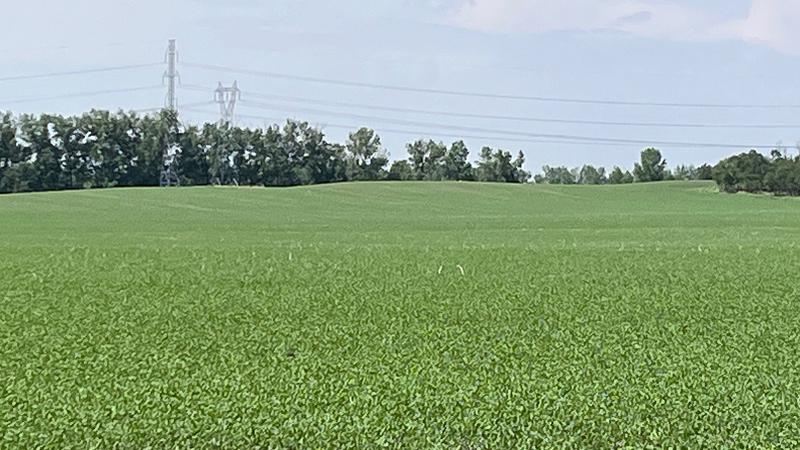
Seeding is near completion in the Central Region of Alberta at 96 per cent of major crops complete, 2 per cent behind the 5-year average.

According to the latest Alberta Crop Report from AFSC and the Government of Alberta, as of May 30, 2023, growing conditions are dry and plants have started to show signs of stress. Officials say emergence for major crops is 75 per cent, 9 per cent ahead of the 5-year average and 10 per cent ahead of the 10-year average.

The report notes spraying has begun in most areas around the region as flea beetles are becoming a potential threat and there has been some grasshopper damage in the southern part of the region as well.

The limited rain received, however, has been enough to keep crops alive in the Central Region, but soil moisture conditions decreased over the past week, as more precipitation is needed.

Currently, surface soil moisture reserves (sub-surface soil moisture reserves) are rated as 24 (32) per cent poor, 42 (41) per cent fair, 34 (27) per cent good, 0 (0) per cent excellent or excessive.

Officials say hay crops and some pastures are showing signs of growth regression, while some areas are holding on quite well. Currently, pasture (tame hay in brackets) is rated as 19 (19) per cent poor, 29 (34) per cent fair, 52 (47) per cent good 0 (0) per cent excellent.

Meantime, a provincial state of emergency was declared on May 6, 2023, due to numerous wildfires. Albertans who require assistance can call 310-4455 for wildfire related information 24 hours a day, 7 days a week.

Officials say survey responses from the North West, North East and Peace regions indicated that wildfire activity has affected some crop and pasture land. Over the past week, seeding of major crops progressed 12 per cent to 97 per cent complete, slightly ahead of the 5-year and 10-year averages.

The South is currently furthest ahead in seeding at nearly 100 complete, followed by the North East (98 per cent), the North West (97 per cent), the Central (96 per cent) and the Peace (94 per cent complete). Currently, all regions are ahead of their respective 5- and 10-year averages, except for the Central Region which is only 2 per cent behind the 5-year average.

Provincially, emergence is ahead of the 5-year average at 76 per cent for all crops and is also 14 per cent ahead of the 5-year average. Dry peas (90 per cent) and spring wheat (86 per cent) are furthest along in total emergence for major crops. Oats (67 per cent emerged) and canola (67 per cent emerged) are both ahead of their 5-year averages of 44 per cent and 53 per cent, respectively. Emergence in the South, Central and North East Regions are only slightly ahead of their 5-year averages, whereas the North West and Peace Region are 32 and 36 per cent ahead of their 5-year averages, respectively.

Surface soil moisture continues to decline across the province as provincial conditions fell 18 per cent to 65 per cent poor to fair and 35 per cent good to excellent. The Peace is the only region that had surface soil moisture above 50 per cent rated good to excellent with 71 per cent good to excellent and 26 per cent poor to fair. These ratings decreased only 5 per cent from the previous week.

Sub-surface soil moisture ratings in the Peace stayed relatively steady during the hot weather due to heavier rains scattered across the Region. All regions had a decrease in surface soil moisture due to the hot and dry weather, except the North East which saw an increase of 4 per cent in surface soil moisture conditions.

The report also notes that pasture and tame hay conditions across the province have decreased slightly, except for the North East and the Peace Regions which were either stable or increased by up to 2 per cent. Overall, 60 per cent of the province’s tame hay is rated as poor to fair and 40 per cent good to excellent. For pasture growth, 53 per cent is rated as poor to fair and 47 per cent is rated as good to excellent. Provincially, pasture weed growth is below the 5-year and 10-year averages, as 12 per cent of Alberta is reporting moderate pasture weed growth.