LOCAL NEWS THAT MATTERS, SENT TO YOU DIRECTLY. SUBSCRIBE FOR FREE!
Sponsored

Market Watch — Sept. 11, 2026

Sep 11, 2026 | 6:30 PM

This week’s highlights

  • Trade war in full swing as oil keeps inflation worries front of mind
  • Inflation data and a full issuance calendar push yields higher
  • Trade tensions escalate as Canada and U.S. exchange retaliatory measures
  • U.S. inflation holds at 3.4%, keeping focus on Fed’s next move
  • ECB raises rates as inflation pressures persist

Week in review

Trade war in full swing as oil keeps inflation worries front of mind

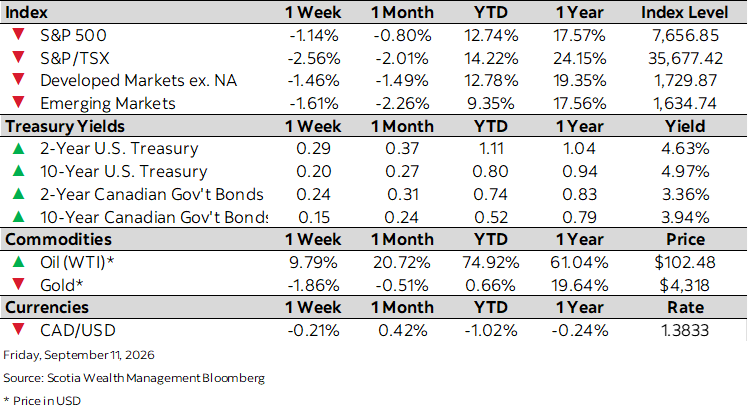
U.S. equities weakened after the Labor Day long weekend as U.S. strikes on Iranian tankers and a Houthi advance onto the Bab el-Mandeb, Saudi Arabia’s main workaround for a constrained Strait of Hormuz, drove oil above US$100, lifting Treasury yields and reviving inflation concerns. Firmer Producer Price Index (PPI) readings and a hotter monthly core Consumer Price Index (CPI) reading subsequently increased expectations for a near-term Federal Reserve (Fed) rate hike. In Canada, markets faced additional pressure as Canadian retaliatory tariffs prompted broader U.S. import bans, tariffs and procurement restrictions, offsetting support from stronger crude prices. European markets declined as the energy shock intensified and the European Central Bank (ECB) raised rates, lifted inflation forecasts, and signalled prices would remain above target, although stronger U.K. growth later supported British equities. Asian markets generally struggled against rising oil prices, higher U.S. yields and a stronger yen, though South Korean technology shares briefly benefitted from continued AI-related momentum.

Highlights:

  • S. equities closed -1.14%1 lower, with the inflation picture doing the damage: hotter producer prices and a core CPI overshoot left traders pricing a September Fed move, even as crude’s climb squeezed valuations.
  • Canadian markets again trailed their southern neighbours down -2.56%2, as Ottawa’s tariff response drew a swift and wider-reaching retaliation from Washington, leaving trade-exposed sectors to overwhelm any lift from firmer energy prices.
  • European equities returned -1.46%3, weighed by the ECB’s decision to tighten again and flag inflation staying above target for some time; the U.K. was the bright spot on a sizeable GDP beat.
  • Emerging market equities ended -1.61%4 lower, as a firmer yen and the global rate backdrop dragged on Asian benchmarks, with Korean semiconductor names the notable exception on sustained AI demand.

Inflation data and a full issuance calendar push yields higher

Treasuries opened the shortened week firmer, with the long end leading, before the oil-driven inflation impulse and a heavy slate of investment grade issuance and Treasury auctions pushed short- and intermediate-term yields up faster than long-term yields, sending front-end yields to their highest since mid-2024. Firm producer prices and an above-consensus monthly core CPI pushed yields higher still, though the long end later recovered as crude retreated and the 10-year stalled beneath 5%. Canadian curves tracked the move, with shorter maturities selling off hardest as hike expectations firmed despite escalating trade friction. Bunds and gilts saw a sharper version of the same pattern into the ECB’s hike and upgraded inflation forecasts, with resilient U.K. growth adding to the hawkish repricing. JGBs were the week’s outlier, initially rallying before yields climbed toward 3% on Bank of Japan tightening bets.

Highlights:

  • The 2- and 10-Year U.S. Treasury yields rose 29 basis points (bps) and 20 bps, respectively. In Canada, the 2- and 10-year sovereign yields were 24 bps and 15 bps higher, respectively. Bond yields and prices move inversely to one another.
  • Shorter maturities led the global selloff as the Middle East energy shock and the ECB’s hike lifted expectations for further rate increases, while a dense Treasury auction and buyback slate kept the U.S. long end under scrutiny near the 5% threshold.
  • Investment grade issuance arrived in size, with a large multi-borrower session followed by a similarly full calendar the next day, compounding the supply burden on global curves.

Weekly dashboard


Trade tensions escalate as Canada and U.S. exchange retaliatory measures

Trade tensions dominated Canadian markets this week as both governments escalated retaliatory measures following the collapse of negotiations. Attention has shifted to the cost of a prolonged standoff, particularly the risks to business confidence, investment and trade flows. Additional tariffs and import restrictions leave exporters facing a less certain planning horizon, and a sustained dispute could begin to weigh on activity. The currency captured the crosscurrents: trade retaliation was a mild drag on the Canadian dollar, though firmer crude prices offset much of it. Rates markets are watching the same growth channel, with shorter Canadian maturities selling off alongside Treasuries even as the trade backdrop clouds the outlook.

Highlights:

  • Canada’s retaliatory tariffs took effect Tuesday, imposing duties of 15% to 50% on C$28 billion of U.S. goods across 629 categories. Scotiabank Economics estimates the measures result in a 42% weighted-average tariff increase on affected imports.
  • Canada’s retaliatory tariffs took effect Tuesday, applying duties of 15% to 50% on C$28 billion of U.S. goods across 629 categories, a 42% weighted-average increase on affected imports, per Scotiabank Economics.
  • Washington answered within a day, banning imports of selected Canadian products from September 29 and imposing 50% tariffs on steel, aluminum, paper, furniture, motorboats and golf carts from September 15.
  • The loonie reflected the tug-of-war, firming as Canadian tariffs took effect before flattening as trade retaliation offset the lift from higher crude, with USD/CAD ending near 1.3833.

U.S. inflation holds at 3.4%, keeping focus on Fed’s next move

U.S. inflation held steady in August, providing little new evidence that price pressures are easing fast enough to give the U.S. Fed room to lower interest rates anytime soon. Data released Friday by the U.S. Bureau of Labor Statistics showed the CPI rose 3.4% year-over-year in August, matching both economists’ expectations and July’s annual inflation rate. On a monthly basis, consumer prices increased 0.4% after a 0.1% rise in July, reflecting a renewed pickup in inflation momentum.

Highlights:

  • Much of the increase was driven by higher energy costs. Gasoline prices climbed 3.9% during the month and accounted for more than one-third of August’s overall increase in consumer prices. The broader energy index rose 2.1%, while shelter costs also remained firm, advancing 0.3%. Food prices increased a modest 0.1%.
  • Core inflation, which excludes volatile food and energy prices and is closely watched by policymakers, rose 0.3% in August after increasing 0.2% in July. However, the annual core inflation rate eased to 2.4% from 2.5% the previous month, suggesting some underlying inflation pressures continue to moderate.
  • The report arrived just days before the Fedl next policy meeting and is likely to play a key role in the central bank’s deliberations. While headline inflation remained unchanged, the combination of firmer monthly price growth, higher energy costs and a pickup in core inflation may reinforce concerns that inflation is proving more persistent than policymakers had hoped.

ECB raises rates as inflation pressures persist
The ECB raised interest rates 25 basis points, marking its second rate increase this year as policymakers sought to contain inflationary pressures stemming largely from higher energy prices. The ECB’s Governing Council lifted its key deposit rate to 2.50% from 2.25%, while the main refinancing rate rose to 2.65% and the marginal lending facility rate increased to 2.90%. In a statement, the ECB said ongoing geopolitical tensions in the Middle East continue to generate inflation pressures and are expected to keep inflation above the central bank’s 2% target for an extended period.

Highlights:

  • The decision comes as eurozone inflation rose to 3.3% in August, driven largely by a surge in energy prices. Oil climbed above US$100 per barrel amid global supply disruptions, heightening concerns that higher fuel costs could spread through the wider economy.
  • Updated ECB projections showed headline inflation averaging 3.0% in 2026, 2.5% in 2027 and 2.1% in 2028. While the 2026 forecast was unchanged, projections for the following two years were revised higher, reflecting expectations that inflation will prove more persistent than previously anticipated.
  • The ECB also raised its growth forecasts, projecting eurozone GDP growth of 0.9% this year, 1.4% in 2027 and 1.5% in 2028. Policymakers cited economic resilience but warned that uncertainty remains elevated, with risks tilted toward higher inflation and weaker growth.