Subscribe to the 100% free rdnewsNOW daily newsletter!
sponsored

Market Watch — May 8, 2026

May 11, 2026 | 6:38 AM

This week’s highlights

  • Equities look through geopolitics as tech earnings regain control
  • Rates reprice geopolitical risk as energy volatility partly unwinds
  • Canada’s unemployment rate rises as full-time jobs drop
  • U.S. labour market shows resiliency as unemployment rate holds steady
  • Eurozone manufacturing PMI strengthened in April

Week in review

Equities look through geopolitics as tech earnings regain control

U.S. equities, as is becoming a familiar trend, initially faced some intraday pressure from surging oil prices and Middle East escalation fears, before stabilizing midweek as hopes for a U.S.–Iran deal drove energy sharply lower and supported a strong rebound led by technology and AI-related earnings upside. While hostilities between the U.S. and Iran did reignite late week, investors largely looked through the developments with muted reactions from energy prices and main indices, though trade policy uncertainty resurfaced as discussions about the upcoming CUSMA review and potential auto-related tariffs re-entered focus. Canada broadly tracked U.S. risk sentiment, with equities buffeted early by geopolitical-driven commodity volatility, then supported as easing oil prices, resilient corporate results, and improving risk appetite lifted domestic cyclicals, despite lingering sensitivity to U.S. trade negotiations given the economy’s exposure to autos and cross-border supply chains.

Europe rallied sharply midweek as energy costs retreated, and corporate earnings surprised positively, though gains faded into Friday amid renewed trade uncertainty tied to potential U.S. tariff threats toward the EU and European Central Bank (ECB) policy caution. China and broader Emerging Markets saw improving sentiment midweek on reduced geopolitical tail risks and stronger Asian equity momentum, but China underperformed late in the week as regional risk aversion returned and global trade concerns resurfaced.

Highlights:

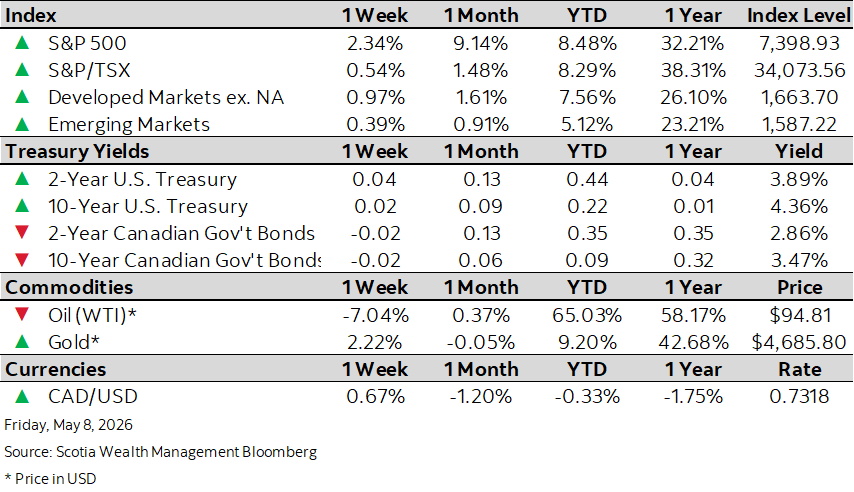
  • U.S. equities returned 2.34%1 after shaking off early geopolitical and energy-driven pressure as falling oil prices and strong tech earnings underpinned risk sentiment, with markets largely shrugging off renewed late‑week Middle East headlines.
  • Canadian equities returned 0.54%2, largely tracking U.S. markets, moving from early commodity volatility toward a steadier tone as oil prices eased and investors discounted ongoing trade and CUSMA-related uncertainty.
  • European stocks returned 0.97%3 amid lower energy costs and earnings strength, but momentum faded as renewed U.S. tariff threats and unresolved ECB policy risks reintroduced caution.
  • Emerging markets rose 0.39%4 seeing a brief midweek lift from easing geopolitical risk, before China lagged again as trade concerns and global risk aversion resurfaced.

Rates reprice geopolitical risk as energy volatility partly unwinds

U.S. rates moved sharply with swings in geopolitical headline risk, as early week escalation in the Middle East and surging oil prices pushed yields higher on inflation concerns, before a midweek rally took hold with de‑escalation hopes driving energy lower and encouraged an unwind of risk premia, reinforced by steady labour data that did little to alter Fed expectations.

Canada followed U.S. moves, with yields rising early alongside energy prices before easing as oil retraced, and bond market pricing reflected a more balanced domestic growth and policy outlook. Europe saw heightened volatility, initially pressured by hawkish ECB rhetoric before participating in the midweek rally as falling energy prices tempered inflation risks, though gains moderated later amid trade-related uncertainty.

Highlights:

  • The 2- and 10-year U.S. Treasury yields were up 4 basis points (bps) and 2 bps, respectively. In Canada, the 2- and 10-year yields were both down 2 bps. Bond yields and prices move inversely to one another.
  • Developed-market sovereign bonds swung with geopolitical headlines, selling off early as oil surged, and inflation risk rose before rallying midweek on de-escalation hopes, falling energy prices, and economic data that left policy expectations largely intact.
  • Investment grade and high yield credit weathered early volatility from energy and geopolitical shocks, then improved midweek as risk appetite recovered, oil retreated, and equity strength helped stabilize spreads despite lingering macro uncertainty.

Weekly dashboard


Canada’s unemployment rate rises as full-time jobs drop

Canada’s labour market weakened in April, according to the latest Statistics Canada (StatCan) report, which showed employment falling by about 18,000 jobs and the national unemployment rate climbing to 6.9%. The increase reflects more Canadians actively searching for work, even as job creation remains sluggish. The decline was driven almost entirely by full‑time employment, which dropped by approximately 47,000 positions. Part‑time work provided a modest offset, rising by about 29,000 jobs. Over the first four months of 2026, full‑time employment fell by 111,000.

Highlights:

  • The unemployment rate for Canadians aged 15 to 24 rose to 14.3 %, roughly double the national average and near highs last seen in late 2025. Core‑aged men (25 to 54) also saw unemployment rise to 6.1%, while rates for women in the same age group held steady at 5.9%.
  • Quebec experienced the largest employment drop, losing 43,000 jobs, followed by declines in Newfoundland and Labrador, Saskatchewan, and New Brunswick. Ontario, however, added 42,000 jobs, largely in health care and social assistance.
  • Wage growth remained solid despite the labour market softening. Average hourly wages rose 4.5% year‑over‑year, continuing a trend of elevated pay increases that the Bank of Canada monitors closely for inflation pressures.

U.S. labour market shows resiliency as unemployment rate holds steady at 4.3%

The latest U.S. nonfarm payrolls report showed that employers added 115,000 jobs in April, a notable slowdown from March’s revised 185,000 gain but still well above economists’ expectations of roughly 55-65,000. The unemployment rate remained unchanged at 4.3%. Despite the slowdown, analysts say the report reflects a labour market that remains stable but cooling, providing the U.S. Federal Reserve with room to keep interest rates steady as it weighs risks from elevated energy prices and geopolitical tensions.

Highlights:

  • Hiring was concentrated in health care, which added 37,000 positions, continuing its role as the dominant engine of U.S. job growth over the past two years. Transportation and warehousing contributed another 30,000 jobs, driven largely by gains in couriers and messengers. Retail trade added 22,000 jobs.
  • Several sectors continued to contract. Federal government employment fell by 9,000, while the information sector shed 13,000 jobs. Manufacturing also slipped slightly, losing 2,000 positions.
  • Wage growth cooled, with average hourly earnings rising just 0.2% in April and 3.6% year‑over‑year, both slightly below expectations and an encouraging sign for policymakers monitoring inflation pressures.

Eurozone manufacturing PMI strengthened in April
Eurozone factories saw a renewed upswing in April as the manufacturing Purchasing Manager’s Index (PMI) climbed to 52.2, up from 51.6 in March, marking the strongest reading since mid‑2022. The rebound placed all eight surveyed eurozone economies above the 50‑point expansion threshold for the first time since June 2022, underscoring a broad-based improvement across the region. The recovery was driven largely by front‑loading of orders and stockpiling, as firms sought to shield themselves from anticipated supply disruptions and rising input costs linked to the ongoing conflict in the Middle East.

Highlights:

  • Surveyed companies reported that customers accelerated purchases ahead of expected price increases, boosting both production volumes and new orders. New export orders also rose for the first time in more than four years, reflecting a short-term surge in overseas demand.
  • Despite the upbeat headline figure, underlying data pointed to persistent vulnerabilities. Input price inflation surged, approaching a four‑year high, while supply chains came under renewed strain.
  • Manufacturers cited logistical disruptions, reduced raw material availability, and high order volumes as key factors behind the worst supplier delivery delays since July 2022. These pressures contributed to a cautious outlook among firms, many of which continued to reduce headcount despite rising order books.

1  S&P 500 Index USD

2 S&P/TSX Composite Index USD

3 Bloomberg Developed Markets ex N. America Large & Mid Cap Price Return Index USD

4 Bloomberg EM Large & Mid Cap Price Return Index USD

Disclaimer: This publication has been prepared by The Bank of Nova Scotia for Scotia Wealth Management clients. It is for general information purposes only and should not be considered or relied upon as personal and/or specific financial, tax, pension, insurance, legal or investment advice. We are not tax or legal advisors, and we recommend that individuals consult with their qualified advisors, including tax and legal advisors, before taking any action based upon the information contained in this publication. The opinions and projections contained in this publication are our own as of the date hereof and are subject to change without notice. Scotia Wealth Management is under no obligation to update this publication, and readers should assume the information contained herein will not be updated. While care and attention has been taken to ensure the accuracy and reliability of the material in this publication, neither The Bank of Nova Scotia nor any of its affiliates or any of their respective directors, officers or employees make any representations or warranties, express or implied, as to the accuracy or completeness of such material and disclaim any liability resulting from any direct or consequential loss arising from any use of this publication or the information contained herein. This publication may contain forward-looking statements based on current expectations and projections about future general economic factors. Forward-looking statements are subject to inherent risks and uncertainties which may be unforeseeable and such expectations and projections may be incorrect in the future. Forward-looking statements are not guarantees of future performance and you should avoid placing undue reliance upon them. This publication and all the information, opinions and conclusions contained herein are protected by copyright. This publication may not be reproduced in whole or in part without the prior express consent of The Bank of Nova Scotia. To the extent this document contains information or data obtained from third party sources, it is believed to be accurate and reliable as of the date of publication, but Scotia Wealth Management does not guarantee its accuracy or reliability.

® Registered trademark of The Bank of Nova Scotia, used under licence (where applicable). ™ Trademark of The Bank of Nova Scotia, used under licence (where applicable). Scotia Wealth Management® consists of a range of financial services provided by The Bank of Nova Scotia (Scotiabank®); The Bank of Nova Scotia Trust Company (Scotiatrust®); Scotia Jarislowsky Fraser, a service of 1832 Asset Management L.P.; 1832 Asset Management U.S. Inc.; Scotia Wealth Insurance Services Inc.; and ScotiaMcLeod®, a division of Scotia Capital Inc. Private banking services are provided by The Bank of Nova Scotia. Estate and trust services are provided by The Bank of Nova Scotia Trust Company. Portfolio management is provided by 1832 Asset Management L.P. and 1832 Asset Management U.S. Inc. Insurance services are provided by Scotia Wealth Insurance Services Inc. Wealth advisory and brokerage services are provided by ScotiaMcLeod, a division of Scotia Capital Inc. International investment advisory services are provided by Scotia Capital Inc. Financial planning services are provided by The Bank of Nova Scotia and ScotiaMcLeod. Scotia Capital Inc. is a member of the Canadian Investor Protection Fund and is regulated by the Canadian Investment Regulatory Organization. Scotia Wealth Insurance Services Inc. is the insurance subsidiary of Scotia Capital Inc., a member of the Scotiabank group of companies. When discussing life insurance products, ScotiaMcLeod advisors are acting as Life Insurance Agents (Financial Security Advisors in Quebec) representing Scotia Wealth Insurance Services Inc.

Scotia Wealth Management® in The Bahamas consists of a range of financial services provided by Scotiabank (Bahamas) Limited and The Bank of Nova Scotia Trust Company (Bahamas) Limited, which are entities licensed to operate within The Bahamas. International private banking and international investment advisory services are provided by Scotiabank (Bahamas) Limited. International wealth structuring solutions are provided by The Bank of Nova Scotia Trust Company (Bahamas) Limited. ® Registered trademark of The Bank of Nova Scotia, used under licence.

Scotia Wealth Management® in the Cayman Islands consists of a range of financial services provided by Scotiabank & Trust (Cayman) Ltd. International private banking services, international investment advisory services, and international wealth structuring solutions are provided by Scotiabank & Trust (Cayman) Ltd., an entity licensed by the Cayman Islands Monetary Authority. ® Registered trademark of The Bank of Nova Scotia, used under license.

Scotia Wealth Management® in Jamaica consists of a range of Private Banking services provided by the Scotiabank Group of companies (Scotiabank®). ®Registered trademark of The Bank of Nova Scotia, used under licence.