Subscribe to the 100% free rdnewsNOW daily newsletter!
sponsored

Market Watch: August 4, 2023

Aug 5, 2023 | 11:53 AM

WEEK IN REVIEW

MARKETS REVERSE COURSE FRIDAY FOLLOWING STRONG JOBS REPORT

After a period of choppy trading that saw mega-cap tech stocks trade lower mid-week, a strong U.S. jobs report put a bid back under equity markets but was not enough to reverse previous losses. Investors assessed the latest batch of earnings and the cooler-than-expected July jobs report. Bullish sentiment seems to have returned after this latest report with nearly 87% of traders now expecting the U.S Federal Reserve (Fed) to hold rates steady at its next meeting in September.

Highlights:

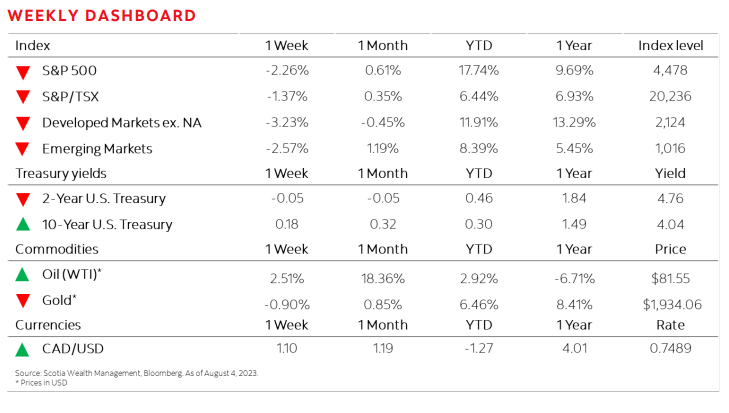
• U.S. markets closed -2.26%1 lower despite the strong jobs report and earnings results pushing equities back towards positive territory. With roughly 85% of companies reporting third-quarter results so far, 80% have beaten investors’ expectations.

• In Canada, market sentiment also turned positive, but the index eventually settled -1.37%2 lower as a result of sizable losses in the info tech sector. Returns were quite concentrated, with energy (+1.39%) and real estate (+0.45%) being the only positive sectors.

• European markets also participated in the turn-around rally but again not to a significant enough extent to reverse losses, closing -2.28%3 lower for the week. Strong returns in travel and leisure stocks weren’t enough to push the region into the black following the Bank of England’s interest rate hike.

• Emerging markets also struggled, down -2.41%4, as rising bond yields continue to put pressure on stocks.

LONGER-DATED SOVEREIGN BOND YIELDS RISE TO HIGHEST SINCE NOVEMBER 2022

Longer-dated U.S. Treasury yields rose following the release of the July U.S. employment report which has seen the Treasury market shed all its gains for 2023. The yield curve steepened, with the long end of the curve underperforming amid resilient economic data releases, Fitch’s U.S. credit rating downgrade, and the announcement of an increase in Treasury debt issuance in the coming months. U.S. credit was mixed but markedly negative, with spreads mostly flat to wider as the market digests the latest payrolls report

Highlights:

• The 2-year U.S. Treasury yield was down 5 basis points (bps) but remained near its highest level this year, while the 10-year yield rose 18 bps. The yield curve also steepened in Canada, with the 2-year yield down 6 bps and 10-year up 10 bps.

• In Canada, holders of Canadian Pacific Railway bonds sued the railroad company, demanding it repay its debt early and at a premium after they said the company missed a deadline tied to its acquisition of Kansas City Southern. The bonds considered are $1 billion of Canadian Pacific notes due 2041.

• While the Fed has said they remain data dependent, a strong but softening U.S. jobs market will likely leave the Fed debating whether or not to tighten toward a peak of 6.0%.

ECONOMIC SNAPSHOT

CANADIAN FACTORY ACTIVITY SLOWS FOR THIRD STRAIGHT MONTH IN JULY

Canada’s manufacturing sector contracted for the third straight month in July as an uncertain economic outlook held back new orders, offsetting a pickup in production, according to data from S&P Global. The slowdown in factory activity occurred amid a sharp rise in interest rates. The Bank of Canada raised its policy rate in July to a 22-year high of 5%. The economy was also buffeted in recent months by Canada’s worst-ever spring wildfire season and a dock workers strike at the country’s busiest ports. The port strikes and wildfires limited the improvement in vendor performance, S&P Global said. The suppliers’ delivery times index dipped to 50.4 after climbing in June to a survey-record high of 51.8.

Highlights:

• The S&P Global Canada Manufacturing Purchasing Managers’ Index (PMI) rose to a seasonally adjusted 49.6 in July from 48.8 in June.

• The new orders index, at 49.2, was in contraction for the fifth straight month, although up from 48.5 in June, while employment fell to its lowest level since June 2020 at 48.4, down from 49.4.

• New export orders were a bright spot, expanding for the first time in 14 months, helped by improved demand from the United States. Output also expanded, rising to 51.1 from 49.7 in June.

U.S. JOBS MARKET REMAINS STRONG BUT SHOWS SIGNS OF GRADUAL COOLING

The U.S. labour market showed fresh signs of easing, with slowly falling job openings adding to figures that show the the Fed is making progress in cooling the economy and lowering inflation. The numbers reflect a labour market that is gradually cooling but remains solid more than a year after the Fed began lifting interest rates to slow the economy and combat high inflation. The central bank raised interest rates last week to a 22-year high after skipping an increase in June.

Highlights:

• The U.S. Labor Department reported job openings declined 34,000 to a seasonally adjusted 9.6 million in June from the prior month, the lowest level since April 2021.

• Employers reported fewer openings in the transportation and warehousing industries. Openings also declined in state and local education and the federal government.

• Job openings were down from a record 12 million in March 2022. But remain well above pre-pandemic levels and exceed the six million unemployed people looking for work in June.

CHINA’S ECONOMIC RECOVERY WEAKENS AS GROWTH CONCERNS LINGER

Growth momentum in China’s economy showed continued signs of weakness in July, raising calls for Beijing to intervene more aggressively to prevent negative sentiment from taking root. An official measure of Chinese manufacturing activity contracted for a fourth straight month in July, while a gauge of activity in the services sector, a key driver of growth after China lifted its COVID-containment measures in January, fell to its lowest level this year. China’s dimming economic picture also adds pressure on the global economy, which is relying in large part on China to sustain a post-pandemic recovery as the U.S. and Europe, weighed down by lingering concerns around inflation, seek to fend off a recession. Policymakers in China are confronting a range of economic challenges, including elevated youth unemployment, deflationary risks and a prolonged housing market slowdown.

Highlights:

• In the second quarter of the year, China’s economy barely grew when compared with the first three months of the year, which enjoyed a brief post-zero COVID rebound.

• China’s official nonmanufacturing purchasing managers index (PMI) softened to 51.5 in July from 53.2 in June, while a gauge of business activity in the services sector softened to 51.5, the lowest level since December 2022. Construction activity also tumbled in July.

• China’s official manufacturing PMI rose slightly to 49.3 in July from 49 in June.

IN THE NEWS: SAUDI ARABIA EXTENDS VOLUNTARY OIL PRODUCTION CUT

In an effort to prop up oil prices, Saudi Arabia has announced it will extend its decision to cut one million barrels per day (bpd) of oil for another month until September. While oil prices have recovered somewhat over the last month (+18.4%), lowerthan-expected U.S. stockpiles, China’s flagging recovery, inflationary pressures, and banking sector turmoil have kept a lid on prices. The production cut, implemented in July and August, “can be extended or extended and deepened,” state news agency SPA said.

Behind the headline:

• Saudi Arabia will produce 9m bpd – approximately 9% of global production – close to 2m bpd lower than at the same time last year. These voluntary cuts fall outside the scope of the agreed-upon OPEC+ production cuts.

• This figure adds to the agreed upon 3.66m bpd production cuts, and the 1.66m bpd of voluntary cuts other OPEC+ members have put in place until the end of 2024.

• Not all OPEC+ members are adhering to the production cut schedule, however, with Russia cutting only 300k bpd of the agreed upon 500k bpd.

DISCLAIMER

This publication has been prepared by The Bank of Nova Scotia for Scotia Wealth Management clients and may not be redistributed. It is for general information purposes only and should not be considered or relied upon as personal and/or specific financial, tax, pension, insurance, legal or investment advice. We are not tax or legal advisors and we recommend that individuals consult with their qualified advisors, including tax and legal advisors, before taking any action based upon the information contained in this publication. Opinions and projections contained in this publication are our own as of the date hereof and are subject to change without notice. Scotia Wealth Management is under no obligation to update this commentary and readers should assume the information contained herein will not be updated. While care and attention has been taken to ensure the accuracy and reliability of the material in this publication, neither The Bank of Nova Scotia nor any of its affiliates or any of their respective directors, officers or employees make any representations or warranties,express or implied, as to the accuracy or completeness of such material and disclaim any liability resulting from any direct or consequential loss arising from any use of this publication or the information contained herein. This commentary may contain forward-looking statements based on current expectations and projections about future general economic factors. Forward-looking statements are subject to inherent risks and uncertainties which may be unforeseeable and such expectations and projections may beincorrect in the future. Forward-looking statements are not guarantees of future performance and you should avoid placing undue reliance upon them. This publication and all the information, opinions and conclusions contained herein are protected by copyright. This publication may not be reproduced in whole or in part without the prior express consent of The Bank of Nova Scotia. Scotia Wealth Management® consists of a range of financial services provided by The Bank of Nova Scotia (Scotiabank®); The Bank of Nova Scotia Trust Company (Scotiatrust®); Private Investment Counsel, a service of 1832 Asset Management L.P.; 1832 Asset Management U.S. Inc.; Scotia Wealth Insurance Services Inc.; and ScotiaMcLeod®, a division of Scotia Capital Inc. Private banking services are provided by Scotiabank. Estate and trust services are provided by The Bank of Nova Scotia Trust Company. Portfolio management is provided by 1832 Asset Management L.P. and 1832 Asset Management U.S. Inc. Insurance services are provided by Scotia Wealth Insurance Services Inc. Wealth advisory and brokerage services are provided by ScotiaMcLeod, a division of Scotia Capital Inc. International investment advisory services are provided by Scotia Capital Inc. Financial planning services are provided by Scotiabank and ScotiaMcLeod. Scotia Capital Inc. is a member of the Canadian Investor Protection Fund and the Canadian Investment Regulatory Organization. Scotia Wealth Insurance Services Inc. is the insurance subsidiary of Scotia Capital Inc., a member of the Scotiabank group of companies. When discussing life insurance products, ScotiaMcLeod advisors are acting as Life Insurance Agents (Financial Security Advisors in Quebec) representing Scotia Wealth Insurance Services Inc. © Copyright 2023 The Bank of Nova Scotia. All rights reserved. 1 S&P 500 Index CAD 2 S&P/TSX Composite Index CAD 3 Bloomberg Developed Markets ex N. America Large & Mid Cap Price Return Index CAD 4 Bloomberg EM Large & Mid Cap Price Return Index CAD