
LOCAL NEWS THAT MATTERS, SENT TO YOU DIRECTLY. SUBSCRIBE FOR FREE!
Sponsored

Market Watch — Oct. 2, 2026

Oct 5, 2026 | 12:59 PM

Market highlights

  • Softer U.S. jobs data offsets early energy and rates pressure
  • Bonds rally as weaker jobs data pares Fed hike expectations

Economic highlights

  • Canadian GDP rebounds in August, supporting solid Q3 growth outlook
  • U.S. job growth slows as economy expands moderately and inflation pressures ease
  • Eurozone inflation accelerates as energy costs surge; economic sentiment slips

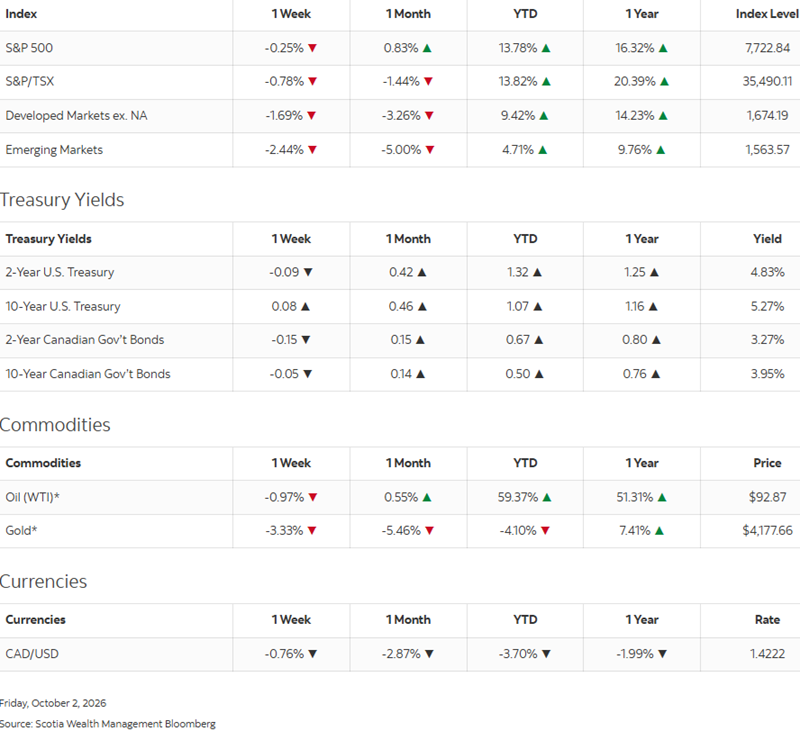
Index


Friday, October 2, 2026

Source: Scotia Wealth Management Bloomberg

* Price in USD

Week in review

Softer U.S. jobs data offsets early energy and rates pressure

In the U.S., equities opened the week lower after President Trump rejected Iran’s proposal to reopen the Strait of Hormuz, pushing oil prices and Treasury yields to multi-year highs, while hawkish Federal Reserve (Fed) commentary kept rate hikes in play. A softer-than-expected core Personal Consumption Expenditures (PCE) reading, the Fed’s preferred inflation gauge, offered midweek support before Friday’s payroll miss pared October hike bets and sparked a rebound. Canadian stocks followed a similar path but lagged, as a flat July GDP print and firmer August flash estimate offered little fresh direction, leaving the index slightly lower for the week. European equities rose modestly through to the middle of the week on easing Hormuz concerns and European Central Bank (ECB) President Lagarde’s dovish read on long-term rates, faded as sovereign yields climbed, then recovered Friday as oil slid on France’s proposal for a coordinated 100M-barrel strategic reserve release. In China, proposed U.S. sanctions weighed early before Trump-Xi tariff cuts and renewed factory expansion lifted sentiment ahead of Golden Week, while Korean chipmakers again led emerging markets and Hong Kong slid Friday.

  • U.S. equities closed -0.25%¹ lower, as a weak jobs report eased Fed hike fears and outweighed earlier pressure from oil and yields.
  • Canadian equities returned -0.78%², lagging the late U.S. rally as higher bond yields weighed and domestic data offered no clear catalyst.
  • European equities finished -1.69%³ lower, tracking swings in energy prices and bond yields before oil’s late decline lifted sentiment.
  • Emerging market equities fell -2.44%⁴, as improving U.S.-China trade ties and strength in Korean chipmakers offset a late Hong Kong selloff.

Bonds rally as weaker jobs data pares Fed hike expectations

Treasuries sold off early as the breakdown of U.S.-Iran talks over the Strait of Hormuz reignited inflation concerns and a run of hawkish Fed speakers kept tightening expectations firm, lifting long-end yields to levels not seen in roughly two decades. A softer-than-expected core PCE print offered brief relief Wednesday, but energy-driven pressure resurfaced Thursday before a disappointing September payrolls report that cut October hike pricing. Canadian government bonds outperformed Treasuries throughout, as investors priced a more cautious Bank of Canada path. In Europe, Bunds led a Tuesday rally after Lagarde suggested higher long-term rates would do more to cool growth and inflation, then gained further Friday on haven flows, while French yields climbed on fiscal concerns. In Japan, JGB yields drifted higher alongside global long-end rates.

  • The 2- and 10-Year U.S. Treasury yields fell 9 basis points (bps) and rose 8 bps, respectively. In Canada, the 2- and 10-year sovereign yields were 15 bps and 5 bps lower, respectively. Bond yields and prices move inversely to one another.
  • Sovereign bond markets rallied into Friday as softer U.S. inflation and jobs data drew buyers to shorter maturities. France was the exception, with short-dated yields rising sharply on fiscal concerns as investors rotated into German Bunds.
  • Investment-grade credit closed out its weakest quarter since 2022 as the climb in government yields eroded returns, even as issuers kept new supply robust heading into the fourth quarter.

Canadian GDP rebounds in August, supporting solid Q3 growth outlook

Canadian gross domestic product (GDP) data released this week pointed to an economy that remains resilient, albeit at a slower pace than earlier in the year. July output was unchanged following three consecutive months of growth. Encouragingly, Statistics Canada’s advance estimate indicated that growth likely regained momentum in August, supporting expectations for continued expansion through the third quarter. While economic growth appears to be moderating from the stronger pace recorded in Q2, current tracking still suggests a healthy rate of expansion that should help calm concerns over a slowdown amid high energy prices and trade disruptions. Overall, the latest data reinforces a picture of steady economic activity, with underlying indicators suggesting the Canadian economy continues to grow at a sustainable pace.

Highlights:

  • July Canadian GDP was unchanged (0.0% MoM), matching expectations and Statistics Canada guidance. Output increased in 10 of 20 industrial sectors, while annual growth came in at 1.4% YoY, slightly above consensus expectations.
  • Statistics Canada’s flash estimate for August GDP was +0.2% MoM, driven primarily by gains in mining and quarrying, partially offset by weaker oil and gas extraction, indicating growth likely reaccelerated after July’s pause.
  • Combining July’s 0.0% reading with the August flash estimate of +0.2%, third-quarter GDP is tracking at roughly 2.0% annualized, below Q2’s 3.8% growth but still consistent with a solid expansion. Manufacturing sales are also estimated to have risen 1.1% MoM in August.

U.S. job growth slows as economy expands moderately and inflation pressures ease

U.S. hiring slowed sharply in September. Payroll gains fell well short of expectations, earlier months were revised lower and the unemployment rate edged up. Layoffs remain limited, but employers are showing little appetite to add staff, which fits a low-hire, low-fire labour market. Growth held up better than first reported, with second-quarter GDP revised higher. Consumer spending was also strong in August, although weak income growth pushed the savings rate to its lowest level since late 2022. Inflation eased as well, with headline and core PCE both coming in below forecasts, though higher gasoline prices still drove part of the monthly increase. Overall, the data points to an economy still growing at a moderate pace as the labour market loses momentum, and markets have scaled back expectations for further Fed rate hikes this year.

Highlights:

  • Payrolls rose by 29,000, against expectations of 90,000, and July and August were revised down by a combined 60,000. Unemployment rose to 4.2%, and wage growth slowed to 3% year over year.
  • Second-quarter real GDP was revised to an annualized 2.2% from 1.5%, driven by consumer spending, business investment and exports.
  • Headline PCE rose 3.4% year over year and core PCE rose 3%. Both were below forecasts of 3.7% and 3.3%, respectively.

Eurozone inflation accelerates as energy costs surge; economic sentiment slips
Eurozone inflation accelerated in September, underscoring renewed price pressures as economic confidence weakened. Annual consumer price inflation (CPI) rose to 3.8% from 3.2% in August, moving further above the European Central Bank’s 2% target. The increase was driven largely by energy prices, which climbed 18.8% year over year, up from 14.3% the previous month. Services inflation edged up to 3.2% from 3.0%, while food, alcohol and tobacco inflation rose to 1.4% from 1.1%. Core inflation, which excludes energy, food, alcohol and tobacco, ticked up to 2.5% from 2.4%, indicating underlying price pressures remained relatively stable despite the headline surge.

Highlights:

  • The inflation data comes as business surveys point to a fragile economic backdrop. The European Commission reported that the eurozone’s Economic Sentiment Indicator slipped 0.5 points to 97.9 in September, remaining below its long-term average of 100.
  • Despite the decline in overall sentiment, industrial confidence improved for another month. The Commission said manufacturers reported stronger production expectations and better assessments of order books, extending a recent upward trend in the sector. However, higher inventories of finished goods and lingering caution about demand continued to weigh on the outlook.
  • Consumer confidence weakened during the month, reflecting more pessimistic views about household finances and the broader economy. Employment expectations also deteriorated, falling 1.3 points to 97.5 in the euro area.

1 S&P 500 Index CAD

2 S&P/TSX Composite Index CAD

3 Bloomberg Developed Markets ex N. America Large & Mid Cap Price Return Index CAD

4 Bloomberg EM Large & Mid Cap Price Return Index CAD

Full market watch