LOCAL NEWS THAT MATTERS, SENT TO YOU DIRECTLY. SUBSCRIBE FOR FREE!
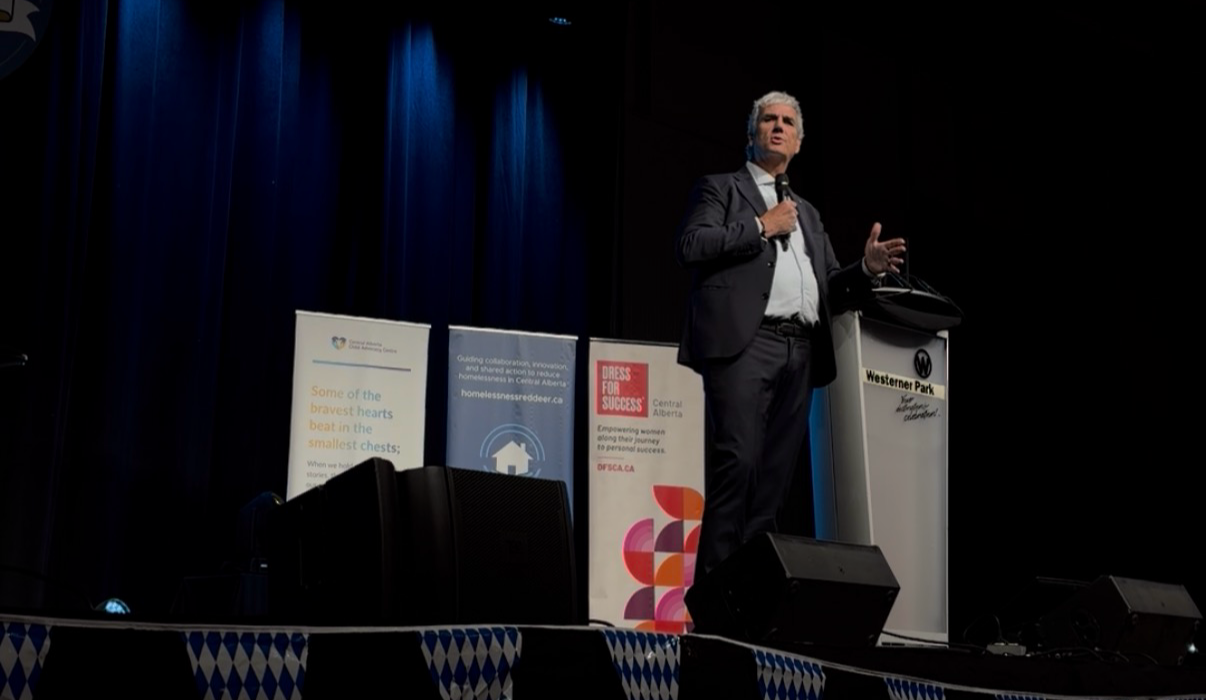
Joe 'The Skid Row CEO' Roberts speaks at an event in Red Deer on Friday, Oct. 2, 2026. (Image Credit: Supplied)
'Skid Row CEO'

An evolving vision for addressing homelessness: Red Deer agencies unite for event

Oct 2, 2026 | 6:40 PM

It probably doesn’t require a microscope to see there’s been an evolution in how agencies and organizations around Red Deer are looking to address homelessness.

—

LISTEN TO THIS STORY AND THE CONVERSATIONS WITHIN ON THE OCT. 2, 2026 EPISODE (#86) OF THE EVERYTHING RED DEER PODCAST


—

Unity among agencies pulling in the same direction was on display during an event Friday at Westerner Park.

There, the Central Alberta Child Advocacy Centre (CACAC), the Red Deer Homeless Foundation, and Dress for Success Central Alberta came together for a leadership luncheon. The luncheon also featured keynote speaker Joe Roberts, who is known as the ‘Skid Row CEO’ and for having walked across Canada with a shopping cart in 2016/17.

Roberts, who is nearly 60, made mistakes as a youth, and he’d tell you that himself.

This led him down a road into homelessness, specifically in Vancouver’s Downtown Eastside – a rough area, to say the least.

Ultimately, given a gracious helping hand up, Roberts got back on his feet and decided to walk across Canada not just to raise awareness but to push for change.

‘The Push for Change’ was what he dubbed his trek and is the title of his 2022 book, which also bears the subtitle, ‘Stepping Into Possibility’ — something he discussed at length Friday to a packed room.

Roberts said it’s unfortunate that homelessness has become so divisive and even a political football.

“If [a person] doesn’t know anybody or experience it [themself], they don’t understand that someone experiencing homelessness or substance use disorder is likely somebody who experienced early childhood trauma, and maybe some mental health issues,” he said of the biggest thing the public misses about homelessness.

“It’s about being more empathetically curious as to what it is you’re looking at, and when you do that, step back, pause, suspend your judgement and look at it through the lens of [them not being] bad people, but people who are ill or need medical attention. When we position homelessness as more of a health care issue than a moral issue, we can create some long-term systemic change. If we judge it, we’ll still have it here in 10 years; it won’t go away.”

Roberts’ father passed from heart failure when he was just a child. Another man who came into his family’s life was abusive, he shared.

That’s where understanding that child advocacy isn’t simply about addressing a trauma in the here and now, but preventing a youth from going down a road they’ll be hard-pressed to turn back from.


(Image Credit: Supplied)

“The best opportunity for us to reduce long-term adult homelessness is supporting young people before they become homeless or when they’re experiencing challenges. If you get them the mental health support they need, if you get them the substance use disorder training or support that they need, you’ve got a better chance of turning that kid around and giving them what they need to transition safely into adulthood,” said Roberts.

“The entire walk across the country was about early detection and prevention because we know if you can support those kids and they don’t end up becoming adult homeless, that’s a reduced strain on the systems.”

Mark Jones, CEO at the Child Advocacy Centre, shared that his organization’s estimate of the number of people experiencing homelessness who also experienced a child trauma is a whopping 85 per cent.

Asked what further gap Red Deer must bridge to achieve its goals on homelessness, Jones said it’s important to remember that, as they say, Rome wasn’t built in a day.

“Homelessness and trauma aren’t going to be solved in a day either. But how it’s going to be solved is the systems working together, and people pulling on the rope in the same direction, saying ‘How can our organization be part of the solution, and not the problem,'” he said.

“I hope one day that people in Red Deer can say this city has created a culture of caring and everybody is working together for our most vulnerable people. If we can’t say they are being taken care of, we need to figure out what we need to do.”

Jones shared that the CACAC will be a partner on Project Nexus, once it’s up and running.

Project Nexus is the multi-phase, multi-agency effort to situate a homeless shelter and wraparound services of all kinds in one place – the place being in Red Deer’s Riverside Heavy Industrial area.

Also a partner, though not directly on-site (as with the CACAC), is Dress for Success Central Alberta, which is continuing to meet people where they are.

“My biggest takeaway [from Joe’s talk] was when he shared that he was a community investment gone right. I think that’s such an important message to keep in the forefront of all of our minds — that all the people that we help across different organizations, we don’t know where they’re at in their journey and we don’t know how that story is going to end,” said Erin Forbes, executive director.

“The best we can do is to serve people where they’re at and respect what they need and then help them in their journey.”

Dress for Success, of course, provides clothes for people when they need them, particularly in the case of someone having a job interview or other important occasion. They also assist with resumes and offer career services.

Forbes added that they’re always on the lookout for volunteers.

Then there’s Darcy Mykytyshyn, CEO of the Homeless Foundation, who said his team is working very hard to get the doors open on phase one — the shelter — of Project Nexus as soon as possible.

That could come as soon as sometime this winter, with construction starting in the next 30 to 60 days.

Mykytyshyn, a former Red Deer MLA, said the biggest challenge has been keeping pace with the foundation’s ambitious timelines.

Yesterday, he shared, the foundation’s Good Neighbour Committee met with residents of the Pines and other nearby stakeholders to discuss their security plan. He couldn’t share details of the security plan at this juncture.

“I left that meeting feeling really positive that we’ve started a good foundation from which we can work collaboratively with our neighbours in terms of providing support to the homeless,” he said.

“When we created the foundation, we established four pillars by which we would define success. One of those was around advocacy and education, and creating a different discussion about what homelessness is, who’s impacted by it, and as we start to think about solutions, we have a different appreciation for what we need to do, and we can be more creative around how we help people.”

Mykytyshyn also shared they’re trying to steer clear of language like ‘ending homelessness.’

The preference now is to talk about managing homelessness.

“I think we’ve realized that there will always be some kind of homelessness, and homelessness is a very big, broadly defined challenge. There’s a stat that is generally accepted in this sector, which is that for every person that we count, there are 10 more people somewhere on the homelessness spectrum,” he stated.

“They’re either in an abusive relationship, they’re couch surfing, they’re sleeping in a car. Our goal is to try to minimize homelessness.

“We decided by working with the new shelter provider to bring a different experience to Red Deer, that was going to be the foundation for how we need to do other things in our community. We need transitional housing, we need temporary housing, we need permanent supportive housing. We need to step back as a community and think about how we deliver. And there is opportunity for all aspects of the community to support that strategy.”

The three organizations will be announcing more details this Monday, Oct. 5 for a significant fundraiser being held this coming April.

READ MORE