Weather warnings may be in place around central Alberta!
Sponsored

Market Watch — July 31, 2026

Jul 31, 2026 | 5:32 PM

This week’s highlights

  • Productive finish masks an otherwise volatile week
  • Fixed income markets reach to inflation risks and policy uncertainty
  • Canada’s economy expands for second straight month, led by resource sector gains
  • U.S. economy slows as inflation remains elevated
  • Eurozone rebounds in second quarter as growth accelerates

Week in review

Productive finish masks an otherwise volatile week

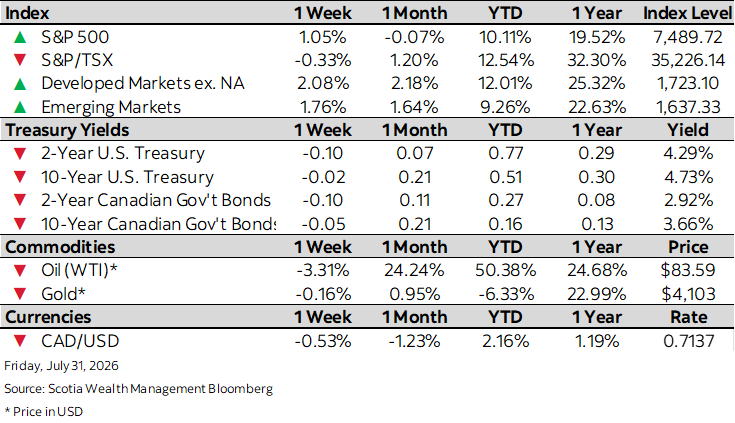
U.S. equities finished the week in positive territory, experiencing notably large intraday swings as investors digested earnings, economic data and policy developments. Markets opened on a constructive note as lower yields and optimism around technology earnings supported risk appetite. Sentiment became more cautious midweek as renewed U.S.-Iran tensions pushed oil prices higher, raising inflation concerns ahead of the Federal Reserve’s (Fed) policy decision. Investors also weighed softer-than-expected second-quarter GDP growth, though underlying consumer spending and domestic demand remained resilient. A Fed rate hold, softer Personal Consumption Expenditure (PCE) inflation data and strong results from select mega-cap technology companies helped stabilize sentiment, pushing markets into positive territory Friday.

Canadian equities were supported by elevated oil prices and signs of improving domestic economic momentum. While Middle East tensions created some volatility, a stronger-than-expected May GDP report reinforced the view that growth rebounded meaningfully in the second quarter, helping underpin sentiment toward Canadian assets. Resource-related sectors remained a source of support as energy prices stayed elevated, while improving activity across several sectors, including real estate, manufacturing and financial services, pointed to a firmer economic backdrop.

European equities advanced on supportive earnings, resilient economic growth across the bloc, and easing policy concerns. While geopolitical tensions and higher oil prices created some midweek softness, sentiment improved after the Bank of England held rates steady and pointed to continued progress on underlying inflation.

Emerging market equities experienced a volatile week as investors reassessed expectations for AI-related spending and semiconductor earnings. Technology shares across parts of Asia came under pressure midweek after several chip-related results failed to meet elevated expectations, weighing on sentiment in Korea and Japan. However, the region recovered into the weekend as semiconductor stocks rebounded, while Chinese equities remained relatively resilient throughout the week, helping support broader emerging market performance.

Highlights:

  • U.S. equities returned 1.05%1 with markets trading sideways for much of the week as softer inflation and strong earnings offset anemic GDP growth and geopolitical and Fed-related uncertainty.
  • Canadian equities returned -0.33%2 despite strong GDP data and higher oil prices providing broad support.
  • European stocks returned 2.08%3 as resilient growth, supportive earnings and easing policy concerns kept markets in the green.
  • Emerging markets returned 1.76%4 after a late-week rebound in semiconductor stocks helped recover from a midweek technology-driven selloff across a handful of East Asian countries.

Fixed income markets react to inflation risks and policy uncertainty

Treasury markets began the week on firmer footing as investors positioned for a busy calendar of central bank meetings and economic releases. Sentiment shifted midweek as renewed U.S.-Iran tensions pushed oil prices higher, reviving inflation concerns and prompting markets to reassess the risk of a Fed rate hike. Investors also digested softer-than-expected U.S. GDP growth, highlighting slowing headline economic momentum even as underlying consumer demand remained resilient. While the Fed ultimately left rates unchanged, the decision did little to ease concerns that policymakers may need to increase rates as investors continued to price in the beginning of a tightening cycle. Canadian fixed income markets largely followed U.S. developments, though stronger Canadian GDP data reinforced evidence of a domestic growth rebound. In Europe, inflation and energy-related concerns gave way to improving sentiment after the Bank of England held rates steady and highlighted ongoing disinflation trends. In Asia, attention centered on the Bank of Japan, which maintained rates but signalled that inflation risks could support further policy normalization.

Highlights:

  • The 2- and 10-year U.S. Treasury yields were 10 basis point (bps) and 2 bps lower, respectively. In Canada, the 2- and 10-year yields fell 10 bps and 5 bps, respectively. Bond yields and prices move inversely to one another.
  • U.S. sovereign yields moved lower as markets navigated the competing forces of softer growth, persistent inflation pressures and central bank reluctance to tighten monetary policy.
  • Credit markets proved resilient, supported by earnings strength and healthy fundamentals despite renewed volatility stemming from policy uncertainty and geopolitical developments.

Weekly dashboard


Canada’s economy expands for second straight month, led by resource sector gains

Canada’s economy grew 0.3% in May, exceeding expectations and marking a second consecutive month of expansion as both goods-producing and services-producing industries posted gains, Statistics Canada (StatCan) reported. The increase was broad based, with 13 of 20 industrial sectors contributing to growth. Goods-producing industries rose 0.6% on the month, while services-producing industries advanced 0.2%. The data is likely to reinforce the Bank of Canada’s view that economic activity has resumed after a soft first quarter, while providing further evidence that growth has remained relatively resilient even as inflation pressures moderate and interest rates remain above pre-pandemic levels.

Highlights:

  • Mining, quarrying, and oil and gas extraction sectors were key drivers of growth, climbing 1.0% in May. StatCan said support activities for mining and oil and gas extraction recorded particularly strong gains, while higher oil sands production in Alberta also boosted output.
  • Construction and utilities also contributed to the advance, while growth in the services sector was supported by gains in real estate and rental and leasing activities, transportation and warehousing, and the public sector. The public sector aggregate, which includes education, health care and public administration, expanded 0.3% during the month.
  • The report points to stronger momentum in the second quarter after economic growth stalled earlier in the year. StatCan’s preliminary estimate suggests real GDP increased a further 0.2% in June, indicating that the economy maintained its footing heading into the summer.

U.S. economy slows as inflation remains elevated

The U.S. economy expanded at a slower pace in the second quarter while inflation remained above the Federal Reserve’s target, leaving markets to weigh moderating growth against persistent price pressures following the Fed’s decision to hold rates steady. Data released by the U.S. Commerce Department showed U.S. gross domestic product grew at an annualized rate of 1.5% in the April-to-June period, down from 2.1% in the first quarter. However, underlying demand remained resilient, with real final sales to private domestic purchasers rising 3.9%, supported by firm household and business spending. Meanwhile, the Personal Consumption Expenditures (PCE) Price Index posted a softer-than-expected monthly reading but remained well above the Fed’s 2% target.

Highlights:

  • A key measure of underlying demand, real final sales to private domestic purchasers, rose 3.9% in the quarter, suggesting household and business spending remained relatively firm despite higher borrowing costs.
  • At the same time, the Commerce Department reported that the PCE Price Index, the Fed’s preferred inflation gauge, fell 0.1% in June from the previous month but was still up 3.7% from a year earlier. Core PCE, which excludes food and energy, rose 0.1% on the month and 3.3% annually.
  • The mixed economic picture follows the Fed’s earlier decision to keep its benchmark interest rate unchanged at 3.5%-3.75%, extending a pause that has been in place throughout 2026. Policymakers have remained cautious as inflation has proven stubborn even as economic growth has moderated.

Eurozone economy rebounds in second quarter as growth accelerates
The eurozone economy regained momentum in the second quarter of 2026, posting its strongest quarterly growth in a year as consumer spending, government investment and resilient business activity helped offset ongoing geopolitical and energy market challenges. Data released by Eurostat showed gross domestic product (GDP) in the 20-country currency bloc rose 0.4% in the April-to-June period compared with the previous quarter, following flat growth in the first three months of the year. The result exceeded expectations and suggested the region has so far weathered recent economic headwinds better than many analysts had feared.

Highlights:

  • Performance varied widely among member states. Ireland led the bloc with quarterly growth of 3.9%, driven largely by multinational corporate activity, while Lithuania and Sweden recorded gains of 1.7% and 1.4%, respectively. Belgium and Austria reported no growth during the quarter.
  • Among the eurozone’s largest economies, Germany, France and Italy each expanded by 0.2%, while Spain continued to outperform its peers with growth of 0.7%. Spain has been one of the strongest contributors to the region’s growth in recent years.
  • The stronger-than-expected GDP report comes a week after the European Central Bank left interest rates unchanged. The latest figures may reinforce the view that the eurozone economy remains on a modest but stable growth path heading into the second half of the year.
  • 1  S&P 500 Index USD
  • 2 S&P/TSX Composite Index USD
  • 3 Bloomberg Developed Markets ex N. America Large & Mid Cap Price Return Index USD
  • 4 Bloomberg EM Large & Mid Cap Price Return Index USD

Disclaimer

This publication has been prepared by The Bank of Nova Scotia for Scotia Wealth Management clients. It is for general information purposes only and should not be considered or relied upon as personal and/or specific financial, tax, pension, insurance, legal or investment advice. We are not tax or legal advisors, and we recommend that individuals consult with their qualified advisors, including tax and legal advisors, before taking any action based upon the information contained in this publication. The opinions and projections contained in this publication are our own as of the date hereof and are subject to change without notice. Scotia Wealth Management is under no obligation to update this publication, and readers should assume the information contained herein will not be updated. While care and attention has been taken to ensure the accuracy and reliability of the material in this publication, neither The Bank of Nova Scotia nor any of its affiliates or any of their respective directors, officers or employees make any representations or warranties, express or implied, as to the accuracy or completeness of such material and disclaim any liability resulting from any direct or consequential loss arising from any use of this publication or the information contained herein. This publication may contain forward-looking statements based on current expectations and projections about future general economic factors. Forward-looking statements are subject to inherent risks and uncertainties which may be unforeseeable and such expectations and projections may be incorrect in the future. Forward-looking statements are not guarantees of future performance and you should avoid placing undue reliance upon them. This publication and all the information, opinions and conclusions contained herein are protected by copyright. This publication may not be reproduced in whole or in part without the prior express consent of The Bank of Nova Scotia. To the extent this document contains information or data obtained from third party sources, it is believed to be accurate and reliable as of the date of publication, but Scotia Wealth Management does not guarantee its accuracy or reliability.

® Registered trademark of The Bank of Nova Scotia, used under licence (where applicable). ™ Trademark of The Bank of Nova Scotia, used under licence (where applicable). Scotia Wealth Management® consists of a range of financial services provided by The Bank of Nova Scotia (Scotiabank®); The Bank of Nova Scotia Trust Company (Scotiatrust®); Scotia Jarislowsky Fraser, a service of 1832 Asset Management L.P.; 1832 Asset Management U.S. Inc.; Scotia Wealth Insurance Services Inc.; and ScotiaMcLeod®, a division of Scotia Capital Inc. Private banking services are provided by The Bank of Nova Scotia. Estate and trust services are provided by The Bank of Nova Scotia Trust Company. Portfolio management is provided by 1832 Asset Management L.P. and 1832 Asset Management U.S. Inc. Insurance services are provided by Scotia Wealth Insurance Services Inc. Wealth advisory and brokerage services are provided by ScotiaMcLeod, a division of Scotia Capital Inc. International investment advisory services are provided by Scotia Capital Inc. Financial planning services are provided by The Bank of Nova Scotia and ScotiaMcLeod. Scotia Capital Inc. is a member of the Canadian Investor Protection Fund and is regulated by the Canadian Investment Regulatory Organization. Scotia Wealth Insurance Services Inc. is the insurance subsidiary of Scotia Capital Inc., a member of the Scotiabank group of companies. When discussing life insurance products, ScotiaMcLeod advisors are acting as Life Insurance Agents (Financial Security Advisors in Quebec) representing Scotia Wealth Insurance Services Inc.

Scotia Wealth Management® in The Bahamas consists of a range of financial services provided by Scotiabank (Bahamas) Limited and The Bank of Nova Scotia Trust Company (Bahamas) Limited, which are entities licensed to operate within The Bahamas. International private banking and international investment advisory services are provided by Scotiabank (Bahamas) Limited. International wealth structuring solutions are provided by The Bank of Nova Scotia Trust Company (Bahamas) Limited. ® Registered trademark of The Bank of Nova Scotia, used under licence.

Scotia Wealth Management® in the Cayman Islands consists of a range of financial services provided by Scotiabank & Trust (Cayman) Ltd. International private banking services, international investment advisory services, and international wealth structuring solutions are provided by Scotiabank & Trust (Cayman) Ltd., an entity licensed by the Cayman Islands Monetary Authority. ® Registered trademark of The Bank of Nova Scotia, used under license.

Scotia Wealth Management® in Jamaica consists of a range of Private Banking services provided by the Scotiabank Group of companies (Scotiabank®). ®Registered trademark of The Bank of Nova Scotia, used under licence.