Follow our top 10 countdown of the most memorable stories of the last decade, as reported by rdnewsNOW!
(Image Credit: Scotia Wealth Management)
Sponsored

Markey Watch – June 26, 2026

Jun 29, 2026 | 9:53 AM

A summary of the week’s important events and how they could impact the market.

This week’s highlights

  • AI volatility drives a choppy week for global equities
  • Bonds rally as oil retreats and PCE cools rate hike concerns
  • Canadian headline inflation rises, but core measures remain contained
  • Rate hike bets cool as U.S. inflation signals remain mixed
  • Eurozone business activity stabilizes, though still in contraction, PMI shows

Week in review

AI volatility drives a choppy week for global equities

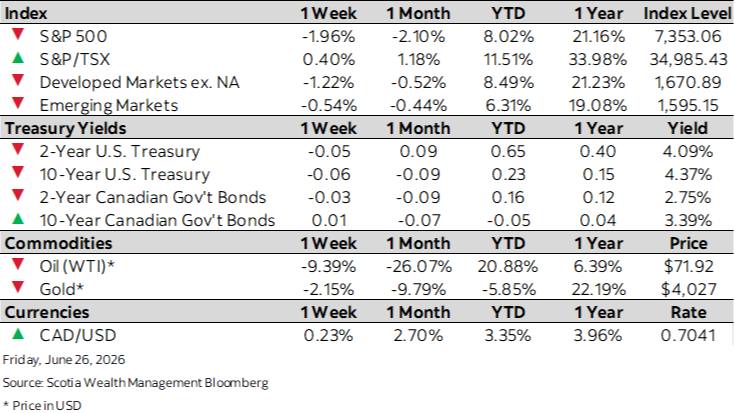
Equities began the week supported by improved U.S.-Iran negotiation headlines and lower oil, but sentiment softened as a global technology selloff raised questions about crowding in the AI trade. Markets stabilized midweek on firmer U.S. Purchasing Manager Index (PMI) data, then rallied after Micron’s results revived chip leadership and a largely in-line Personal Consumption Expenditures (PCE) print avoided a further hawkish shock, though inflation remained elevated and Federal Reserve (Fed) hike risks stayed on the table. By Friday, renewed concerns around AI financing, valuations, and the durability of chip-linked momentum weighed on risk appetite. Canadian equities largely followed U.S. direction through the week, initially supported by improved geopolitical headlines before being pulled lower by the global technology selloff. The TSX also faced a more domestic headwind from softer commodities, particularly as oil retraced its wartime gains, pressuring resource-sensitive areas of the index. May Consumer Price Index (CPI) data added a policy overlay: headline inflation rose on energy costs, but core measures remained relatively contained, leaving investors to assess whether the Bank of Canada (BoC) would need to recalibrate policy.

European equities were mixed as lower energy prices and firmer sovereign bond markets offered some support, but regional PMI data pointed to continued softness in activity, with the Eurozone still in contraction and Germany remaining a key weak spot. U.K. markets also had to absorb weaker domestic PMI data and renewed political uncertainty after Prime Minister Starmer stepped down, which helped cap the improvement in sentiment. In China and Emerging Markets, equities were volatile and heavily influenced by the global technology cycle. Chinese equities briefly stabilized alongside the broader midweek recovery in risk appetite, but renewed chip-demand concerns weighed on the region into Friday, while South Korea saw especially sharp swings given its sensitivity to the semiconductor trade.

Highlights:

  • U.S. equities returned -1.96%1, swinging lower on the AI trade, stabilizing after firmer PMI data and Micron’s results, while an in-line PCE print eased Fed concerns before chip-demand worries resurfaced into Friday.
  • Canadian equities returned 0.40%2, caught between global risk appetite and domestic macro considerations, with resource-heavy areas pressured by falling oil, while contained core CPI kept the BoC policy outlook from becoming more restrictive.
  • European stocks returned -1.22%3, finding some support from lower energy prices and firmer sovereign bond markets, though the benefit was limited by contractionary regional PMI data, ongoing weakness in Germany, and added U.K. political uncertainty.
  • Chinese and Emerging markets declined -0.54%, whipsawed by the global technology cycle, stabilizing briefly during the midweek rebound before renewed chip-sector concerns weighed on the region, with South Korea particularly exposed.

Bonds rally as oil retreats and PCE cools rate hike concerns

Treasuries began the week under pressure as improved U.S.-Iran headlines and firmer risk sentiment pushed yields higher, but the tone improved as the technology led equity selloff, falling oil prices and later a mostly in-line PCE print eased concerns about imminent Fed hikes. The Canadian bond market initially sold off after headline CPI surprised higher on energy costs, though contained core measures limited the policy repricing, before yields moved more in line with global duration markets. European bonds were generally supported by lower energy prices, softer regional PMI data and continued signs of weak activity, particularly in Germany and the U.K.

Highlights:

  • The 2- and 10-year U.S. Treasury yields were down 5 basis points (bps) and down 6 bps, respectively. In Canada, the 2- and 10-year yields were down 3 bps and up 1 bp, respectively. Bond yields and prices move inversely to one another.
  • Developed-market sovereigns strengthened after early weakness, helped by lower oil prices, softer growth signals in Europe and U.K., and U.S. PCE data that slightly reduced pressure for Fed hikes.
  • Corporate risk tone followed the broader cross-asset swing, weakening alongside the tech-led equity selloff before finding some support from lower oil prices, easing Fed concerns and stronger sovereign bond markets.

Weekly dashboard


(Image Credit: Supplied)

Canadian headline inflation rises, but core measures remain contained

Canada’s latest CPI report pointed to a headline inflation pickup driven largely by energy, while underlying price pressures remained comparatively contained. The key takeaway is that the BoC is likely to stay cautious rather than overreact to one print: headline inflation moved above expectations, but preferred core measures were stable and in line with forecasts. That said, the report does not fully ignore inflation risk, as shorter-term momentum suggests some underlying pressures are building beneath the surface. With rates only modestly higher after the release, and markets pricing limited additional tightening, policymakers may prefer to wait for more data before reassessing the policy path, particularly as growth, labour market conditions, energy prices and U.S. trade policy remain important variables

Highlights:

  • Headline CPI rose 3.2% year-over-year in May, above the 3.0% consensus estimate and April’s 2.8% reading, with gasoline prices up 33.2% year-over-year as the main driver.
  • Core inflation was more contained: the Bank of Canada’s preferred weighted-median and trimmed-mean measures were 2.1% and 2.0%, respectively, both unchanged from April and in line with expectations.
  • Shorter-term inflation momentum firmed, with the annualized month-over-month average of trimmed-mean and weighted-median CPI rising to 2.48% from 1.92%, while the three-month average reached 2.29%.

Rate hike bets cool as U.S. inflation signals remain mixed

This week’s U.S. data gave markets a modest reason to reassess the near-term path for Fed policy, as May personal consumption expenditure (PCE) inflation, the Fed’s preferred inflation gauge, came in broadly in line with expectations while the monthly headline reading was slightly softer than anticipated. The result helped cool some of the market’s more aggressive rate hike expectations, with the overnight index swap (OIS) pricing trimming year-end Fed hike bets modestly after the release. However, the underlying inflation picture remains far from settled. Headline inflation has moved back above 4% year-over-year, largely reflecting the sharp contribution from energy prices, while core PCE edged higher and services inflation accelerated, underscoring that the stickier components of inflation continue to warrant close attention.

Highlights:

  • Markets trimmed cumulative year-end Fed hike expectations to roughly 32-33 bps from about 34-35 bps ahead of the PCE release, reflecting relief that the inflation data did not deliver a stronger upside surprise.
  • Inflation remains uneven; Headline PCE rose 4.1% year-over-year, driven primarily by energy prices, while core PCE increased to 3.4% and services inflation accelerated to 3.8%, keeping the focus on persistent underlying price pressures.
  • Personal spending and income both rose 0.7% month-over-month, yet the savings rate held at 3%, its lowest level since mid-2022, suggesting household resilience remains an important but increasingly nuanced market variable.

Eurozone business activity stabilizes, though still in contraction, PMI shows
Eurozone business activity shrank at a slower pace in June, offering tentative signs of stabilization after a weak spring, according to S&P Global’s latest flash purchasing managers’ index (PMI) release. The composite PMI, which tracks activity across manufacturing and services, rose to 49.5 in June from 48.5 in May, marking a three‑month high and beating economists’ expectations. While the reading remains below the 50 threshold that separates growth from contraction, the improvement suggests the downturn in the bloc’s private sector may be moderating, with some indicators hinting that output may be stabilizing after earlier weakness.

Highlights:

  • Sector performance remained uneven. Manufacturing activity continued to expand, with its PMI slipping to 51.3 from 51.6, indicating slower but ongoing growth in factory output. Services activity, however, remained a drag, with its index rising to 48.9 from 47.7 but still firmly in contraction territory.
  • Demand conditions were still soft. New orders declined for a fourth straight month, though the rate of contraction eased slightly. Employment across the bloc edged lower, reflecting continued caution among businesses amid uncertain economic conditions.
  • One bright spot in the survey was inflation. Input cost increases slowed to their weakest pace since the escalation of geopolitical tensions earlier this year, while output price growth also moderated. The easing in price pressures could give the European Central Bank more flexibility as it weighs the balance between inflation and weakening growth.