Sign up for our free daily newsletter!
Sponsored

Market Watch — May 29, 2026

May 29, 2026 | 4:45 PM

This week’s highlights

  • Strong earnings season drives returns as markets await geopolitical clarity
  • Optimistic geopolitical headlines drive modest decline in yields
  • Canada’s economy unexpectedly contracted for a second straight quarter
  • U.S. data highlights softer growth alongside persistent inflation pressures
  • French economy contracts, Italy sees modest growth in 1Q

Week in review

Strong earnings season drives returns as markets await geopolitical clarity

Though geopolitical headlines have seemed to drive the direction of markets recently, a strong 1Q earnings season has underpinned positive returns for investors.

In the U.S., with over 95% of the S&P 500 having reported, the blended year-over-year earnings growth rate for the quarter currently sits at 27.5%, over twice as high as the pre-season forecast of 12.4% and above the prior period’s 12.7% growth rate. CY26 earnings are projected to rise by 22% year-over-year, while 2027 estimates have been stable and currently sit at 14.7%. For CY26 specifically, earnings growth expectations have moved higher since the start of the year, bucking the typical pattern of downward revisions that has characterized much of the past decade.

A similar story is playing out in Canada with strong earnings that beat markets expectations from each of the big 5 banks. While stock returns this week on the banks were mixed, energy prices continued to decline, and despite the softer-than-expected Canadian GDP report, the TSX still managed to turn positive for the week.

International markets also marched higher for the week despite their some softer than expected GDP data out of Europe as corporate profits and optimism around the end to the conflict in Iran drove investor sentiment.

Highlights:

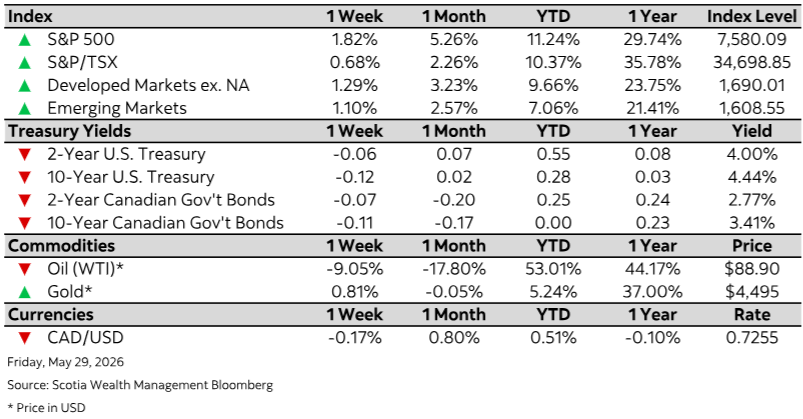
  • U.S. equities returned 1.82%1, on a short trading week, led primarily by the technology sector with Micron, AMD, and Dell in particular driving the index higher
  • Canadian equities returned 0.68%2, despite the decline in oil prices as Shopify and the railways overcame declines in energy companies
  • Developed markets ex North America returned 1.29%3, moving broadly higher on the macro and geopolitical headlines
  • Emerging markets returned 1.10%4, with Taiwan Semiconductor, Samsung doing much of the heavy lifting

Optimistic geopolitical headlines drive modest decline in yields

Yields for the week saw a steady decline as headlines became increasingly optimistic about an end to the conflict in Iran. Forward-looking geopolitical headlines were intertwined with May inflation reports, both of which provided no surprises, providing bond markets a little more ease around the risk of rising rates. In the U.S., April’s Personal Consumption Expenditure (PCE), the preferred inflation measure of the U.S. Federal Reserve (Fed), came in lower than expected while the year-over-year price change matched consensus.

Canadian sovereigns yields were nudged lower by a softer-than expected Canadian GDP report with the Canadian fixed income market now pricing no change in the Bank of Canada’s monetary policy rate until October with possible one hike (25 bps.) in December.

Highlights:

  • The 2- and 10-year U.S. Treasury yields were down 6 basis points (bps) and 12 bps, respectively. In Canada, the 2- and 10-year yields were down 7 bps and 11 bps. Bond yields and prices move inversely to one another.
  • European sovereign yields were unaffected by lower-than-expected inflation reports in France and Germany.
  • Investment grade and high yield credit mirrored their sovereign counterparts optimism about the direction of global inflation and central bank policy with expectations of a continued decline in energy prices.

Weekly dashboard


Canada’s economy unexpectedly contracted for a second straight quarter

The Canadian economy surprised the market with an unexpected 0.1% contraction in the first quarter. Combined with the revised 1% decline in GDP in the last quarter of 2025, this marks Canada’s first technical recession since the first two quarters of 2020. While the headline print was weak and household consumption and business investment softened, the ‘miss’ mainly owed to a large decline in government investment (weapons systems).

The 1Q26 reading fell well below the 1.5% QoQ median estimate among economists polled by Bloomberg, prompting a small adjustment in market-implied expectations for the Bank of Canada’s overnight rate, with traders pricing in ~28bps in cumulative hikes by year-end compared to the 30bps penciled in ahead of the release.

Looking ahead, Statistics Canada’s guidance indicates GDP rose by 0.4% month-over-month in April, suggesting a strong start to 2Q26.

Highlights:

  • Household consumption decelerated considerably in the quarter, coming in at a 0.7% QoQ rise after the 2.7% gain in 4Q25, as services spending took a large step back from a 5.2% jump in 4Q25 to a mere 2% increase last quarter (with travel abroad scaled back).
  • After a 24.6% QoQ surge in 4Q25, government fixed investment contracted by 9.6% QoQ last quarter, acting as a 0.44ppts drag on the headline annualized pace of GDP growth (+0.94ppts in 4Q25); weapons systems went from an ~800% QoQ increase to a ~65% QoQ decline. Despite this sequential decline in government investment, it sat 9.4% above its level in 1Q25, reflecting the government’s fiscal and defense push.
  • Imports grew by a massive 12% QoQ, the most since 2Q22 and coming after a 2% rise in 4Q25, while exports fell by 0.5% QoQ, steadying after the previous quarter’s 6.7% increase. On the imports front, the jump was lead by higher gold purchases according to Statistics Canada, with purchases of autos and machinery also picking up. Meanwhile, exports dropped on the back of weaker sales of passenger vehicles, impacted by U.S. tariffs, with the real value of autos and parts exports falling to its lowest level since 3Q21.

U.S. data highlights softer growth alongside persistent inflation pressures

U.S. GDP growth was revised lower in the second estimate for 1Q26, while April PCE inflation reinforced the message that underlying price pressures remain elevated despite cooling real activity. According to the Bureau of Economic Analysis (BEA), real GDP expanded at a 1.6% quarter over quarter annualized (QoQa) pace in 1Q26, down from the advance estimate of 2.0% and below consensus, reflecting downward revisions to both consumer spending and investment.

Highlights:

  • The composition of growth points to increasing reliance on non consumer drivers. Consumer spending decelerated versus the initial estimate, while exports, government spending, and investment continued to contribute positively.
  • April’s personal income and spending report highlighted growing tension between inflation and household purchasing power. Headline PCE rose 0.4% MoM and accelerated to 3.8% YoY, the highest since 2023, driven largely by higher energy prices linked to Middle East tensions.
  • Rate expectations have moved little on the news as markets continue to price a prolonged hold, with no cuts expected in the near term and residual risk still skewed toward further tightening. Current pricing continues to imply one 25bp rate hike toward late 2026 or early 2027, reflecting persistent inflation concerns even as growth momentum softens.

French economy contracts, Italy sees modest growth in 1Q
Two of the European Unions largest economies felt the effects of geopolitical uncertainty in the first quarter. In France, GDP contracted 0.1% while Italian GDP grew by 0.3% for the quarter, a modest but positive surprise to market expectations. On a year-over-year basis, both France and Italy showed resiliency amid tariff and conflict headlines, posting economic growth just below a 1% pace.

Highlights:

  • French consumption was the main driver to contracting GDP, declining 0.2% on the quarter after posting a healthy increase to end 2025
  • While the Italian economy surprised to the upside, government outlook for growth was cut to 0.6% this year and next, down 0.1 and 0.2 percentage points respectively
  • The effects of rising energy prices, dwindling supplies of jet fuel, and canceled flights on each country’s tourism will be watched closely throughout the summer

1  S&P 500 Index USD

2 S&P/TSX Composite Index USD

3 Bloomberg Developed Markets ex N. America Large & Mid Cap Price Return Index USD

4 Bloomberg EM Large & Mid Cap Price Return Index USD

DISCLAIMER: This publication has been prepared by The Bank of Nova Scotia for Scotia Wealth Management clients. It is for general information purposes only and should not be considered or relied upon as personal and/or specific financial, tax, pension, insurance, legal or investment advice. We are not tax or legal advisors, and we recommend that individuals consult with their qualified advisors, including tax and legal advisors, before taking any action based upon the information contained in this publication. The opinions and projections contained in this publication are our own as of the date hereof and are subject to change without notice. Scotia Wealth Management is under no obligation to update this publication, and readers should assume the information contained herein will not be updated. While care and attention has been taken to ensure the accuracy and reliability of the material in this publication, neither The Bank of Nova Scotia nor any of its affiliates or any of their respective directors, officers or employees make any representations or warranties, express or implied, as to the accuracy or completeness of such material and disclaim any liability resulting from any direct or consequential loss arising from any use of this publication or the information contained herein. This publication may contain forward-looking statements based on current expectations and projections about future general economic factors. Forward-looking statements are subject to inherent risks and uncertainties which may be unforeseeable and such expectations and projections may be incorrect in the future. Forward-looking statements are not guarantees of future performance and you should avoid placing undue reliance upon them. This publication and all the information, opinions and conclusions contained herein are protected by copyright. This publication may not be reproduced in whole or in part without the prior express consent of The Bank of Nova Scotia. To the extent this document contains information or data obtained from third party sources, it is believed to be accurate and reliable as of the date of publication, but Scotia Wealth Management does not guarantee its accuracy or reliability.

® Registered trademark of The Bank of Nova Scotia, used under licence (where applicable). ™ Trademark of The Bank of Nova Scotia, used under licence (where applicable). Scotia Wealth Management® consists of a range of financial services provided by The Bank of Nova Scotia (Scotiabank®); The Bank of Nova Scotia Trust Company (Scotiatrust®); Scotia Jarislowsky Fraser, a service of 1832 Asset Management L.P.; 1832 Asset Management U.S. Inc.; Scotia Wealth Insurance Services Inc.; and ScotiaMcLeod®, a division of Scotia Capital Inc. Private banking services are provided by The Bank of Nova Scotia. Estate and trust services are provided by The Bank of Nova Scotia Trust Company. Portfolio management is provided by 1832 Asset Management L.P. and 1832 Asset Management U.S. Inc. Insurance services are provided by Scotia Wealth Insurance Services Inc. Wealth advisory and brokerage services are provided by ScotiaMcLeod, a division of Scotia Capital Inc. International investment advisory services are provided by Scotia Capital Inc. Financial planning services are provided by The Bank of Nova Scotia and ScotiaMcLeod. Scotia Capital Inc. is a member of the Canadian Investor Protection Fund and is regulated by the Canadian Investment Regulatory Organization. Scotia Wealth Insurance Services Inc. is the insurance subsidiary of Scotia Capital Inc., a member of the Scotiabank group of companies. When discussing life insurance products, ScotiaMcLeod advisors are acting as Life Insurance Agents (Financial Security Advisors in Quebec) representing Scotia Wealth Insurance Services Inc.

Scotia Wealth Management® in The Bahamas consists of a range of financial services provided by Scotiabank (Bahamas) Limited and The Bank of Nova Scotia Trust Company (Bahamas) Limited, which are entities licensed to operate within The Bahamas. International private banking and international investment advisory services are provided by Scotiabank (Bahamas) Limited. International wealth structuring solutions are provided by The Bank of Nova Scotia Trust Company (Bahamas) Limited. ® Registered trademark of The Bank of Nova Scotia, used under licence.

Scotia Wealth Management® in the Cayman Islands consists of a range of financial services provided by Scotiabank & Trust (Cayman) Ltd. International private banking services, international investment advisory services, and international wealth structuring solutions are provided by Scotiabank & Trust (Cayman) Ltd., an entity licensed by the Cayman Islands Monetary Authority. ® Registered trademark of The Bank of Nova Scotia, used under license.

Scotia Wealth Management® in Jamaica consists of a range of Private Banking services provided by the Scotiabank Group of companies (Scotiabank®). ®Registered trademark of The Bank of Nova Scotia, used under licence.