Subscribe to the 100% free rdnewsNOW daily newsletter!
(Image Credit: Supplied)
challenge accepted, president says

The perfect storm: RDP to run $12 million deficit over next two years

Mar 14, 2026 | 7:02 AM

There’s no getting around the fact that a $12 million deficit over the next two years will be a challenge for Red Deer Polytechnic. 

However, institution president Stuart Cullum believes his team is not only up to the challenge created by what he calls a perfect storm, but is prepared to work toward balancing the budget by 2028. 

The ingredients of that perfect storm: inflationary pressures, stagnant funding, and an unexpected decline in international enrolment. 

Cullum recently shared budget numbers with staff, and they look somewhat different a year on. 

In January 2025, RDP was projecting a $10 million deficit, with approval given from the Government of Alberta to spread it over three years — $5 million in 2025-26, $4 million in 2026-27, and $1 million in 2027-28. 

This was done to give RDP time to find additional revenue sources and ways to reduce spending. 

One year later, the deficit over the latter two years — this coming budget year and next — is no longer a combined $5 million; it’s $12.6 million.  

The goal to balance by 2028 remains the same, Cullum insists. 

THE IMPACT OF SHIFTING ENROLMENT NUMBERS 

“The increase is in part due to a greater erosion of the international student population than we anticipated. When we were talking this time last year, we were looking at the effects of caps. We were looking at the effects of programs no longer being eligible for postgraduate work permits,” Cullum says.  

“It’s gone from around 60 to 70 per cent acceptance rate to around 20 per cent.” 

Canadian study permits issued to international students declined from nearly 120,000 in 2023, to roughly 105,000 in 2024, then to around 40,000 in 2025. 

At RDP, international credit student numbers went from 1,215 in winter 2024-25, to 906 in winter 2025-26. 

While international enrolment is down, overall enrolment is up. This school year, there are just shy of 8,300 students; the count was approximately 8,060 last year, 7,500 in 2023-24, 6,400 the year prior (2022-23), and 5,900 the year before that (2021-22). It was in 2021 when then Red Deer College gained polytechnic status.

According to Cullum, 95 per cent of learners are achieving relevant employment within their field. 

“People come to RDP because it’s a great educational experience, but they also get good employment, and I think that’s showing in our domestic growth,” he says. 

But the decline in international enrolment has also meant not being able to fill certain programs, and that’s meant some tough decisions. 

2025 – Suspended programs 

  • Administrative Professional Certificate  
  • Executive Assistant Diploma  
  • Human Resources Management Post-Baccalaureate Certificate  
  • Pre-Health Sciences Certificate  
  • University Transfer Bachelor of Education Secondary  

*Also reduced academic upgrading offerings. Important to note that students currently enrolled in suspended programs are not impacted, and can finish the program at RDP. 

2025 – Launched credit programs 

  • Advanced Accounting Diploma 
  • Artificial Intelligence and Data Analytics Post-Baccalaureate Certificate  
  • Artificial Intelligence and Data Analytics (AIDA) diploma 
  • Network Administration Diploma 
  • Diagnostic Medical Sonography Diploma 

Furthermore, in Cullum’s presentation, he shared data from Royal Bank of Canada showing public spending on Canadian colleges and universities has been steadily decreasing since 2012, when it totalled around 1.475 per cent of GDP. By 2024, it had fallen to 1.1 per cent. 

IS HELP COMING? 

This leads us to the provincial budget released by the Alberta government at the end of February. 

Cullum calls that budget “measured,” though it will also carry a deficit this year of over $9 billion. 

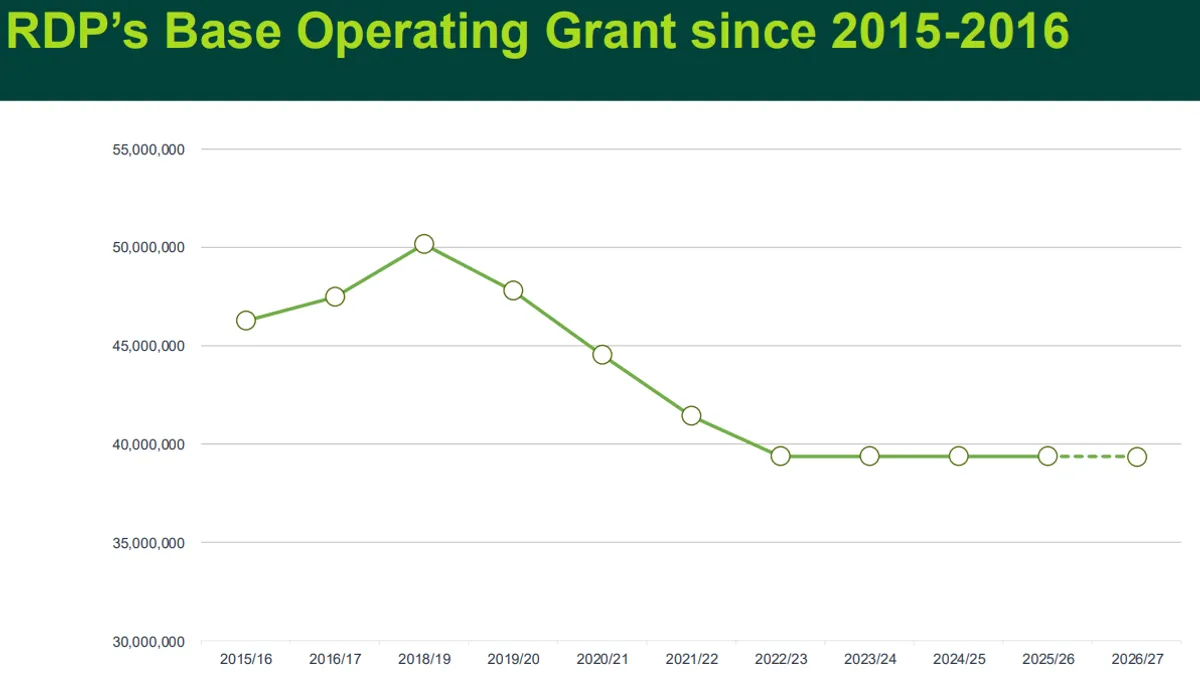
“We are thankful the Government of Alberta has chosen to provide additional base operating grant resources, which is something that’s not happened for the past seven years. We’ve actually received deductions for the last three,” he says, noting RDP will see a 2.7 per cent boost. 

A slide from an RDP Employee Town Hall presentation given in February 2026; the graph shows declining base operating funding, which RDP received annually from the provincial government.

“We also received additional dollars to our maintenance renewal funding, which we receive every year to support upkeep of facilities and maintaining our campuses.” 

Cullum notes the government had to make tough choices and thankfully saw, as the polytechnic does, that post-secondary is important to the economic and social viability of the region and province. 

The 2.7 per cent base increase is equal to about $1.089 million, with the maintenance increase worth just over $100,000. 

Then there’s system enrolment expansion funding, which Cullum explains supports enrolment growth within high-demand areas; it has been renewed for three years. This funding is critical as it’s allowed RDP over the last number of years to launch new programs, including the aforementioned ones. 

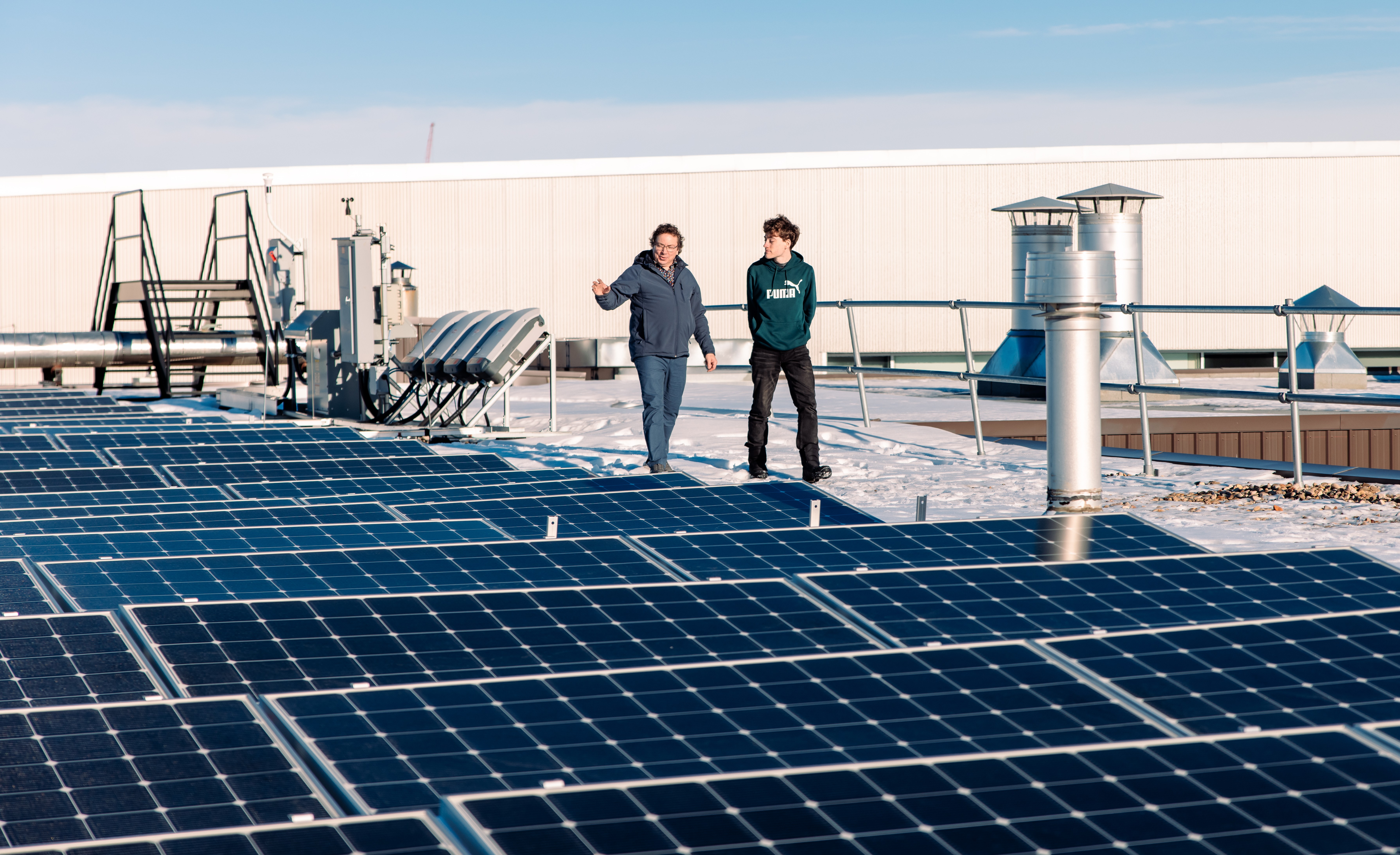
There’s also final-year funding in the provincial budget to complete work begun in 2024 on the Centre for Innovation-Manufacturing Technology Access Centre (CIM-TAC).  


(Image Credit: Supplied)

A NEW FUNDING MODEL 

In fall 2025, the Alberta government received the final report from a panel tasked with examining post-secondary funding, and how competitive Alberta’s system is with other regions of the country. 

The report was chaired by economist Jack Mintz, and it made eleven key recommendations: 

  • a new funding framework 
  • targeted funding for specialized initiatives 
  • funding for apprenticeship programs 
  • changes to capital funding 
  • moving away from 2% yearly tuition cap 
  • more assistance to students in form of non-repayable assistance 
  • ensuring international students are welcomed by federal government 
  • more flexibility for raising revenue and reducing costs 
  • reducing red tape (less frequency of reporting) 
  • streamline process for new programs 
  • institutional neutrality (refrain from policies and practices that are contrary to equality of, and freedom from, discrimination provisions in the Charter of Rights and Freedoms and the Alberta Human Rights Act (section 15(1) in the former and section 4 in the latter); and to uphold and protect freedom of expression and intellectual diversity

Cullum agrees a new funding model would be welcome, adding it’s actually something they’ve been calling for. 

“The [current] funding model is a bit of a mystery, I would say. It’s pretty well agreed upon that it’s not very clear how the funding is distributed to public post-secondary institutions across Alberta. Over the years, funding has increased on a percentage basis, but it’s predicated on a basis that no one truly understands,” he says.  

“There’s interest in building a funding model that aligns the overall funding to the needs of the post-secondary system and to its sustainability.” 

He says the proposed model is partially based on student demand, but also on the cost of programs. 

Cullum says that’s where RDP is perhaps most supportive because college and polytechnic programs typically cost more than those within university and undergraduate environments. 

“We deliver a lot of apprenticeship programs, technology programs, and health programs,” he says. “All of those programs are critically important for our economy and our community, but they generally have higher costs because of the technology required, the labs that are required, and the practical nature of learning that occurs within them.” 

Tuition, which is making up more than 35 per cent of RDP’s revenue this school year, also comes into the picture. 

According to RDP, it has increased tuition, and says it will continue to do so, in accordance with the Government of Alberta Tuition and Fees Regulation and Post Secondary Learning Act. As of 2024-25, tuition rate increases are capped at 2.0 per cent. Prior to that, the increases were capped as follows: 2023-24 fiscal year = 5.5 per cent; 2022-23 fiscal year = 7.0 per cent; and 2021-22 = 7.0 per cent. 

Cullum says there are ways to increase revenue without hiking tuition. 

That includes looking at increasing continuing education and corporate training activities, ensuring strong collaborations with industry partners and donors, and building capacity in other ways.” 

“The international student revenue stream has significantly and irrevocably diminished, so we have to do that,” he says.  

“We are not only doing that, we are looking at how we can structure our organization to do even more.” 

Divisions of RDP will continue to develop budgets focused on restructuring between now and May 1. Position reduction notifications will be shared between May 11-29, the town hall presentation stated. The budget will be presented to the board of governors on May 27.

rdnewsNOW requested an interview with the students’ association at RDP, but no one was available due to ongoing S.A. elections.