Subscribe to the 100% free rdnewsNOW daily newsletter!
(Image Credit: ID 106879568 © Tloventures | Dreamstime.com)
lead dr. speaks, but many questions remain

Study: Closure of Red Deer’s overdose prevention site had no detrimental impacts

Mar 14, 2026 | 6:58 AM

A new study published by an organization launched by the Government of Alberta claims there’s been no increase in overdose deaths, ER visits, or EMS response due to the closure of Red Deer’s overdose prevention site.

The study, conducted by the Canadian Centre of Recovery Excellence (CoRE), was published in the 123-year-old scientific journal, Addiction, on March 10.

In a release, it’s noted CoRE it was launched in 2024 by the governing United Conservative Party, which has been crystal clear in its stance over the years that it favours recovery-oriented treatment over what’s offered at a supervised consumption site (SCS).

Red Deer’s SCS, which was smaller and therefore dubbed an overdose prevention site (OPS), was opened by the previous NDP government in October 2018.

It closed March 31, 2025 despite a court challenge, which is still technically ongoing. That case, which asked for an injunction against the closure on Constitutional grounds, is slated to be heard in the Court of Appeal of Alberta in Edmonton on May 8 of this year.

READ MORE: Appeal against ruling on temporary Red Deer OPS injunction dismissed

Given the connection between CoRE and the UCP, there’s some school of thought that the study could be slanted and/or inaccurate; that’s if you ask some of the people who work with folks on the streets, like Turning Point Society, and members of the Red Deer Firefighters Association.

That’s not to mention data provided by the Government of Alberta itself on the Substance Use Surveillance System, which warrants some clarity.

WHAT DOES THE STUDY CLAIM?

Fewer deaths, fewer visits to the emergency room at Red Deer Regional Hospital, and fewer required responses by EMS to opioid overdoses… among a subset of OPS users, not the general population.

“This study is the first of its kind. Alberta is the only jurisdiction that treats overdose prevention like other health services by regulating sites and requiring sites to collect a health care number or health care identifiers. Much of the scientific publications to date supporting overdose prevention sites use population-level data, or voluntary data from people who are motivated to be part of a study,” Dr. Nathaniel Day, CoRE’s Chief Scientific Officer, said in a release.

“Our research, using all identified site users, and comparing them to the users of a site that did not close, shows that closing the site had little to no impact on health care utilization. However, the study showed site users were more likely to access treatments for opioid use disorder after the site closed.”

Dr. Day explains the study examined two provincially-regulated OPS programs — in Red Deer and Lethbridge.

Closure of Red Deer’s OPS was announced in September 2024, and implemented March 31, 2025. The Lethbridge OPS remained open throughout the study, which looked into provincial health data from June 30, 2024 through Sept. 27, 2025.

Per CoRE:

“To improve the quality and strength of this research, CoRE looked not only at the outcomes for Red Deer clients but also compared them to clients using a similar program in Lethbridge. This allowed researchers to better understand if any detected changes for Red Deer were related to the closure or related to other factors, given that the Lethbridge site remained open. For example, the number of people in Lethbridge taking evidence-based treatments increased slightly over time, but not nearly as much as the site users in Red Deer who had significantly increased rates of accepting treatment as the site prepared for closure and was ultimately closed.

“This study is the first to look at the consequences of site closure using linked administrative health care data. Early results indicate that the site closure did not result in an increase in mortality or acute health care services for site users. However, the closure was associated with a statistically significant increase in the number of people accessing treatment. Stable EMS and Emergency Department use of addiction-related visits is reassuring for the overall health system. CoRE continues to study this issue and explore longer-term outcomes for site users.”

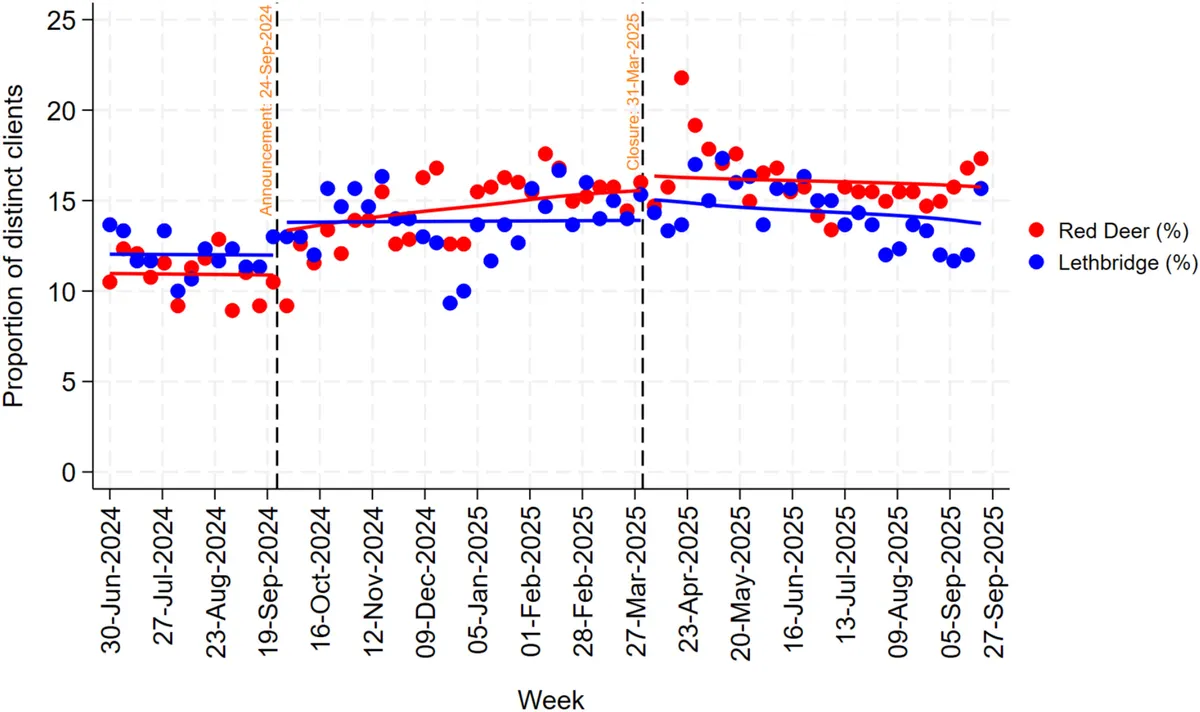
A graph (Figure 1) from the study tracks the number of OPS users, as examined in the study who took up opioid agonist therapy (ie. methadone, suboxone) before the Red Deer OPS closure announcement, then after it was announced but before it closed, and finally after it closed. Red Deer users are represented by red dots, and Lethbridge users by blue dots; the intervals are represented by vertical dotted lines.
A graph (Figure 1) from the study tracks the number of OPS users, as examined in the study who took up opioid agonist therapy (ie. methadone, suboxone) before the Red Deer OPS closure announcement, then after it was announced but before it closed, and finally after it closed. Red Deer users are represented by red dots, and Lethbridge users by blue dots; the intervals are represented by vertical dotted lines. (Image Credit: Supplied)

EVIDENCE TO THE CONTRARY?

To be clear, this study only looked at and tracked the 381 unique users of Red Deer’s OPS, and 300 unique users of Lethbridge’s OPS, between June 2024 and September 2025.

In other words, it did not track the overall population, which would be whom the numbers on Alberta’s Substance Use Surveillance System represent. Looking at that website is where it can get confusing, because for each of the three categories the study cites, there are distinct increases in the periods immediately following the OPS closure.

Deaths – Red Deer

Q3 2024 (July-Sept.): 4 recorded deaths in Red Deer [pre-closure]

Q4 2024 (Oct.-Dec.): 7 recorded deaths in Red Deer [pre-closure]

Q1 2025 (Jan.-March): 5 recorded deaths in Red Deer [pre-closure]

Q2 2025 (April-June): 9 recorded deaths in Red Deer [post-closure]

Q3 2025 (July-Sept.): 4 recorded deaths in Red Deer [post-closure]

*partial data for Q4 2025, no data for Q1 2026


(Image Credit: Substance Use Surveillance System)

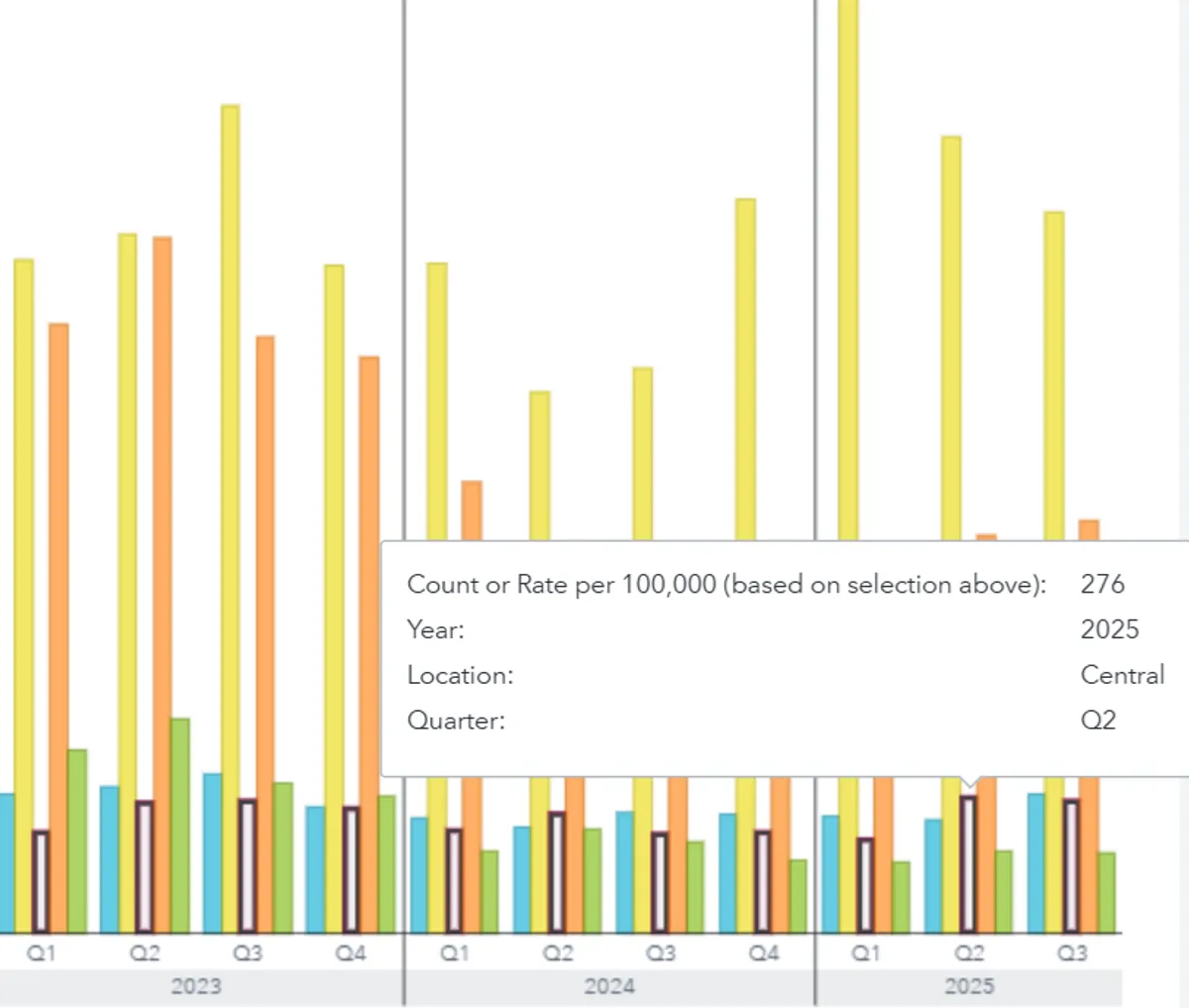
ER visits and hospitalizations – Central Zone (Red Deer Regional as hub hospital and primary source of numbers)

Q3 2024: 204 visits [pre-closure]

Q4 2024: 207 visits [pre-closure]

Q1 2025: 194 visits [pre-closure]

Q2: 2025: 276 visits [post-closure]

Q3 2025: 270 visits [post-closure]


(Image Credit: Substance Use Surveillance System)

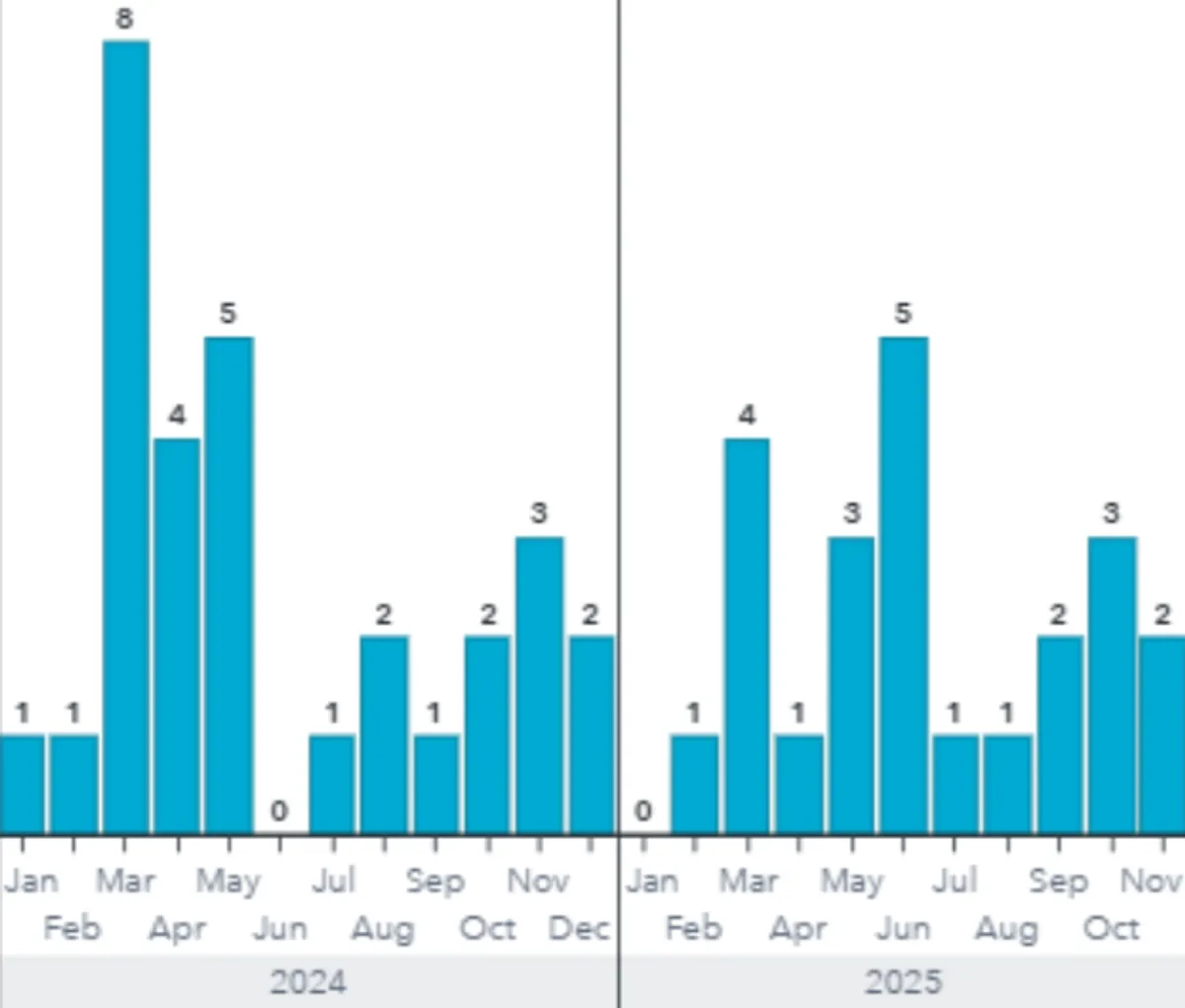
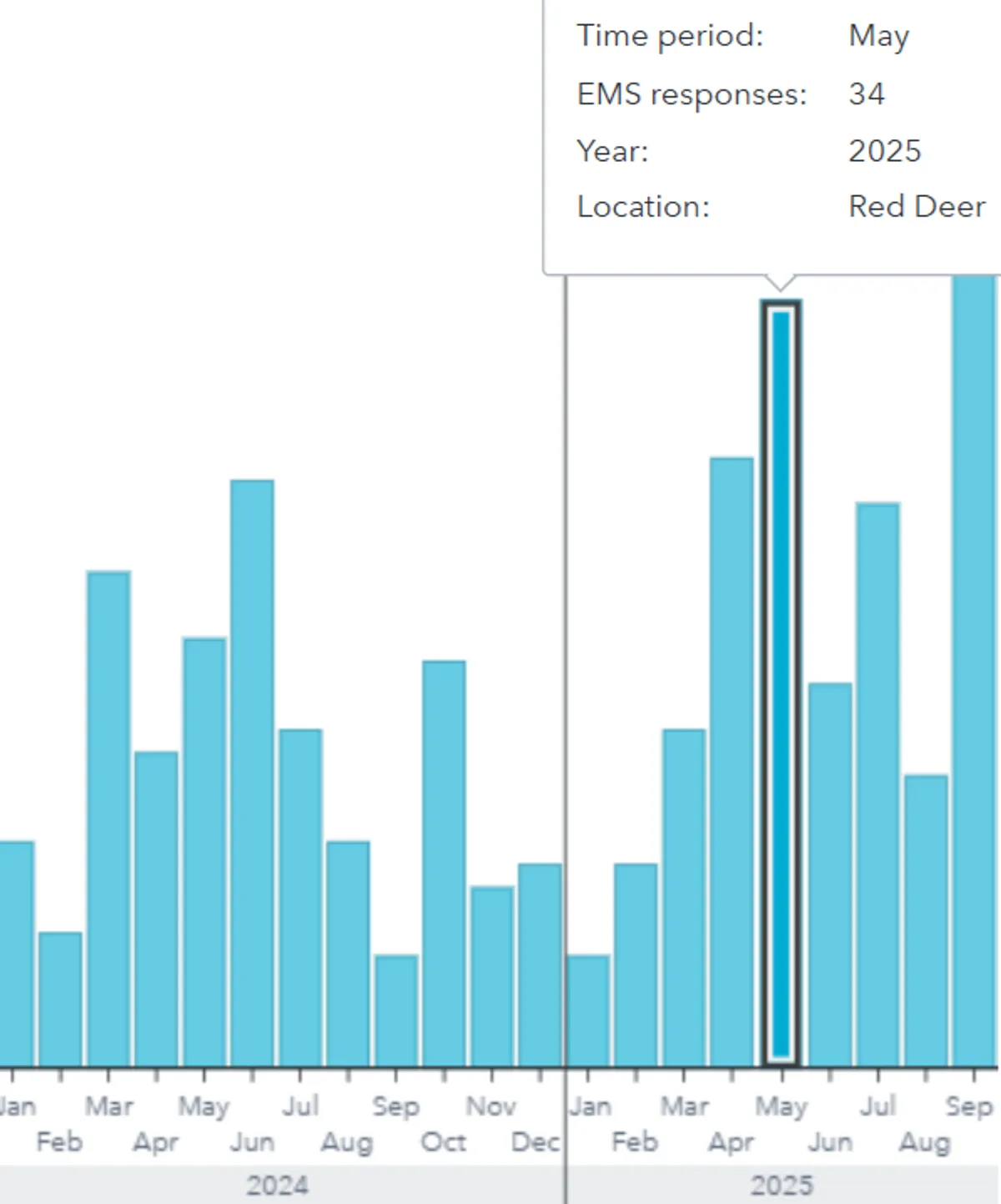
EMS response – Red Deer

Week of March 17, 2025: 2 responses [pre-closure]

Week of March 24: 0 responses [pre-closure]

Week of March 31: 2 responses [pre-closure]

Week of April 7: 4 responses [post-closure]

Week of April 14: 6 responses [post-closure]

Weeks of April 21 & 28: 11 responses each [post-closure]


(Image Credit: Substance Use Surveillance System)

Of the first 13 weeks of 2025, leading up to the closure, there was one week with eight EMS responses, one with five, and no other surpassed two.

Over the following 38 weeks of 2025 (post-closure), so not including the final week of the year, only three weeks bottomed out at two responses, while there was one week of 16, one with 15, one with 13, two with 12, and two with 11 responses.

ASSESSING & CLARIFYING THE DATA

rdnewsNOW interviewed Dr. Day about the optics of the publicly available data, in relation to the study.

How does one reconcile the overall increases with the study’s claim that there were none among the 381 OPS users?

Dr. Day first clarified that users were tracked using their personal health numbers, and wouldn’t have been aware of it in real-time. Officials with CoRE and the study did this within the boundaries of privacy and ethics, and best research practices, he added.

“[For example], in 2024, there was a small number of people who died in Red Deer who were exposed to carfentanil, which is thousands of times more potent than morphine. In 2024, it was four per cent. Up until the time we submitted the data for publication in the journal, it had increased to 36 per cent,” said Day, referring to Table 1 of the study.

Table 1 shows there were 110 deaths in 2024 among the general population, and 56 in the portion of 2025 they had analyzed (through September).

“So in Red Deer, there was a big change in the drug supply, and that could explain, though we don’t know for sure, why in the general population there were more EMS calls and more hospitalizations, if that’s what the data shows,” he continued.

As seen above, that is indeed what the data shows.

Furthermore, Table 1 of the study shows decreases in every other substance analyzed, including fentanyl, methamphetamine, cocaine, alcohol, and benzodiazepine.

FIRE FIGHTERS, TURNING POINT, AND NDP RESPOND

Brad Readman, president, IAFF Local 1190 (Red Deer Firefighters), is a boots-on-the-ground member of Red Deer Emergency Services, and is a captain at Station #2 on the city’s north end.

“I do know from my members, doing EMS calls 365 days a year, 24 hours a day, that opioid overdoses have increased, and they’ve done so in the downtown core. Is it a coincidence they increased when the OPS closed? Maybe. But also Turning Point closed,” he said, referencing the three-decade-old organization’s closure of its main building downtown in 2025. That happened due to provincial funding being pulled.

“There’s not a one-stop fix for everything. We need to have a variety of solutions, and as far as I’m concerned, one death is too many. Once we can prevent death, we’re winning.”

Adding that the more tools, the better, Readman clarified that his organization does not keep data which would correlate to what the study tracked.

“They can make a study and data say anything they want; that’s the positive and negative of [working with] data,” he added. “But I will say this: when they’re trying to sell a narrative, of course they’re going to want a study that supports the narrative. We are seeing widespread opioid overdoses throughout the downtown.”

We arrive at Turning Point, whose interim executive director Carolyn Corrigal says the findings should be considered one part of a broader body of research, rather than a standalone conclusion capable of forming policy.

She emphasizes this is because it conflicts with decades of international evidence on supervised consumption services.

“The opioid and drug poisoning crisis is complex, making it imperative to collect and analyze data from multiple perspectives to fully understand impact. Notably, this data tracked only the most current users of the AHS-operated OPS site via personal health numbers, and entry into recovery programming when OPS services were closed may have been influenced by the increased client capacity that resulted from prior access to OPS,” Corrigal opined.

“When the OPS closed in April 2025, our teams at the Turning Point drop-in space saw a drastic increase in on-site emergencies, requiring us to double up overdose response teams as multiple incidents occurred concurrently. Anecdotally, frontline teams report seeing overdoses occur in businesses, on streets, and in public spaces, and requests for the response training we provide are now coming from unrelated businesses who previously did not encounter these situations.”

She added that without supervised consumption services, many individuals are pushed to use substances alone or in remote locations such as wooded areas — or at home if fortunate — where overdoses may go unreported and responses rely on peers who may hesitate to call emergency services for fear of repercussions.

This contributes to significant undercounting of overdoses, emergencies, and deaths, especially given delayed or excluded toxicology reports, she said.

Additionally, she explained that Red Deer lacks formal drug-checking programs, but information from neighbouring communities indicates that what are referred to as fentanyl “downers” [AKA depressants] are becoming more commonly contaminated with tranquilizers.

“The drug supply is highly variable from batch to batch, and even when current batches trend toward lower fentanyl and higher tranquilizer content, it may not produce lethal emergencies, but it can still cause serious harms, including heavy sedation, confusion, and impaired cognition — effects that frontline workers have consistently observed over the past six months and effects where individuals would still benefit from supervision,” she further explained.

“Understanding these patterns requires systems to monitor ongoing long-term risks accurately. Moreover, the wrap-around services provided by OPS — including wound care, system navigation, social supports, recovery referrals, capacity building and sterile infection-prevention supplies create a broader ripple effect with long-term benefits that should also be measured.”

Janet Eremenko, the Alberta NDP Opposition’s shadow minister for mental health and addictions, contributed the following:

“I want to see programs and services that keep people alive and bring them back to a healthy place. That’s my number one priority. This report sheds a bit of light on the immediate implications of terminating a program, but it doesn’t come near to telling the full story. CoRE received $8.7 million in Budget 2026. It should produce research that is peer-reviewed, stands up to scrutiny and is free of political interference.”

REPORT NOT SLANTED, SAYS DR. DAY

“Honestly, I appreciate the question,” Dr. Day said of being asked to respond to people who may believe the study is slanted due to CoRE’s connection to a UCP government that is perceived as being vehemently against supervised consumption services.

“CoRE was created by an act of the legislature to have access to data to specifically evaluate all components of the recovery-oriented system of care that’s been developed in Alberta. That includes harm reduction services, and others. The reason for CoRE is to inform data-driven policies instead of just politics-driven policies so that best practices can be implemented,” he shared.

“Our job is to empower decision-makers with the best available evidence and information to ensure supports and services are available to help the very real people who need help.”

Day insists that the scientists with whom CoRE collaborates, nationally and globally, follow scientific methodology, and are responsible for ethical oversight.

“I would hope to reassure people who might be skeptical of the results that first and foremost, the research was approved with independent ethical oversight before we embarked on the study. Secondly, all the data and analysis were subject to peer review at one of the world’s top journals on addiction. The review process is rigorous, and it’s very hard to have research published in this very prestigious, high-impact journal,” he remarked.

“These are real people, family members, our neighbours, our friends, who need meaningful help, so it behooves us, regardless of political orientation, to actually look at the data and try to find the best ways to support people, because it matters.”