Subscribe to the 100% free rdnewsNOW daily newsletter!
(Image Credit: Scotia Wealth Management)
Sponsored

Market Watch: March 13

Mar 13, 2026 | 4:10 PM

This week’s highlights

  • Positive corporate and economic news overshadowed by Middle East conflict
  • Global yields continue to climb on energy-linked inflation concerns
  • Canada’s trade deficit widens to $3.65 billion in January on auto weakness
  • U.S. inflation held steady in February before Iran war sent energy costs soaring
  • Eurozone fourth-quarter growth revised lower

Week in review

Positive corporate and economic news overshadowed by Middle East conflict

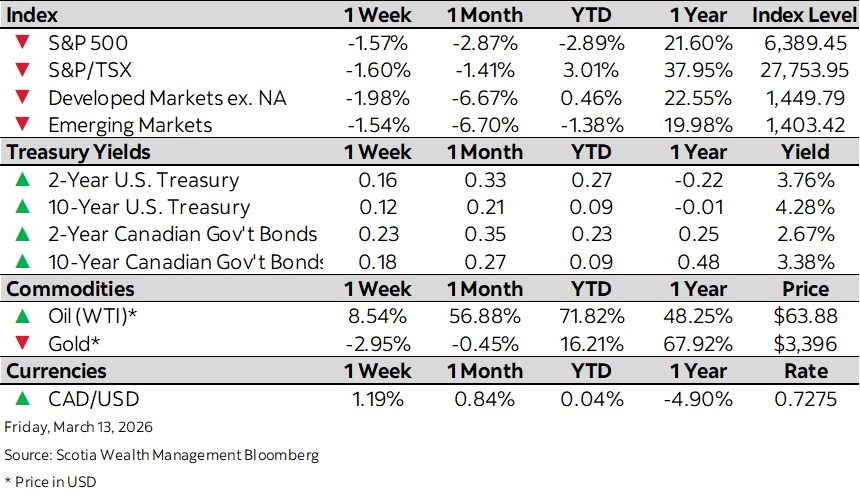
U.S. equity markets were whipsawed by intensifying Middle East tensions that drove sharp swings in oil prices and overshadowed in‑line Consumer Price Index (CPI) data alongside strong corporate updates, including Oracle’s earnings beat and upgraded guidance. Sentiment weakened mid‑week as reports of tanker attacks, refinery shutdowns, and mine‑laying in the Strait of Hormuz tightened supply expectations and revived inflation concerns, pushing rate‑cut expectations lower. Canadian equities faced pressure from soft labour data but drew intermittent support from elevated crude. European markets fluctuated as rising yields and renewed energy‑security risks offset mixed corporate developments. In China and broader emerging markets, early‑week strength from robust Chinese trade data faded as energy‑ and tariff‑related global growth concerns intensified following new U.S. Section 301 probes.

Highlights:

  • U.S. equities returned -1.57%1 as oil-price spikes overwhelmed CPI data and solid earnings, with deteriorating rate-cut expectations and headline driven energy volatility repeatedly reversing rebounds keeping risk appetite anemic.
  • Canadian equities returned -1.60%2 as sharply higher crude prices offered intermittent support while a substantial February jobs decline and shifting Bank of Canada (BoC) expectations maintained downwards pressure.
  • European stocks returned -1.98%3 after facing persistent pressure from energy-supply worries which were offset to a degree by corporate updates, with markets overall constrained by inflation and hawkish policy concerns.
  • Emerging markets decreased -1.54%4 despite strong Chinese trade results due to the escalating Middle East conflict raising global growth concerns, intensified commodity price volatility, and muted optimism around China’s momentum and regional resilience.

Global yields continue to climb on energy-linked inflation concerns

U.S. fixed income markets spent the week adjusting to sharply fluctuating energy‑driven inflation risk, with Treasury yields rising early as the conflict‑driven oil shock reduced expectations for Federal Reserve (Fed) easing and kept rate volatility elevated despite in‑line CPI and softer labour indicators. Canadian yields tracked the global move higher despite a materially weaker Friday jobs report which failed to shift tightening expectations from the BoC. European sovereign bonds faced heavier selling amid heightened sensitivity to energy supply disruptions and growing speculation that a protracted conflict could force a more hawkish European Central Bank (ECB) stance.

Highlights:

  • The 2- and 10-Year U.S. Treasury yields were 16 bps and 12 basis point (bps) higher, respectively. In Canada, the 2- and 10-year yields were up 23 bps and 18 bps, respectively. Bond yields and prices move inversely to one another.
  • Sovereign bond markets sold off as the conflict‑driven surge in oil prices lifted inflation risk and pushed yields higher across the U.S., Canada, and Europe before soft labour data and stabilizing energy prices offered some relief.
  • Corporate credit traded cautiously as heightened geopolitical uncertainty and rising rate expectations pressured spreads, while heavy U.S. issuance early in the week and shifting inflation dynamics kept both IG and HY markets sensitive to headline‑driven volatility.

Weekly dashboard


Canada’s trade deficit widens to $3.65 billion in January on auto weakness

Canada’s trade deficit in January surprisingly widened as exports dropped more than imports, led by a meaningful drop in shipments of motor vehicles and parts. According to Statistics Canada (StatCan) said the country posted a deficit of $3.65 billion in January, almost three times more than the deficit of $1.3 billion observed in December. Analysts had forecasted a $900 million deficit for the month. Economists however expect that Canada’s international trade could benefit in the coming months due to higher crude oil prices owing the war in the Middle East.

Highlights:

  • Total exports dropped by 4.7% in January, the largest drop since April last year. Exports declined in six out of 11 categories, StatCan said. In volume terms exports declined 5.8%.
  • Exports of motor vehicles and parts dropped to its lowest level since September 2021, posting a massive 21.2% drop in January. This was mainly due to lower motor vehicle production in Canada following prolonged seasonal production stoppages, StatCan said. Exports of metal and non-metallic mineral products dropped 8%.
  • Higher energy exports, which rose by 4.1%, helped offset some of the decline. This is Canada’s biggest export category by value and contributes close to one-fourth of its total exports.

    U.S. inflation held steady in February before Iran war sent energy costs soaring

    U.S. inflation in February printed some of the lowest numbers in two years, as the recent spike in energy prices has yet to show up in the data. According to the U.S. Labor Department, consumer prices rose 2.4% in February compared with a year earlier, matching January’s 2.4% increase. Excluding the volatile food and energy categories, core prices climbed 2.5% from a year ago, also matching January’s level, which was the lowest in five years. Both figures are above the U.S. Federal Reserve’s 2% target.

    Highlights:

    • The snapshot was taken before the U.S. and Israel attacked Iran, which has caused wild gyrations in oil prices and is expected to push inflation much higher when data for March is released in early April.
    • On a monthly basis, prices rose 0.3% in February from the previous month, up from 0.2% in January. Core prices moved up just 0.2%, down from a 0.3% rise in January.
    • Grocery prices rose more quickly, continuing a trend that has hit family budgets. They rose 0.4% in February and were up 2.4% from a year earlier. Gas prices increased 0.8% last month, though were down 5.6% compared with a year ago.

      Eurozone fourth-quarter growth revised lower
      Economic growth in the eurozone was slightly less than previously reported in the final quarter of last year, prompted by a larger-than-expected contraction in Ireland. Gross domestic product (GDP) increased 0.2% in the three months through December, the European Union’s statistics agency Eurostat reported. That was lower than the 0.3% previously reported in February.

      Highlights:

      • Ireland’s economy contracted 3.8%, the Eurostat data showed, more than the 0.6% decline estimated in February. Ireland’s GDP is particularly volatile due to the contribution of large multinational companies.
      • However, Irish GDP over the whole of 2025 was 12.3% higher than in 2024, one of the world’s fastest expansions. Eurozone GDP grew 1.5% in 2025, Eurostat said, the same as it said in February.
      • Despite the downward revision to overall GDP, private consumption grew at a strong clip in the quarter, with government spending and investment still strong. Trade was a drag on activity, the data showed, as the currency area tried to cushion the blow of U.S. tariffs.

        1  S&P 500 Index USD2 S&P/TSX Composite Index USD3 Bloomberg Developed Markets ex N. America Large & Mid Cap Price Return Index USD4 Bloomberg EM Large & Mid Cap Price Return Index USD