Subscribe to the 100% free rdnewsNOW daily newsletter!
Taking decision-makers to task

Podcast: Lacombe area mayors confront Ottawa on future of research and development centre

Mar 3, 2026 | 9:44 AM

“We respectfully ask that irreversible actions are not finalized before your work is complete. Pause, validate, then decide.”

That’s how Lacombe Mayor Thalia Hibbs concluded her impassioned plea this past weekend in Ottawa, speaking to the House of Commons Standing Committee on Agriculture and Agri-Food.

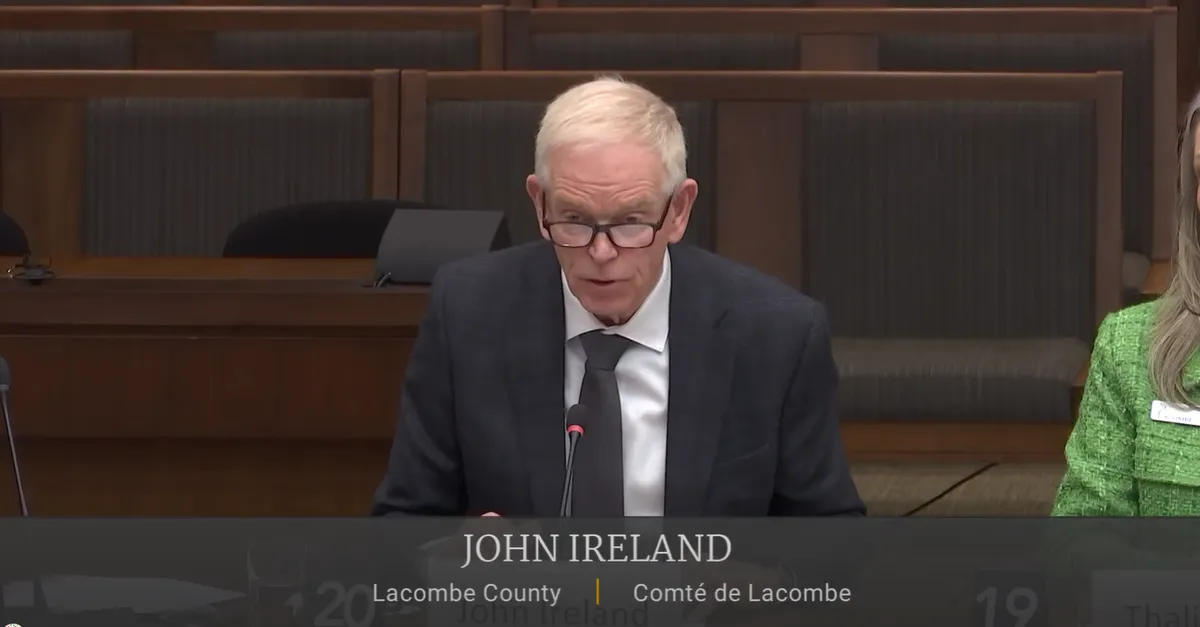
Hibbs, plus Lacombe County Reeve John Ireland, were there representing a joint task force formed last month. The task force’s sole mission is to persuade national decision-makers to reconsider the recent move to close the 119-year-old Lacombe Research and Development Centre.

It was announced in late January that Agriculture and Agri-Food Canada (AAFC) would shut the facility’s doors, as well as those of several similar centres across the country.

While the closure could take up to a year, it’s been said, it will eventually lead directly to 112 jobs lost. AAFC has cited financial savings as the main driver, though have not disclosed a dollar figure.

In January, Mayor Hibbs outlined to rdnewsNOW and on The Everything Red Deer Podcast how damaging this move would be for the region and the nation, given how much work has gone on at the centre for over a century.

Hibbs told the committee on Friday she was not there to repeat prior testimony, but to further contextualize it.

“This is a national concern. For 119 years, Canadians have invested in building one of the country’s most integrated agricultural research ecosystems. The Lacombe site is not simply any laboratory, it’s a full-cycle federal research asset. From soil and forage development to livestock genetics to federally inspected processing and carcass analysis, all on one site,” Hibbs remarked.

“Few facilities in Canada combine this level of integration across an entire agricultural value chain. That integration matters. Once disrupted, it cannot be restarted. Multi-generational livestock genetics cannot be reconstructed in a budget cycle. Long-term soil and crop trials cannot be recreated once broken. A research team built over decades cannot be reassembled once dispersed. If this centre is dismantled, the loss is permanent.”

Hibbs, of course, lamented the potential impacts on Lacombe, including loss of employment opportunities for students, elimination of the centre’s significant local purchasing, and a downturn in the housing market — not to mention out-migration.

Hibbs also alluded to concerns about the site becoming greyfield, or in other words, the once-viable and in-use building being left to sit empty.

As well, she noted a constellation of partnerships between the site and Western Crop Innovations, Lakeland College, and the University of Alberta, plus producers across western Canada.

“This intellectual ecosystem cannot be relocated without consequence. Centres on the Prairies are not interchangeable. Our environmental conditions are unique from other sites. The research at Lacombe has resulted in impactful advancements through its integrated farm-to-fork facilities in meat quality, safety, sustainability, and innovative processing, while also being able to respond to industry crises, all in the heart of Canada’s cattle production,” she continued.

“Closing Lacombe will eliminate the primary player in keeping Canadian beef, pork, and lamb globally competitive. There will be a halt in advances in meat science, including AI, robotics, and advanced imaging. Most critically, there will be an increased vulnerability to future threats.”

Hibbs went on to ask specifically for a 12- to 18-month validation period, which would allow for inventory of active research assets, genetic materials, and long-term trials; plus assessment of sequencing and protection measures to prevent irretrievable loss; and finally, publishing of a transparent site-specific cost-benefit analysis comparing near-term savings with long-term national impact.

Reeve Ireland, a farmer himself, told the committee 98 per cent of his municipality is zoned agricultural, and that ag is not just an industry here, but an identity.

He called the LRDC an “engine of innovation,” then said he isn’t here to talk about the facility’s history, but rather the future.

“The challenges facing central Alberta farmers today are more complex than at any point in the last century. We are operating in climate extremes. Thirty years ago, one of our biggest fears was an August frost. Today, we have gained nearly 23 frost-free days to our growing season. While this allows for higher-yield, longer season crops, it also brings new weeds, new pathogens, and a desperate need for drought-tolerant varieties,” Ireland explained.

“As rainfall becomes more unpredictable, we have moved almost universally to minimum tillage to conserve every drop of moisture. These shifts are real-time, region-specific research. You cannot manage a farm in Lacombe using data gathered anywhere else in the country, even southern Alberta. Despite being in the same province, our climates, soil profiles, and moisture levels are vastly different. Relying on a single southern station to serve the entire province is like asking a doctor to diagnose a patient that he has never met, based on a chart from someone four hours away.”

Ireland continued, saying three critical realities that must be faced.

One, he claimed, is the $63 return for every dollar invested into agricultural research; second is the geopolitical landscape which has led to trade disputes; and lastly is the reality of unbiased science.

“There is a role for the private sector, but AAFC research is unique because it is empirical and unbiased. It is not tied to a corporate marketing plan or a specific seed chemical package,” he stated.

“Public research gives farmers the confidence to adopt new practices because the data is focused on the producer’s success, not a shareholder’s dividend.”

AAFC provided a new statement to rdnewsNOW Tuesday, seemingly doubling down on its intent to go through with the closure.

“We understand that our research centres are deeply connected to their communities, and that the closures of our sites will have an impact. A full closure of sites cannot occur immediately, as it involves a complex series of decisions that must be carefully worked through. The wind-down of science operations at affected sites could take up to 12 months, varying by location, with full divestiture expected to take longer,” says Cameron Newbigging, media services, AAFC.

“We will take the time necessary to engage with research partners on the future of active projects, preserve findings, and continue to build on these collaborations through our other centres. Regarding the Lacombe Research and Development Centre, Agriculture and Agri-Food Canada (AAFC) is engaging with affected parties, including the province, municipality, local partners, and stakeholders, to ensure clear communications and a smooth transition process.

“We recognize the importance of maintaining continuity through this transition and will work with partners to preserve research findings and manage the wind-down of affected activities responsibly.

Newbigging says AAFC is committed to Alberta, with high-impact science focused on crops and horticulture production, animal production, food processing and safety, biodiversity, and environmental sustainability being delivered through the Lethbridge Research and Development Centre, and the Beaverlodge research farm.

Lacombe County council also recently passed a resolution to bring this matter forward to the next convention of Rural Municipalities of Alberta (RMA), March 16-18. The resolution asks RMA to advocate to the Government of Canada to reverse its decision.

The public can stay up-to-date on developments of the Task Force’s advocacy efforts here: https://www.lacombecounty.com/LRDC; and here: https://www.lacombe.ca/1621/Lacombe-Research-and-Development-Centre.

READ MORE