Subscribe to the 100% free rdnewsNOW daily newsletter!
Sponsored

Market Watch – Jan. 9, 2026

Jan 9, 2026 | 4:51 PM

This week’s highlights

  • Geopolitics and mixed data temper early-year equity gains
  • Rates swing on softer inflation and labour data
  • Canada reports trade deficit as share of U.S. exports hits non-pandemic low
  • U.S. job gains cooled in December, capping year of weak hiring
  • Eurozone manufacturing slips deeper into contraction at year-end, PMI shows

Week in review

Geopolitics and mixed data temper early-year equity gains

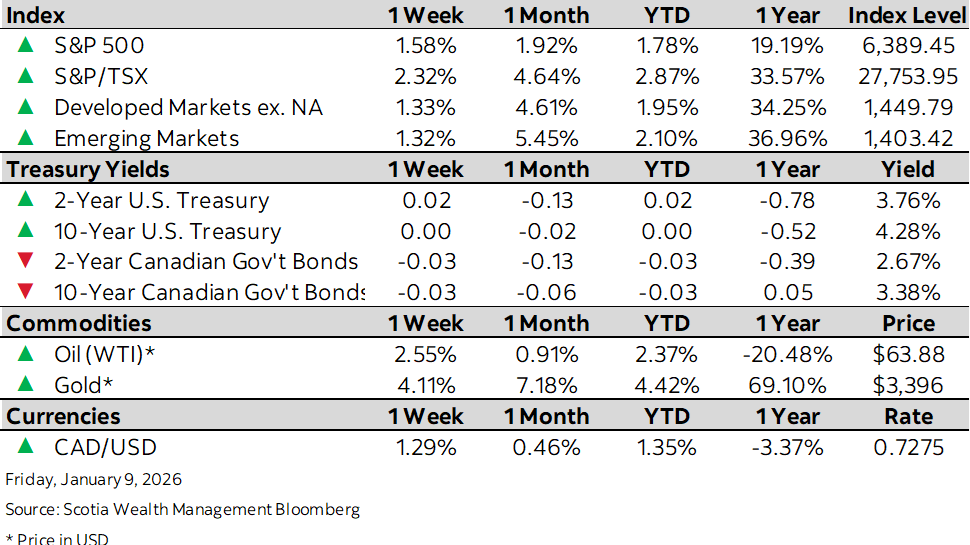
U.S. equities started the week firmer on tech leadership and AI momentum, but mid‑week softer ADP and mixed ISM prints, plus shifting Federal Reserve‑cut (Fed) odds, sapped risk appetite; crude swung on Venezuela headlines and tariff talk but was otherwise relatively stable, while a stronger USD and haven flows periodically pressured stocks. In Canada, early gains faded as higher yields and commodity volatility weighed; labour‑market uncertainty and a steady CAD near 1.38 vs. USD kept risk‑taking measured, with energy moves tied to Venezuela and global supply headlines influencing sentiment more than domestic data.  In Europe, inflation undershot in Germany and the broader bloc, briefly supporting rates, yet equities wavered as defense names rallied on geopolitics, while subdued European Central Bank‑easing (ECB) expectations and mixed country moves constrained follow‑through. Asia opened softer despite optimism surrounding chip manufacturers and policy hopes, then cooled as oil/trade noise and property overhang reasserted. Emerging market FX resilience limited USD upside but did little to offset growth and commodity uncertainties.

Highlights:

  • U.S. equities returned 1.58%1 as tech and AI optimism lifted stocks early, then weaker ADP and mixed ISM shifted focus to a patient Fed path. Oil whipsawed on Venezuela supply chatter and tariff proposals, with a firmer USD and haven bids tempering risk.
  • Canadian equities returned 2.32%2, tracking early global strength before yields and commodity swings tightened risk. CAD drifted weaker as crude responded to Venezuela and Russia‑oil tariff talk, while labour data and Bank of Canada (BoC) expectations kept positioning conservative amid macro cross‑currents..
  • European stocks rose 1.33%3 with softer German/Eurozone inflation supporting rates but leaving equities mixed; defense rallied on geopolitics, offsetting weakness elsewhere. Limited ECB‑easing pricing and uneven country performance constrained upside despite stabilizing energy prices and modest macro beats..
  • Emerging markets were 1.32%4 despite early chip‑driven optimism fading as property risks resurfaced and commodity headlines-especially Venezuela’s role and tariff threats-complicated the outlook. EM FX steadiness capped USD gains, yet growth and supply‑chain uncertainties kept equity momentum in check.

Rates swing on softer inflation and labour data

U.S. rates began the week slightly lower on geopolitical tension but reversed as mixed economic data shaped Fed expectations. Softer ISM manufacturing and ADP employment initially supported a bull flattening, while stronger ISM services and resilient wage growth later tempered cut bets, leaving markets pricing roughly two reductions for 2026. Canadian yields tracked U.S. moves, dipping midweek on risk aversion before edging higher as labour data overshot expectations and BoC hike probabilities nudged up. In Europe, softer inflation prints briefly reinforced disinflation trends, pulling bund yields lower, though hawkish ECB rhetoric kept easing expectations muted. Asian curves were steady, with Japan seeing mild upward pressure amid ongoing debate over gradual normalization, while emerging markets absorbed commodity volatility without significant rate repricing.

Highlights:

  • The 2-Year U.S. Treasury yields rose 2 basis points (bps) while the 10-Year was flat. In Canada, the 2- and 10-year yields were both down 3 bps. Bond yields and prices move inversely to one another.
  • Government bond yields moved lower early in the week on geopolitical risk and weak U.S. manufacturing data, then partially reversed as stronger services and wage figures tempered expectations for aggressive rate cuts. U.S. and Canadian rates finished lower for the week after mixed U.S. labour data on Friday.
  • Both Investment-grade and High Yield spreads tightened for the week, the former on steady issuance and the latter on softening risk appetite, geopolitical headlines and uneven macro data, though tech optimism and solid fundamentals limited broader deterioration.

Weekly dashboard


Canada reports trade deficit as share of U.S. exports hits non-pandemic low

Canada recorded a smaller-than-expected trade deficit in October and the share of exports to the United States fell to its lowest ever non-pandemic level, official data indicated. Statistics Canada (StatCan) recorded a deficit of $583 million as imports increased at a greater pace than exports. Analysts had expected a $1.36 billion deficit. StatCan revised September’s surplus up to $243 million from an initial $153 million.

Highlights:

  • Exports to the United States ⁠dipped 4.1% while imports increased 5.3%. As a result, Canada’s ⁠trade surplus with its neighbour fell to $4.8 billion from $8.4-billion in September.
  • Exports to non-U.S. nations jumped 15.6% to reach a record high, pushed up by shipments of gold to Britain and oil to China.
  • After falling 4.3% in September, the value of total imports rose 3.4% in October. Imports of electronic and electrical equipment and parts jumped 10.2%, pushed up by record shipments of computers and computer peripherals.

U.S. job gains cooled in December, capping year of weak hiring

United States employers hired at a moderate pace in December, closing out a year that saw the U.S. labour market cool into a “low hire, low fire” stasis. American employers added a seasonally adjusted 50,000 jobs in December and the unemployment rate fell to 4.4%, the Labor Department reported. That was below the 73,000 new jobs that economists had expected to see and was weaker than the revised 56,000 jobs added in November.

Highlights:

  • October’s job losses were revised even lower in the latest report, to a decline of 173,000. November’s job gains were also revised down, meaning employment was 76,000 lower than previously reported in those two months.
  • December’s report closes out a year in which demand for labour slowed markedly and companies reined in hiring. In 2025, job creation sputtered, wage growth cooled and the unemployment rate rose.
  • Much of the job creation that took place in 2025 was concentrated in two sectors: education and health services.

Eurozone manufacturing slips deeper into contraction at year-end, PMI shows
Eurozone factory activity retreated further into contraction territory in December as production decreased for the first time in 10 months, dampened by accelerating declines in new orders. According to S&P Global, the Eurozone manufacturing purchasing managers’ Index (PMI) fell to 48.8 in December from 49.6 in November, marking its lowest reading in nine months and lower than a preliminary estimate of 49.2. The output subindex dropped to 48.9 from November’s 50.4, marking its first contraction since February.

Highlights:

  • New orders fell at the quickest pace in almost a year, with export demand decreasing at the fastest rate in 11 months.
  • Germany, the bloc’s largest economy, recorded the weakest performance with its PMI reading hitting a 10-month low, while Italy and Spain also slipped back into contraction territory. France provided a rare bright spot, with its manufacturing PMI jumping to a 42-month high.
  • Supply chain pressures re-emerged for factories, with vendor delivery times increasing to the longest since October 2022. This contributed to input cost inflation accelerating to a 16-month high.