
Subscribe to the 100% free rdnewsNOW daily newsletter!
sponsored

Market Watch – Aug. 2, 2025

Aug 5, 2025 | 11:41 AM

This week’s highlights

  • Barrage of central bank decisions, economic data and tariffs push markets lower
  • Short-term U.S. Treasury yields decline as market anticipates rate cut in the fall
  • Bank of Canada holds key rate, says economy weathered tariffs better than expected
  • U.S. economy rallies in second quarter, with higher-than-expected GDP growth of 3%
  • Eurozone economy shows signs of resilience even as tariffs bite

Week in review

Barrage of central bank decisions, economic data and tariffs push markets lower

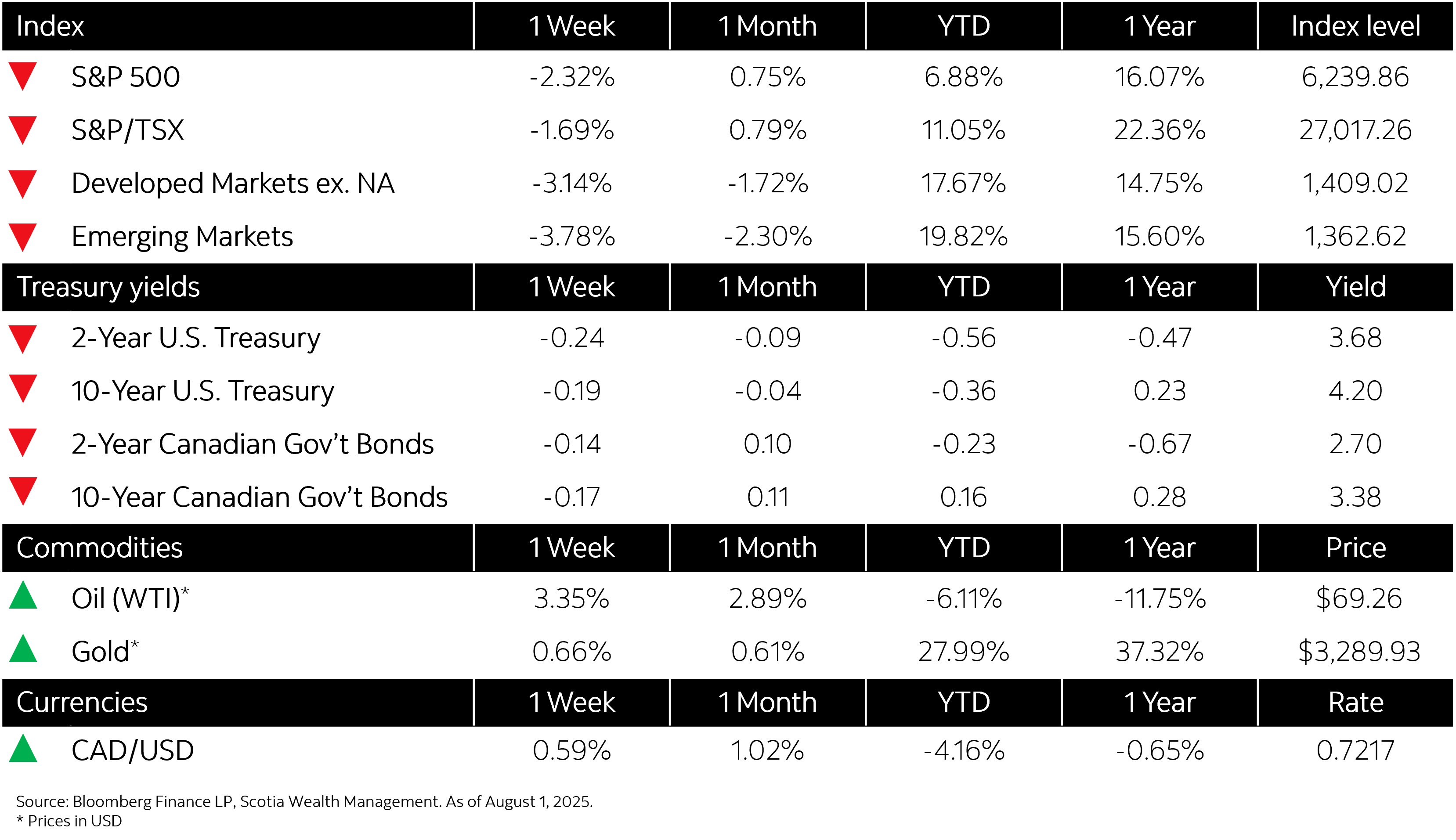
Global markets began the week bracing for an exceptionally busy week dominated by tariffs, a slate of major central bank decisions and first-tier economic data. By the end of the week, markets slid after the U.S. slapped dozens of trading partners with increased tariffs. In the U.S., the U.S. Federal Reserve (Fed) held rates steady while gross domestic product (GDP) surprised with a Q2 reading of 3.0%. Personal Consumption Expenditures Price Index (PCE) rose, underscoring the Fed’s worries about sustainably bringing back inflation towards its 2% target. Friday’s U.S. job report showed hiring slowed in July, a signal that pockets of weakness that had been marring the labour market are starting to take hold. U.S. markets ended the week in the red. In Canada, equities also ended in negative territory. The Bank of Canada (BoC) kept its overnight rate unchanged, and GDP edged down in May. Late Thursday, U.S. President Donald Trump signed an executive order increasing duties on Canadian goods 10 percentage points to 35% for all products not covered by the U.S.-Mexico-Canada trade agreement. European markets were down despite the EU signing a trade deal with the U.S. While the EU avoids the 30% tariffs, it still leaves a significant 15% duty on exports to the U.S. Preliminary GDP data showed eurozone resilience, increasing 0.1% in Q2, despite the uncertainty over tariffs. In Asia, Japanese equities were lower as the Bank of Japan held it monetary policy rate at 0.50% and estimated growth forecasts for the country remain modest.

Highlights:

  • U.S. equities returned -2.32%1, despite strong headline Q2 GDP data along with Microsoft and Meta both delivering earnings beats driven by cloud and AI momentum. Gains were hindered by Amazon reporting weaker than expected margins from Amazon Web Services while also issuing lower than expected earnings guidance and sharp revisions to U.S. jobs numbers for May and June, while July’s figures fell short of expectations.
  • Canadian markets returned -1.69%2 after the U.S. increased duties on Canadian goods and the BoC kept interest rates steady at 2.75%. Also, Statistics Canada reported real GDP edged down in May but its preliminary guidance shows a light increase in June, hinting at a resilient but stagnant Canadian economy last quarter.
  • European markets returned -3.14%3, rising early on possible trade clarity after the EU signed a trade deal with the U.S., but sentiment turned as markets digested the potential economic implications of the 15% tariff rate. Further hindering European markets was Novo Nordisk, one of the region’s largest companies by market cap, reporting weaker-than-expected obesity drug sales as well as lower forward guidance.
  • Emerging markets declined -3.78%4, with Chinese leaders signalling they would refrain from rolling out more major stimulus for now, as authorities pivot to addressing excess capacity in the economy.

Short-term U.S. Treasury yields decline as market anticipates rate cut in the fall

U.S. rates were lower early in the week prior to the Fed rate announcement, before reversing higher following surprising GDP numbers and in-line PCE data. They ended the week lower however after the release of U.S. jobs data for July fell short of expectations led investors to increase the chances of a Fed rate cut in the fall. Canadian yields also moved downward with weaker GDP data strengthening the case for a rate cut from the Bank of Canada. In Europe, short-term rates increased following the latest inflation numbers for France and Germany that were in-line with consensus and modest GDP numbers.

Highlights:

  • The 2-year U.S. Treasury yield dropped 24 basis points (bps) while the 10-year yield fell 19 bps. In Canada, the 2-year yield fell 14 bps while the 10-year was down 17 bps. Bond yields and prices move inversely to one another.
  • In keeping rates unchanged, the Fed referenced “solid” expansion and removed reference to falling uncertainty, forcing markets to lower expectations of a rate cut in September.
  • One day later, weak jobs data saw markets reverse course with investors now anticipating at least a 25 bp cut this fall
  • A tightening of spreads to begin the week gave way to wider spreads to end the week as the market backdrop deteriorated. Looking ahead, August investment grade average returns have been effectively flat over the last decade. With spreads at near historically tight levels, the onus is on rates to do the heavy lifting of price gains, in addition to about 40bps of coupon income, according to data compiled by Bloomberg.

Weekly dashboard

Bank of Canada holds key rate, says economy weathered tariffs better than expected

The Bank of Canada (BoC) held its policy interest rate steady for the third consecutive time, noting that the Canadian economy has weathered U.S. tariffs better than expected while uncertainty remains pervasive. As widely anticipated, the central bank’s governing council voted to keep the benchmark interest rate at 2.75%, where it has been since March. Governor Tiff Macklem said there was a “clear consensus” to hold the rate steady, but suggested the door remained open to additional rate cuts if needed.

Highlights:

  • “If a weakening economy puts further downward pressure on inflation and the upward price pressures from the trade disruptions are contained, there may be a need for a reduction in the policy interest rate,” he said, according to prepared press conference remarks.
  • As in April, the bank decided not to publish a central forecast in its quarterly Monetary Policy Report (MPR). Instead, it outlined potential scenarios for inflation and economic growth that depend on the trajectory of Mr. Trump’s global trade war and Ottawa’s ongoing negotiations with Washington.
  • “The lack of a conventional forecast does not impede our ability to take monetary policy decisions,” Macklem said. “But the unusual degree of uncertainty does mean we have to put more weight on the risks, look over a shorter horizon than usual, and be ready to respond to new information.”

U.S. economy rallies in second quarter, with higher-than-expected GDP growth of 3%

The U.S. economy returned to growth in the second quarter after contracting in the first, largely due to trade swings. The U.S. Commerce Department reported U.S. gross domestic product, the value of all goods and services produced across the economy, rose at a seasonally and inflation adjusted 3.0% annual rate in the second quarter. The reading exceeded the 2.3% growth that economists expected.

Highlights:

  • Over the first six months of the year, the economy grew, but at a much more modest pace than last year: at a 1.2% annual rate. That was slower than 2.5% growth in 2024, measured from the fourth quarter of the prior year, and comes as the economy has grappled this year with stop-start tariff policies, a nosedive and partial recovery in consumer sentiment and worker deportations.
  • While consumers continue to be supported by a strong labour market, weakness in business investment is likely to continue in the third quarter due to ongoing trade disputes.
  • Although the U.S. economy returned to growth, there are soft spots beneath the positive headline number, which was boosted by a big drop in imports. Consumer spending, the engine of the U.S. economy, strengthened, while business investment weakened.

Eurozone economy shows signs of resilience even as tariffs bite
The eurozone economy slowed in the three months through June, but showed a resilience that suggests it could recover in the months ahead despite the higher tariffs its exports now face in the U.S. Gross domestic product in the 20-nation currency union grew 0.1% over the quarter, European Union figures showed. That marks a slowdown from the 0.6% growth the eurozone booked in the first quarter of the year. On an annualized basis, the eurozone economy expanded by 0.4%, down from 2.3% in the first quarter.

Highlights:

  • The eurozone economy avoided the contraction that was forecast by many economists, further evidence of the resilience displayed by the global economy during a time of great uncertainty about U.S. trade policy.
  • The slowdown in eurozone output between the two quarters points to the effect of frontloading as U.S. firms rushed to stock up ahead of April’s tariff announcement by U.S. President Trump, with a reverse effect in the months following that announcement.
  • But with EU leaders having reached a trade deal with the U.S., the eurozone economy could recover some momentum in the second half of the year. European companies now have a better, if not yet entirely clear, view of what duties to expect on their U.S. exports.