
Subscribe to the 100% free rdnewsNOW daily newsletter!
sponsored

Market Watch: April 4, 2025

Apr 7, 2025 | 10:19 AM

This week’s highlights

  • Equity markets on the backfoot as tariffs shake up global trade
  • Sovereign yields move lower, credit spreads widen amid broad risk-off sentiment
  • Canadian factory PMI hits 15-month low on widening global trade war
  • U.S. hiring defied expectations in March, with 228,000 new jobs
  • Eurozone inflation falls close to target, but price pressures remain

Week in review

Equity markets on the backfoot as tariffs shake up global trade

As investors braced for the tariff announcement on Wednesday, U.S. equity markets were initially influenced by declining business optimism and capital spending expectations, but saw a dramatic downturn on Thursday and Friday following the implementation of significant new tariffs. A baseline 10% tariff on imports was applied to most countries, with additional reciprocal tariffs targeting specific nations heavily, such as China (54% combined rate), Japan (24%), and the EU (20%). Despite being spared from additional tariffs, Canadian markets faced pressure from trade uncertainty and a sharp job loss, leading to increased bets on an April rate cut. In Europe, inflation moderated, easing domestic cost pressures, but the new U.S. tariffs weighed heavily on equities. China and emerging markets were impacted by retaliatory tariffs and export controls, with China imposing a 34% tariff hike on U.S. goods and restricting imports of certain items, leading to negative sentiment in equity futures. Overall, global markets experienced heightened volatility driven by the new trade policies and economic data releases.

Highlights:

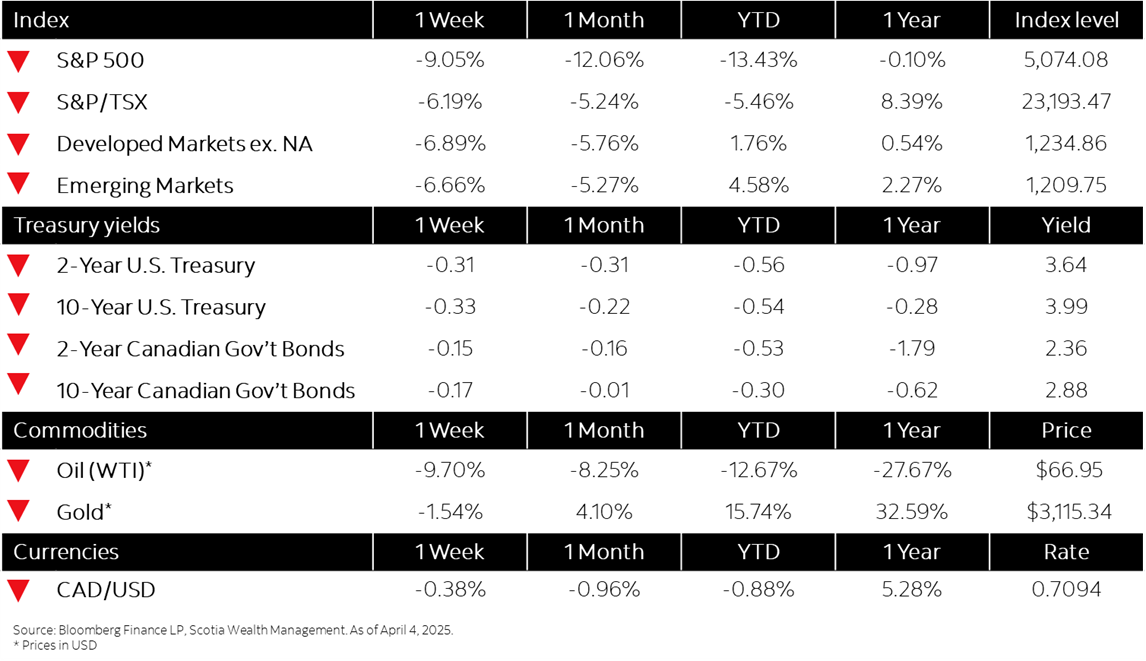
  • U.S. markets returned -9.05%1 for the week after a dramatic downturn following the implementation of significant new tariffs, leading to heightened market volatility and investor concerns about the impacts of a broader trade war.
  • Canadian markets returned -6.19%2 for the week facing pressure from trade uncertainty and a sharp job loss which led to increased bets on an April rate cut by the Bank of Canada.
  • European markets returned -6.89%3 for the week, initially buoyed by easing inflation and hopes of policy easing, but the new U.S. tariffs weighed heavily on equities, particularly in export-heavy economies like Germany, contributing to overall market volatility.
  • Emerging markets closed -6.66%4 lower, impacted by retaliatory tariffs and export controls, with China imposing a 34% tariff hike on U.S. goods, leading to negative sentiment in equity futures and concerns about the broader economic implications of the trade conflict.

Sovereign yields move lower, credit spreads widen amid broad risk-off sentiment

U.S. and Canadian rates moved lower throughout the week, driven by a broad selloff in risk assets and accelerating safe-haven flows into sovereign debt following the implementation of significant new tariffs on Wednesday. European yields also declined amid easing inflation and the impact of U.S. tariffs. Credit spreads widened, with high yield (HY) premiums approaching last summer’s highs and investment grade (IG) spreads also moving higher. The impact of tariffs on Canadian exports was felt as February international trade turned negative, significantly missing estimates. Overall, fixed income markets experienced heightened volatility and widening spreads due to the new trade policies and economic data releases.

Highlights:

  • The 2- and 10-year U.S. Treasury yields were 31 basis point (bps) and 33 bps lower, respectively. In Canada, the 2- and 10-year yields were 15 bps and 17 bps lower, respectively. Bond yields and prices move inversely to one another.
  • The Bank of Canada is expected to cut rates due to economic pressures and flagging labour market, while the Federal Reserve is likely to hold rates steady amid resilient U.S. job growth and inflation expectations.
  • Yields are trading close to a nine-month high of about 8.0% for HY with triple-C debt reaching 11.5%. Primary markets remained shut throughout the latter half of the week as investors stayed on the sidelines.

Weekly dashboard

Canadian factory PMI hits 15-month low on widening global trade war

Canadian manufacturing activity contracted at a steeper rate in March as a widening global trade war triggered the sharpest decline in new orders since shortly after the start of the COVID-19 crisis. The S&P Global Canada Manufacturing Purchasing Managers’ Index (PMI) fell to 46.3 from 47.8 in February, touching its lowest level since December 2023. A reading below 50 indicates contraction in the sector.

Highlights:

  • “Unsurprisingly, export trade suffered especially, and firms are growing increasingly pessimistic about the outlook, typically now expecting to see output decline from present levels over the coming year,” said Paul Smith, economics director at S&P Global Market Intelligence. “Adding to the gloomy picture, and again a direct consequence of trade tariffs, inflationary pressures have picked up.”
  • The output index fell to 45.7 from 47.5 in February, and the new orders measure was at 42.3, its lowest level since May 2020. Canada sends about 75% of its exports to the United States.
  • The measure of future output fell to 45.1, its lowest level in data going back to July 2012, while the input price index was at 63.6, up from 58.9 in February and its highest level since August 2022.

U.S. hiring defied expectations in March, with 228,000 new jobs

U.S. employers added jobs in March at a much stronger pace than expected, a sign that the labour market remained strong despite economic uncertainty, government layoffs and market turbulence. The U.S. added 228,000 jobs last month, the U.S. Labor Department reported, well above the gain of 140,000 jobs that economists had expected. That was also well above the average monthly gain of 158,000 over the prior 12 months. However, job gains for January and February were revised lower.

Highlights:

  • Services-sector hiring picked up in March after a period of winter weakness in industries like leisure and hospitality. Healthcare added 54,000 jobs, including jobs at hospitals and nursing facilities. The transportation sector also had strong growth, adding jobs for couriers and messengers and in truck transportation.
  • Economists said that while the strong report offered some relief about the recent state of the U.S. labour market last month, that is likely to be upended by the new tariff uncertainty.
  • The Department of Government Efficiency’s federal government layoffs were a modest drag on payrolls. Federal government employment declined by just 4,000 in March after dropping 11,000 in February.

Eurozone inflation falls close to target, but price pressures remain
The eurozone’s annual inflation rate edged closer to the European Central Bank’s (ECB) target in March as the currency area’s unemployment rate fell to a fresh record low. Consumer prices were 2.2% higher in March than in the same month last year, and the inflation rate was down from 2.3% in February, the European Union’s statistics body reported. That was in line with economists’ expectations.

Highlights:

  • Services inflation fell markedly to 3.4% over the month, from 3.7% in February, pointing to cooling in an area where prices had previously continued to rise rapidly.
  • Despite the 2% target being all but reached, the ECB may choose to hold off on rate cuts amid heightened uncertainty about the scale and focus of U.S. tariff increases.
  • There are also signs that the jobs market remains tight, with Eurostat also reporting that the eurozone’s unemployment rate fell to 6.1% in February from 6.2% in January, reaching a new record low.