Subscribe to the 100% free rdnewsNOW daily newsletter!
Sponsored

Market Watch: May 17

May 21, 2024 | 10:56 AM

This week’s highlights

  • Positive inflation reading buoys equity markets
  • Sovereign yields move lower on inflation data
  • Canadian wholesale sales down 1.1% to $81.4 billion in March
  • U.S. inflation eases as core prices post smallest increase since 2021
  • Bank of England leaves interest rates unchanged, signals it’s closer to cutting
  • In the news: U.S. hikes tariffs on Chinese imports in strategic industries

Week in review

Positive inflation reading buoys equity markets

Global equity market performance this week was, unsurprisingly, largely defined by a mid-week rally following a lower-than-expected U.S. inflation reading. Most major indices were fairly quiet and trading sideways until the April Consumer Price Index (CPI) report was released on Wednesday which prompted a risk-on rally. The rally had a particularly outsized effect on the more interest rate sensitive info tech sector which was evidenced by the Dow Jones crossing the symbolic 40,000 level. While the current rally has had some setbacks as investors look for any indication as to when the U.S. Federal Reserve (Fed) might cut interest rates, the combination of continued – albeit slower – economic growth and gradual progress on inflation continues to provide fuel for the rally.

Highlights:

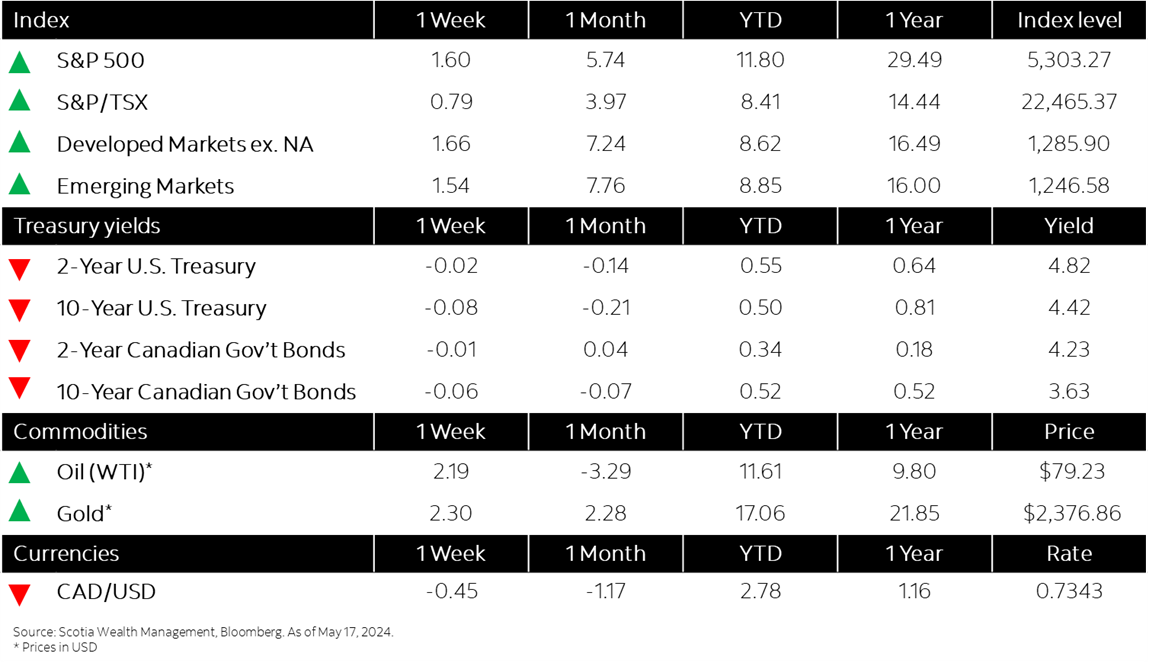
  • U.S. markets returned 1.60%1 for the week, largely due to strong performance from the info tech sector on rate cut optimism and corporate earnings growth.
  • Canadian markets returned 0.79%2 for the week as gains in the materials sector were offset by losses in industrials. Health care was also a strong performer for the week following cannabis reclassification in the U.S. but had a minimal impact on overall returns due to its small weight in the index.
  • European markets rallied throughout most of the week on softer-than-expected U.S. inflation data but wound up giving back some of their gains after a few disappointing earnings reports which left the index up 1.66%3.
  • Despite a fresh round of U.S. tariffs on Chinese goods, emerging markets closed 1.54%4 higher after China began allowing local governments to purchase real estate and cut interest rates and down-payment ratios for homebuyers.

Sovereign yields move lower on inflation data

U.S. Treasury yields were little changed late-week after Thursday’s selloff saw bonds give up most of the gains booked earlier in the week in the run up to Wednesday’s CPI report. On the credit side, spreads continued to trade historically tight across all credit rating buckets. Of note, the difference in the spread level between BBB and BB ratings is now only 74 basis points (bps), the lowest level since early 2020, highlighting investor confidence and their willingness to pay a premium for bonds in anticipation of future rate cuts. The coming week is relatively busy in terms of macro releases with Manufacturing and Services PMI (Purchasing Managers Index) readings, FOMC (Federal Open Market Committee) minutes, followed by durable goods orders and the final University of Michigan sentiment reading for May.

Highlights:

  • The 2- and 10-year year U.S. Treasury yields fell 2 basis points (bps) and 8 bps, respectively, while the 2- and 10-year Canadian yields were down 1 bps and 6 bps, respectively.
  • Investors see less than 1.0% additional compensation to hold the top-rated high yield debt (BB) relative to the lowest rated investment grade debt (BBB), compared to the ten-year average of around 130 bps.

Weekly dashboard

Canadian wholesale sales down 1.1% to $81.4 billion in March

Statistics Canada (StatCan) reported wholesale sales, excluding petroleum, petroleum products, and other hydrocarbons and oilseed and grain, fell 1.1% to $81.4 billion in March. The agency says the overall decline came as sales were down in three of the seven subsectors it tracks. StatCan started including oilseed and grain as well as the petroleum and petroleum products subsector as part of wholesale trade last year but is excluding the data from monthly analysis until there is enough historical data.

Highlights:

  • The motor vehicle and motor vehicle parts and accessories subsector posted the largest drop, with sales falling 5.8% to $13.4 billion in March. The motor vehicle industry group dropped 7.0% to $10.6 billion as several auto plants undertook retooling work, while the new and used motor vehicle parts industry group fell 1.2% to $2.7 billion.
  • The miscellaneous subsector fell 5.0% to $10.2 billion in March, while the machinery, equipment and supplies subsector rose 1.6% to $17.9 billion.
  • In volume terms, wholesale sales, excluding petroleum, petroleum products, and other hydrocarbons and oilseed and grain, fell 1.2% in March.

U.S. inflation eases as core prices post smallest increase since 2021

U.S. inflation eased slightly in April, offering relief to investors and the Fed after a run of economic data at the start of the year revealed simmering price pressures. The CPI, a gauge for goods and service costs across the U.S. economy, rose 3.4% in April from a year ago, the U.S. Labor Department reported. Core prices that exclude volatile food and energy items climbed 3.6% annually, the lowest increase since April 2021. The inflation data should also allow officials at the Fed to breathe more easily as it suggests prices and economic activity aren’t reaccelerating. A separate report released the same day showed retail sales were flat in April, reaffirming that hypothesis.

Highlights:

  • Gasoline prices pushed up overall inflation, while consumers continued paying more for housing in April. But year-over-year rent increases slowed from a month earlier, a key sign for economists that a big driver of inflation in recent years is easing.
  • Grocery and vehicle costs also edged lower in April from the previous month, while price increases for medical care decelerated.
  • Most economists expect the Fed to cut interest rates this year but are divided over when because it will likely take another two reports to shore up officials’ confidence that inflation can return to the lower levels that prevailed before the pandemic. Many expect the Fed might not be ready to cut interest rates before September.

Bank of England leaves interest rates unchanged, signals it’s closer to cutting

The Bank of England (BoE) kept its key interest rate unchanged at a 16-year high but indicated that it is on course to cut rates over the coming months alongside its European peers, and possibly as early as June. The U.K.’s central bank left its key rate at 5.25% for the sixth straight meeting of its policymakers, in line with what investors and economists had been expecting. But in a fresh sign that a move is getting closer, two of the nine members of its Monetary Policy Committee voted to lower the key rate to 5%.

Highlights:

  • Inflation in the U.K. has fallen steadily over recent months, and the BoE said it could likely hit its 2% target in April. Official figures will be released on May 22.
  • Ahead of the BoE announcement, investors saw August as the most likely month for a first cut, with two further moves by mid-2025 and additional reductions to 3.75% by the second quarter of 2027. But BoE Governor Andrew Bailey said the central bank may move faster.
  • Policymakers are increasingly confident that growth can pick up without pushing inflation above its target as there are signs it is cooling and is closely watching inflation and jobs releases for signs of further easing as they judge when to make their first cut.

In the news: U.S. hikes tariffs on Chinese imports in strategic industries

In an effort to protect strategic industries, U.S. authorities this week announced a steep hike in tariffs on a number of Chinese imports including electric vehicles, solar cells, semi conductors and advanced batteries. The move comes in response to what the U.S. deemed “unfair trade practices”; China’s rapid capacity expansion flowing from state-investments in strategic industries threatens to undermine market driven firms which don’t benefit from the same level of subsidies, if any. The move has faced push back from various U.S. commerce groups as well as from China’s commerce ministry which has said the new tariffs would “severely affect the atmosphere for bilateral cooperation” while criticizing the politicization of economic issues. Even as persistent inflation weighs on the economy, the move signals a sea change in the U.S.’ trade views which have long favored tariff-free global commerce towards one that is willing to accept higher prices in exchange for protecting domestic companies and jobs.

Behind the headline:

  • Tariffs that were put in place on more than $300bn USD worth of goods by the former administration will be maintained with an additional $18bn USD falling under the scope of the new tariffs.

Tariff figures on specific industries will be as follows:

  • Steel and aluminium: 0-7.5% to 25%
  • Semiconductors: 25% to 50%
  • Electric vehicles: 25% to 100%
  • Batteries and battery components: 7.5% to 25%
  • Solar cells: 25% to 50%

Overdue Mean Reversion?

This week’s risk dashboard:

  • Mean reversion on the Canada-US inflation spread is getting overdue
  • Canadian CPI could face upside risk
  • The BoC should be far more patient
  • Will China further compress a key loan spread?
  • FOMC minutes likely to be stale on arrival
  • Eurozone negotiated wages to inform ECB pricing
  • UK CPI one of two prints before the June BoE
  • Tumbling Japanese core inflation is a warning sign to the BoJ
  • Canadian retail sales are not that bad

Read the full publication here.

  • A light week for US macro risk
  • Chile’s economy is expected to rebound
  • Chile’s central bank could follow the downshifting LatAm pattern
  • RBNZ may lean against market pricing
  • BoK could stare down won gains
  • BI likely to hold after surprise hike
  • Turkey’s volatile central bank expected to hold
  • PMIs: EZ, UK, Japan, Au, US, India
  • Global macro

1 S&P 500 Index CAD
2 S&P/TSX Composite Index CAD
3 Bloomberg Developed Markets ex N. America Large & Mid Cap Price Return Index CAD
4 Bloomberg EM Large & Mid Cap Price Return Index CAD

Subscribe to our FREE newsletter, and download the rdnewsNOW mobile app on Google Play and the Apple App Store for all the latest updates on this and other stories.