
Subscribe to the 100% free rdnewsNOW daily newsletter!
OLYMPUS DIGITAL CAMERA
Sponsored

Market Watch: November 3

Nov 6, 2023 | 4:15 PM

This week’s highlights

  • Positive market sentiment pushes global indices higher
  • Yields move lower following rate decision, employment data
  • Canada’s economy flatlined in August, minor contraction seen in third quarter
  • Fed extends pause on interest-rate hikes but keeps door open to higher rates
  • Eurozone inflation drops sharply amid energy deflation, economic contraction
  • In the news: Vaccine makers face write-offs as demand for pandemic products wanes

Week in review

Positive market sentiment pushes global indices higher

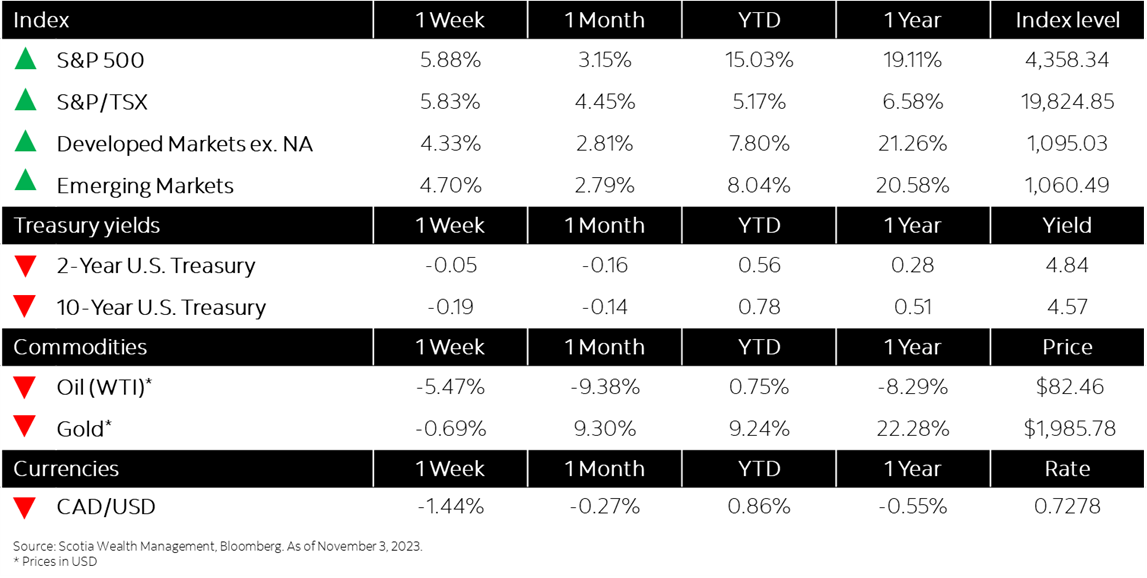
Following several weeks of losses, equity markets had one of their best sessions in the past year as investor sentiment turned positive following the U.S. Federal Reserve rate hike pause and weaker U.S. unemployment data. Signs of economic slowdown have been constructive for markets as they increase the likelihood that policymakers will take their foot off the brakes and either keep interest rates on hold or even possibly cut them should the economic backdrop deteriorate further.

Highlights:

  • U.S. markets closed 5.88 per cent1 higher for the week after the Fed chose to not raise interest rates and employment figures came in lower than expected, lowering the odds of future rate hikes.
  • Canadian markets rose 5.83 per cent2 for the week as investors took comfort in the Fed’s rate pause and a number of better-than-expected earnings reports which helped push the index well into the black.
  • Despite a drag from shipping stocks due to lower revenue forecasts, European stocks rallied 4.33 per cent3 for the week, fueled by a string of strong earnings reports and a perceived dovish tilt from central banks.
  • Emerging markets benefitted from the global risk on sentiment as they repriced odds of further Fed hikes and fallout from the conflict in the Middle East, leaving markets 4.70 per cent4

Yields move lower following rate decision, employment data

U.S. Treasury yields pulled back Friday across the curve after employment data from the Bureau of Labor Statistics came in lower than expected, a sign that monetary policy is having the intended effect. The Fed also opted to not raise interest rates at its most recent meeting despite inflation continuing to run above its two per cent target. Following the most recent jobs data and pause in rate hikes, markets have further reduced the probability of a rate hike at the next Fed meeting in December to around 10 per cent. Credit spreads were soft later in the week, high yield (HY) in particular, after rallying on Thursday following the rate announcement.

Highlights:

  • The two-year U.S. Treasury yield fell five basis points (bps) while the 10-year yield was down 19 bps. In Canada, the two-year yield was down eight bps and 10-year yields 15 bps.
  • U.S. nonfarm payrolls increased by 150,000 in October against forecasts of 170,000, a significant decline from September’s gain of 297,000, and pushed the unemployment rate to 3.9 per cent.
  • Speculative credit spreads closed October at 437 bps, near Bloomberg’s model-implied tight end. Yearend estimates still point to wider levels of 422 to 614 bps, despite the recent rate reversal and risk-on sentiment.

Weekly dashboard

(Market Watch website)

Canada’s economy flatlined in August, minor contraction seen in third quarter

The Canadian economy flatlined in August, underperforming expectations, and likely contracted slightly in the third quarter, Statistics Canada (StatCan) reported. Analysts polled by Reuters had forecast a 0.1 per cent month-over-month rise in August. July gross domestic product (GDP) was revised to being marginally negative from an initial report of zero growth. StatCan said high-interest rates, inflation, forest fires and drought conditions weighed on the economy in August.

Highlights:

  • In a flash estimate, StatsCan said the economy was also unchanged in September, translating to an annualized 0.1 oer cent decline in the third quarter.
  • While likely to be revised, if those figures are confirmed next month, it would be the second consecutive quarter of negative growth after an unexpected contraction in the three months ended June.
  • The Bank of Canada recently lowered its third-quarter annualized GDP growth forecast to 0.8 per cent from 1.5 per cent projected in July. The central bank said its 10 rate hikes between March 2022 and July 2023 have slowed the economy, and GDP growth is expected to remain muted until the end of 2024.

Fed extends pause on interest-rate hikes but keeps door open to higher rates

The Fed left interest rates unchanged at a 22-year high and signalled rates would remain elevated well into next year to keep inflation moving down.

“The committee is proceeding carefully,” Fed Chair Jerome Powell said during a press conference. At the September meeting, most central bank officials projected one more rate increase this year, but some have spoken in recent weeks as though they aren’t eager to hike again unless hotter-than-expected economic data force them to. That is a change from earlier this year when they were more concerned about tightening too little.

Highlights:

  • Officials have been trying to balance two risks. They don’t want to overdo rate rises to avoid causing an unnecessarily severe downturn. They also don’t want to allow inflation to reaccelerate or to settle at levels well above their two per cent target.
  • Fed officials have now skipped a rate hike for two consecutive meetings, making it the longest period without an increase since March 2022. Since then, they have raised rates at the fastest pace in four decades.
  • The big questions for the Fed center on what officials are looking to see in the economy and what it would take for them to conclude they are moving in the right or wrong direction.

Eurozone inflation drops sharply amid energy deflation, economic contraction

Consumer prices are slowing more than expected in the eurozone, driven in part by falling energy prices but also by lower food and services inflation. The consumer price index, which measures how fast prices are rising in the 20-member euro area, stood at 2.9 per cent in October, dropping sharply from 4.3 per cent the month before and below economists’ expectations. Easing inflation will nevertheless add to the sense that the European Central Bank’s tight monetary policy is cooling demand in the currency union. The central bank decided last week to leave rates where they are after a cycle of successive hikes that took the key deposit rate to an unprecedented four per cent.

Highlights:

  • Inflation was brought lower notably by energy prices, which were 11 per cent lower in October compared with last year when price spikes from the Russia-Ukraine crisis resulted in natural gas supply shortages. In September, energy prices were 4.6 per cent lower on year.
  • Food inflation also continued to ease, reaching 7.5 per cent in October from 8.8 per cent the month before. Core inflation, a measure stripping out volatile food and energy prices, meanwhile eased to 4.2 per cent from 4.5 per cent, in line with expectations.
  • Inflation cooled across most of the zone’s major economies in October. In Germany, price rises eased to three per cent, while in France, they cooled to 4.5 per cent and in Italy to 1.8 per cent, bringing the latter country in line with European Central Bank targets.

In the news: Vaccine makers face write-offs as demand for pandemic products wanes
Once the darlings of pandemic investing, vaccine companies such as Pfizer and Moderna are reporting sizable write-offs related to vaccines, antivirals and paring back production capacity. The companies have been lowering earnings projections and announcing cost-cutting initiatives as demand remains soft, a move seen as necessary to shore up investor support as they attempt to navigate the decline of COVID-induced demand. Both Pfizer and Moderna are hoping to refocus investor interest towards their pipeline of non-COVID-related products as the pandemic becomes endemic.

Behind the headline:

  • Pfizer reported a $5.6 billion USD write-off for inventory as demand for its antiviral and COVID vaccines declined, while Moderna reported a $3.1 billion USD charge mainly due to tax allowances and downsizing of its manufacturing footprint.
  • While Pfizer didn’t manage to beat expected revenue ($13.2 billion reported vs. $13.43 billion expected), it did surprise to the upside on earnings per share (-$0.17 reported vs. -$0.34 expected). Moderna managed to beat revenue expectations ($1.83 billion reported vs. $1.38 billion expected) but surprised to the downside on earnings per share (-$9.53 reported vs. -$2.00 expected).
  • Pfizer and Moderna’s sales of Covid vaccines are down 70 per cent and 44 per cent, respectively, from the same period the prior year. Pfizer’s sales of Paxlovid are also significantly lower, with only $202 million in revenue, a 97 per cent drop.

1 S&P 500 Index CAD
2 S&P/TSX Composite Index CAD
3 Bloomberg Developed Markets ex N. America Large & Mid Cap Price Return Index CAD
4 Bloomberg EM Large & Mid Cap Price Return Index CAD

® Registered trademark of The Bank of Nova Scotia, used under licence. Scotia Wealth Management® consists of a range of financial services provided by The Bank of Nova Scotia (Scotiabank®); The Bank of Nova Scotia Trust Company (Scotiatrust®); Private Investment Counsel, a service of 1832 Asset Management L.P.; 1832 Asset Management U.S. Inc.; Scotia Wealth Insurance Services Inc.; and ScotiaMcLeod®, a division of Scotia Capital Inc. Private banking services are provided by The Bank of Nova Scotia. Estate and trust services are provided by The Bank of Nova Scotia Trust Company. Portfolio management services are provided by 1832 Asset Management L.P. and 1832 Asset Management U.S. Inc. Insurance services are provided by Scotia Wealth Insurance Services Inc. Wealth advisory and brokerage services are provided by ScotiaMcLeod, a division of Scotia Capital Inc. International investment advisory services are provided by Scotia Capital Inc. Financial planning services are provided by The Bank of Nova Scotia and ScotiaMcLeod. Scotia Capital Inc. is a member of the Canadian Investor Protection Fund and the Investment Industry Regulatory Organization of Canada. Scotia Wealth Insurance Services Inc. is the insurance subsidiary of Scotia Capital Inc., a member of the Scotiabank group of companies. When discussing life insurance products, ScotiaMcLeod advisors are acting as Life Insurance Agents (Financial Security Advisors in Quebec) representing Scotia Wealth Insurance Services Inc. Scotia iTRADE®(Order-Execution Only Accounts) is a division of Scotia Capital Inc. (“SCI”). SCI is a member of the Investment Industry Regulatory Organization of Canada and the Canadian Investor Protection Fund. Scotia iTRADE does not provide investment advice or recommendations and investors are responsible for their own investment decisions.

This publication has been prepared by Scotia Capital Inc. and is intended as a general source of information only and should not be considered as personal and/or specific financial, tax, pension, legal or investment advice. We are not tax or legal advisors and we recommend that individuals consult with their qualified advisors before taking any action based upon the information contained in this publication. Opinions and projections contained in this publication are our own as of the date hereof and are subject to change without notice. While care and attention has been taken to ensure the accuracy and reliability of the material in this publication, neither Scotia Capital Inc. nor any of its affiliates make any representations or warranties, express or implied, as to the accuracy or completeness of such material and disclaim any liability resulting from any direct or consequential loss arising from any use of this publication or the information contained herein. This publication and all the information, opinions and conclusions contained herein are protected by copyright. This publication may not be reproduced in whole or in part without the prior express consent of Scotia Capital Inc.