Subscribe to the 100% free rdnewsNOW daily newsletter!
Sponsored

Market Watch: October 27

Oct 30, 2023 | 2:19 PM

This week’s highlights

  • Dearth of negative news roils equity markets
  • Yields move slightly lower but remain high ahead of upcoming Fed rate announcement
  • Bank of Canada holds rates steady, trims forecast as inflation risks rise
  • U.S. economic growth accelerates as higher wages help boost consumer spending
  • Eurozone economic activity slides further in October
  • In the news: Tit-for-tat trade restrictions as U.S., China, EU tensions simmer

Week in review

Dearth of negative news roils equity markets

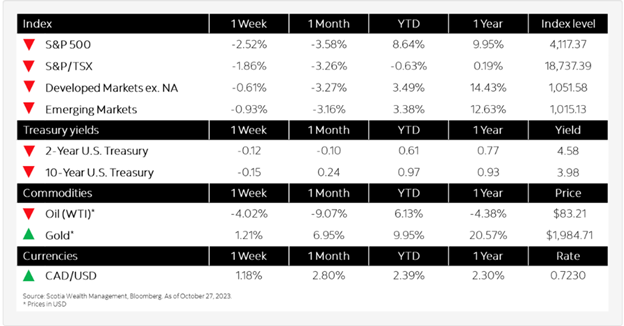
Equity markets the world over faced a week of slow, steady declines as concerns over additional rate hikes weighed on markets, particularly the energy, communication services and financials sectors. Disappointing earnings also impacted returns, with companies such as Ford and Chevron reporting lackluster earnings. High bond yields also contributed to the choppiness of equity markets as higher yields tend to make equities less attractive to investors.

Highlights:

  • U.S. markets closed -2.52%1 lower for the week. Core Personal Consumption Expenditures (PCE), the U.S. Federal Reserve’s (Fed) preferred gauge of inflation, accelerated to a four-month high of 0.3%.
  • Canadian markets fell -1.86%2 for the week as losses in energy, financials and utilities pushed the main index into the red despite the Bank of Canada holding rates steady.
  • European equities, particularly blue chip stocks, were punished due to excessive optimism amid weak growth forecasts and a number of companies missing earnings forecasts, leaving markets -0.61%3 lower for the week.
  • Emerging market losses once again deepened amid the risk-off sentiment following heightened tensions in the Middle East, closing -0.93%4 lower for the week.

Yields move slightly lower but remain high ahead of upcoming Fed rate announcement

Following the latest U.S. PCE reading on Friday Treasury yields were little changed but remained high. All measures came in as expected, but the monthly headline ticked up. The Fed is expected to hold rates steady at its next meeting and for the rest of the year, but higher gross domestic product (GDP) growth and inflation indicators may raise doubts on that moving forward. In addition to the Fed’s upcoming rate decision, ADP employment and non-farm payrolls are due to be released on Wednesday and Friday, respectively. Credit remained firm for the week, while primary supply came in well below projections. There may be some front-loaded issuance on Monday and Tuesday ahead of the Fed meeting.

Highlights:

  • The 2-year U.S. Treasury yield fell 12 basis points (bps) while the 10-year yield was down 15 bps. In Canada, the 2-year yield was down 25 bps and 10-year yields 19 bps.
  • The latest analysis from Bloomberg shows that the often-cited 40% recovery rate for high-yield defaults underestimates loss given defaults during periods of bankruptcy increases.
  • Looking at the past two decades, the experience shows that losses can be as high as 83% (17% recovery) at cycle peaks. The same appears to be true for recoveries from selective defaults that can run as low as 30%.

Weekly dashboard

(Supplied)

Bank of Canada holds rates steady, trims forecast as inflation risks rise

The Bank of Canada held interest rates steady this week while downgrading its forecast for economic growth and warning that inflationary risks have increased. The widely anticipated decision keeps the policy rate at 5%, the highest level in two decades. The bank said it was prepared to raise interest rates again if inflation remains stubbornly high. After 10 interest rate increases over the past year and a half, higher borrowing costs are weighing on consumer spending and business investment while pushing up unemployment. This slowdown means supply and demand in the Canadian economy are “now approaching balance,” the central bank said.

Highlights:

  • The bank upgraded its near-term forecast for inflation and warned that geopolitical uncertainty, notably the conflict in Israel and Gaza, could push up oil prices and feed through into broader inflation. The bank is estimating global oil prices will be around $10 higher over the next two years than in its July forecast.
  • The bank now expects the annual rate of inflation to average around 3.5% for the next year before falling back to it’s 2% target around the middle of 2025. Consumer Price Index inflation was 3.8% in September, down from a peak of 8.1% last summer.
  • The bank’s quarterly Monetary Policy Report, published alongside the rate announcement, revised the GDP growth forecast for 2023 down to 1.2% from 1.8%. It trimmed its 2024 GDP growth estimate to 0.9% from 1.2%.

U.S. economic growth accelerates as higher wages help boost consumer spending

The U.S. economy grew at its fastest pace in nearly two years in the third quarter as higher wages from a tight labour market helped to power consumer spending, again defying dire warnings of a recession that have lingered since 2022. GDP increased at a 4.9% annualized rate last quarter, the fastest since the fourth quarter of 2021, the U.S. Commerce Department’s Bureau of Economic Analysis reported. Economists had forecast GDP rising at a 4.3% rate.

Highlights:

  • Consumer spending, which accounts for more than two-thirds of U.S. economic activity, was the main driver. Consumer spending rose at an annual rate of 4.0% in the third quarter, jumping from a gain of 0.8% in the prior quarter and the largest increase since the fourth quarter of 2021.
  • A strong labour market has provided underlying support to spending. Though wage growth has slowed, it is rising a bit faster than inflation, lifting households’ purchasing power.
  • Most economists have revised their forecasts and now believe that the Fed can engineer a “soft-landing” for the economy, pointing to strength in worker productivity and moderation in unit labour cost growth.

Eurozone economic activity slides further in October

Business activity in the eurozone took an unexpected turn for the worse in October as demand plummeted in a broad-based downturn across the region, a recent survey showed. The S&P Global monthly poll of purchasing managers across the single currency zone fell to a 35-month low of 46.5 after a contraction of activity in both the services and manufacturing sectors. A chunk of October’s business activity was generated by firms completing backlogs of work, suggesting they don’t expect a turnaround anytime soon and overall headcount was cut for the first time since January 2021.

Highlights:

  • The Purchasing Manager’s Index (PMI) covering the bloc’s dominant services industry sank to a 32-month low of 47.8 from 48.7, below forecasts which had predicted no change from September.
  • Demand for services dropped at a sharper rate than in September. The new business index dropped to 45.5 from 46.4, its lowest since the start of 2021.
  • The manufacturing PMI fell to 43.0 from 43.4, marking its 16th month below 50 and the lowest since May 2020 when the pandemic was cementing its grip on the world. Forecasters had predicted 43.7.

In the news: Tit-for-tat trade restrictions as U.S., China, EU tensions simmer

Shoring up restrictions issued last year, the U.S. has imposed new export rules on specific chips and machinery used in the production of advanced semiconductors. Companies looking to export chips or machinery used in chip production to China or specific third-party countries often used as intermediaries will be required to either notify the government or obtain a special license. In response to these new rules, China has announced it will restrict exports of graphite, a key material used in the production of things such as EV batteries. The European Union in turn is weighing levying tariffs on Chinese-made EVs which they claim unfairly benefit from trade restrictions as well as direct subsidies to manufacturers.

Behind the headline:

  • The tighter restrictions are intended to limit China’s ability to develop advanced artificial intelligence and supercomputers which could be used in surveillance systems or to decipher military communications.
  • The move is expected to dampen revenues for chip makers such as Nvidia, AMD and Intel who earn as much as one-third of their revenue from Chinese buyers. Many of the restrictions will take effect in 30 days.
  • China refines ~90% of the world’s graphite and seems willing to leverage its dominance in the critical minerals supply chain as a bargaining tool as trade tensions continue to escalate.
  • Export restrictions of critical minerals such as graphite have the potential to benefit global producers who could step in to fill the void and benefit from higher prices as supply remains constrained.

1 S&P 500 Index CAD
2 S&P/TSX Composite Index CAD
3 Bloomberg Developed Markets ex N. America Large & Mid Cap Price Return Index CAD
4 Bloomberg EM Large & Mid Cap Price Return Index CAD

Important Information · Privacy Policy · Legal · Security Iconic Group
© 2023 The Bank of Nova Scotia. All rights reserved.

® Registered trademark of The Bank of Nova Scotia, used under licence. Scotia Wealth Management® consists of a range of financial services provided by The Bank of Nova Scotia (Scotiabank®); The Bank of Nova Scotia Trust Company (Scotiatrust®); Private Investment Counsel, a service of 1832 Asset Management L.P.; 1832 Asset Management U.S. Inc.; Scotia Wealth Insurance Services Inc.; and ScotiaMcLeod®, a division of Scotia Capital Inc. Private banking services are provided by The Bank of Nova Scotia. Estate and trust services are provided by The Bank of Nova Scotia Trust Company. Portfolio management services are provided by 1832 Asset Management L.P. and 1832 Asset Management U.S. Inc. Insurance services are provided by Scotia Wealth Insurance Services Inc. Wealth advisory and brokerage services are provided by ScotiaMcLeod, a division of Scotia Capital Inc. International investment advisory services are provided by Scotia Capital Inc. Financial planning services are provided by The Bank of Nova Scotia and ScotiaMcLeod. Scotia Capital Inc. is a member of the Canadian Investor Protection Fund and the Investment Industry Regulatory Organization of Canada. Scotia Wealth Insurance Services Inc. is the insurance subsidiary of Scotia Capital Inc., a member of the Scotiabank group of companies. When discussing life insurance products, ScotiaMcLeod advisors are acting as Life Insurance Agents (Financial Security Advisors in Quebec) representing Scotia Wealth Insurance Services Inc. Scotia iTRADE®(Order-Execution Only Accounts) is a division of Scotia Capital Inc. (“SCI”). SCI is a member of the Investment Industry Regulatory Organization of Canada and the Canadian Investor Protection Fund. Scotia iTRADE does not provide investment advice or recommendations and investors are responsible for their own investment decisions.

This publication has been prepared by Scotia Capital Inc. and is intended as a general source of information only and should not be considered as personal and/or specific financial, tax, pension, legal or investment advice. We are not tax or legal advisors and we recommend that individuals consult with their qualified advisors before taking any action based upon the information contained in this publication. Opinions and projections contained in this publication are our own as of the date hereof and are subject to change without notice. While care and attention has been taken to ensure the accuracy and reliability of the material in this publication, neither Scotia Capital Inc. nor any of its affiliates make any representations or warranties, express or implied, as to the accuracy or completeness of such material and disclaim any liability resulting from any direct or consequential loss arising from any use of this publication or the information contained herein. This publication and all the information, opinions and conclusions contained herein are protected by copyright. This publication may not be reproduced in whole or in part without the prior express consent of Scotia Capital Inc.