Sign up for our free daily newsletter!
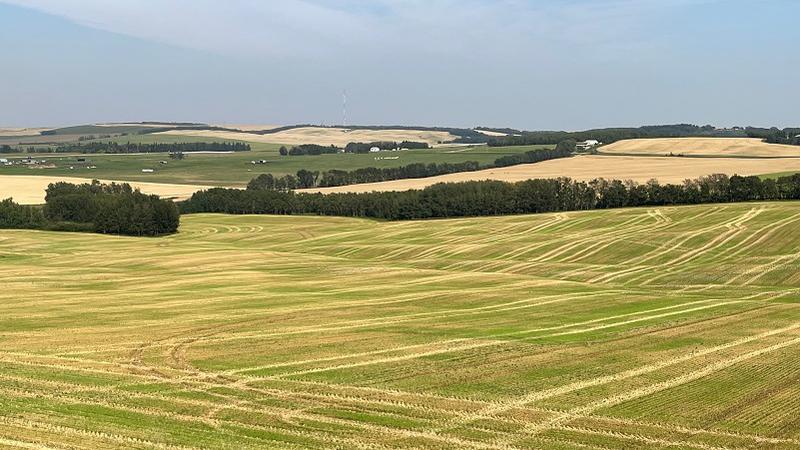
(rdnewsNOW/Sheldon Spackman)
Conditions As Of Sept. 5, 2023

Smoke and changing weather has slowed harvest throughout central Alberta

Sep 8, 2023 | 2:12 PM

Harvest is progressing well in most areas of central Alberta, though wide spread smoke and changing weather has slowed down maturing and progress in parts of the region.

According to the latest Crop Report from AFSC and the Government of Alberta, in the Central Region, 31 per cent of all crops are harvested, ahead of the 5-year average of 25 per cent.

Surface soil moisture conditions (sub-surface in brackets) is currently rated at 36 (37) per cent poor, 39 (35) per cent fair, 24 (29) per cent good, 1 (0) per cent excellent and 0 (0) per cent excessive.

Second cut hay is nearly complete at 88 per cent cut and baled. Yields are at 1.3 tons per acre, slightly below the 5- year average of 1.4 tons per acre. Pasture growth conditions (tame hay conditions in brackets) are rated as 37 (30) per cent poor, 35 (35) per cent fair, 28 (33) per cent good, and 1 (3) per cent excellent.

Officials say harvest has continued to progress quickly in regions where there are still dry conditions such as the southern half of the province. Progress remains slow in the North West and North East where cool and wet conditions have caused a delay in maturity, lodging and difficulty accessing fields.

Overall, 35 per cent of all crops are combined provincially, 8 and 9 per cent ahead of the 5-year and 10-year average, respectively. The majority of progress is from the South Region, which is 71 per cent complete, 20 per cent ahead of the 5-year average. The Central and Peace Region are also ahead of their historical averages as the Central Region progressed 12 per cent since last week to 29 per cent of major crops combined and the Peace Region progressed 17 per cent to be complete 24 per cent of major crops.

Provincially, combining of winter wheat, fall rye, dry peas and lentils are all over 85 per cent complete. As for the other major crops, such as spring wheat, barley, oats and canola, there is still over 50 per cent left to combine of each crop.

Crop quality estimates are starting to be reported and hard red spring wheat ratings are consistent with the 5-year average as 61 per cent is rating 1 CW. Durum is rating 52 per cent as 1 CW, down 9 per cent from the 5-year average. However, only 23 per cent of barley is rated as malt quality, down 10 per cent from the 5-year average.

Oats are below their 5-year average of 47 per cent as 41 per cent is rating 1 CW. As for canola, 73 per cent is rated as 1 CAN, 14 per cent less than the 5-year average. Finally, 21 per cent of dry peas are rated 1 CAN, 10 per cent less than the 5-year average.

Dryland yield indices have either stayed stable or slightly increased since last report. Currently, the provincial yield index of 88 indicates that yields are estimated to be 12 per cent below the 5-year average). The best yields are seen in the North West, estimated to be 12 per cent above the 5-year average. The North East and Peace Regions are estimated to yield 4 per cent and 10 per cent below the 5-year average yield index, respectively.

However, the South and Central Regions’ yield indices indicated that crops are estimated to yield 32 per cent and 21 per cent below the 5-year yield index, respectively. For major crops, all yield indices are indicating estimated yields within 10 per cent of their 5-year averages, except for spring wheat which is estimated to be 16 per cent below the 5-year average yield and canola which is estimated to be 11 per cent below the 5-year average yield.

Precipitation over the past week was focused mostly on the Central Region and western part of the South Region, receiving 10-40 mm. Light showers of 3 to 15 mm were experienced in the North West and North East, while the rest of the South and Peace Regions experienced 0 to 2 mm.

Surface soil moisture rated good to excellent increased 1 per cent provincially while sub-surface soil moisture rated good to excellent decreased 2 per cent. Currently, surface soil moisture (5-year average in brackets) is rated 31 (21) per cent poor, 28 (28) per cent fair, 29 (39) per cent good, 9 (10) per cent excellent and 2 (2) per cent excessive. Sub-surface soil moisture (5-year average in brackets) is rated 36 (24) per cent poor, 28 (29) per cent fair, 29 (33) per cent good, 8 (12) per cent excellent and 0 (1) per cent excessive.

Pasture and tame hay condition ratings slightly decreased across the province over the last week with the largest declines occurring in the North West and North East. Currently, pasture (5-year average in brackets) is rated at 40 (31) per cent poor, 35 (33) per cent fair, 25 (31) per cent good, and 1 (5) per cent excellent. While there has been some pasture regrowth, it has slowed as fall approaches.

Areas that have seen frost over the last week will also see a halt in growth. Currently, tame hay (5- year average in brackets) is rated at 29 (26) per cent poor, 37 (30) per cent fair, 32 (37) per cent good and 2 (7) per cent excellent. Across the province, 32 per cent of second cut acres are still left to cut and bale and while yields are estimated to be above average at 1.1 tons per acre, areas with high moisture are struggling to get hay to dry.