Subscribe to the 100% free rdnewsNOW daily newsletter!
sponsored

Market Watch: Aug. 11, 2023

Aug 11, 2023 | 3:17 PM

WEEK IN REVIEW

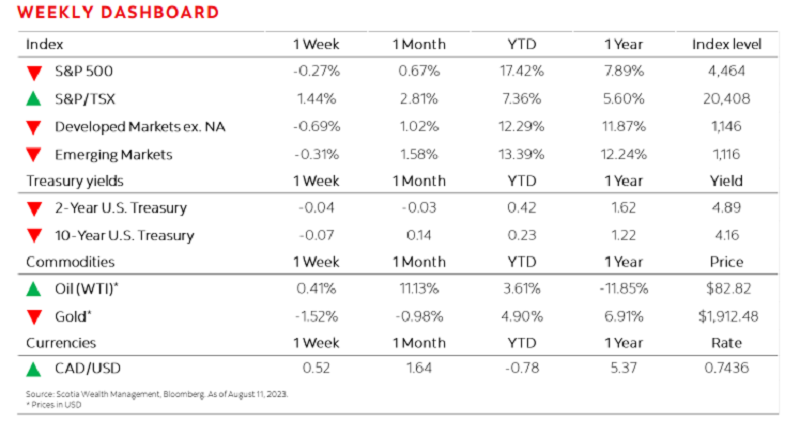
U.S. , INTERNATIONAL MARKETS EXPERIENCE SECOND WEEK OF LOSSES

U.S. and international markets recorded a second week of losses after inching lower on Friday. Investors had to contend with a crosscurrent of corporate earnings which remain relatively strong as well as new inflation data. Much of the week’s market movements were in reaction to the inflation data, however. Investor sentiment was buoyed earlier in the week following the release of Consumer Price Index (CPI) data which came in lower-than-expected, pushing equity markets higher. Then, on Friday, the release of Producer Price

Highlights:

• U.S. markets closed -0.27%1 lower after whipsawing following CPI and then PPI readings. With both consumer and wholesale inflation inching higher for July, it shows that inflation is still a concern. Expectations for no rate hike in September slid to 88.5% from 90% following the release of inflation data.

• In Canada, markets dipped early in the week – particularly rate-sensitive names – following U.S. CPI data, but strong earnings brought the main index back into positive territory, up 1.44%2, led by Consumer Staples and Energy.

• European markets traded -0.69%3 lower for the week after positive returns in both Germany and France’s main indices were tempered by pessimistic growth forecasts for the U.K.

• Emerging markets fell -0.31%4 as troubles in China continued to simmer, with cracks re-emerging in the country’s real estate market on news of the potential default of Country Garden.

LONGER-DATED SOVEREIGN YIELDS FALL AS INVESTORS ASSESS FED’S INTEREST RATE PATH

U.S. and Canadian sovereign bond yields were broadly lower for the week following a hotter-than-expected July PPI reading. The inflation measure ticked up across all readings, headline and core, month-over-month, and year-over-year. Credit spreads remained steady after moving wider since the beginning of the month.

Highlights:

• The 2-year U.S. Treasury yield was down 4 basis points (bps), while the 10-year yield fell 12 bps. In Canada, the 2-year yield was down 9 bps while the 10-year fell 12 bps.

• According to the latest report from Bloomberg, credit rating agency sentiment remains negative, with credit at both ends of the spectrum facing predominantly downgrade actions.

• Bonds rated single A and above that face a reduction in rating are about $228bn USD in size, with Pfizer and Bank of New York Mellon comprising just over one-third of that. Banks remain weak, as evidenced by Moody’s recent actions, with State Street and HSBC making up an additional $14.3bn USD in downgrade potential.

ECONOMIC SNAPSHOT

CANADIAN ECONOMIC ACTIVITY CONTRACTED IN JULY FOR FIRST TIME IN SEVEN MONTHS

Canadian economic activity contracted in July for the first time in seven months as a measure of employment fell, Ivey Purchasing Managers Index (PMI) data showed. The Ivey PMI measures the month-to-month variation in economic activity as indicated by a panel of purchasing managers from across Canada.

Highlights:

• The seasonally adjusted PMI fell to 48.6 in July from 50.2 in June. It was the first reading below the 50 level that indicates a decrease in activity since December.

• The gauge of employment fell to an adjusted 54.2 from 57.6 in June, while the supplier deliveries measure was at 47.9, down from 53.4.

• The unadjusted PMI fell to 45.2 from 53.4.

U.S. CONSUMER PRICES RISE MODERATELY IN JULY

U.S. consumer prices increased moderately in July amid lower costs for goods, including used motor vehicles, a trend that could persuade the U.S. Federal Reserve to leave interest rates unchanged next month. The U.S. Labor Department reported that the CPI rose 0.2% last month, matching the gain in June. Though the increase in the annual CPI rate picked up for the first time in 13 months, that was because it was calculated from a lower base after prices subsided last July following a jump that had boosted inflation to a pace not seen in more than 40 years.

Highlights:

• The CPI advanced 3.2% in the 12 months through July. That followed a 3.0% rise in June, which was the smallest year-on-year gain since March 2021.

• Annual consumer prices have come down from a peak of 9.1% in June 2022. The Fed has a 2% inflation target.

• Excluding the volatile food and energy categories, the CPI gained 0.2% in July, matching the rise in June. In the 12 months through July, the core CPI increased 4.7% after rising 4.8% in June.

CHINESE EXPORTS FALL AT STEEPEST PACE SINCE FEBRUARY 2020

China’s exports to the rest of the world tumbled in July, adding to the challenges for the world’s second-largest economy and offering fresh evidence that a drying up of Western demand is hurting Beijing’s attempts to rekindle growth. Worsening geopolitical tensions between Beijing and the U.S.-led West have also prompted some Western manufacturers to reduce their reliance on China’s supply chain, which in turn is expected to erode trade ties between the two sides.

Highlights:

• According to China’s General Administration of Customs, overseas shipments from China slumped 14.5% in July from a year earlier, the steepest year-over-year decline since February 2020.

• Chinese goods shipments to the U.S. fell 23% in July compared with a year earlier. Shipments to the European Union and to the Association of Southeast Asian Nations, a group of 10 countries that includes Singapore and Indonesia, each dropped by about 21%.

• Shipments to Russia, a country under Western sanctions over its invasion of Ukraine, rose 52% in July from a year earlier, helped by sales of high-value goods including automobiles. For the first seven months of this year, Chinese exports to Russia soared 73% from a year earlier, even as China’s total exports have fallen 5%.

IN THE NEWS

CHINA’S LAST MAJOR REAL ESTATE GIANT TEETERS ON BRINK OF DEFAULT

Country Garden, China’s largest developer by sales and once considered the gold standard in real estate, warned in a report to investors that it is expecting a loss of $7.6bn USD in the first half of the year. The report coincided with two other events: On August 1, the company abandoned a plan to inject capital into the business, and last week missed two bond payments, placing it at risk of default. The figures, reported in a filing on Thursday, lay bare the financial woes facing the embattled company and are a flashing warning sign for China’s economy. That Country Garden is on the brink of collapse is particularly concerning given it had largely benefitted from measures to bolster China’s flagging real estate market last year.

Behind the headline:

• Much of Country Garden’s financial problems stem from a drop in sales of apartments as fewer people are interested in – or able to – purchase a home.

• Country Garden shares, which trade in Hong Kong, were down ~29% over the past week alone, and ~64% year-to date.

• The situation is reminiscent of previous troubles with China Evergrande, another real estate giant that landed in default two years ago, setting off a wave of real estate defaults and sending global markets spiralling

DISCLAIMER

This publication has been prepared by The Bank of Nova Scotia for Scotia Wealth Management clients and may not be redistributed. It is for general information purposes only and should not be considered or relied upon as personal and/or specific financial, tax, pension, insurance, legal or investment advice. We are not tax or legal advisors and we recommend that individuals consult with their qualified advisors, including tax and legal advisors, before taking any action based upon the information contained in this publication. Opinions and projections contained in this publication are our own as of the date hereof and are subject to change without notice. Scotia Wealth Management is under no obligation to update this commentary and readers should assume the information contained herein will not be updated. While care and attention has been taken to ensure the accuracy and reliability of the material in this publication, neither The Bank of Nova Scotia nor any of its affiliates or any of their respective directors, officers or employees make any representations or warranties, express or implied, as to the accuracy or completeness of such material and disclaim any liability resulting from any direct or consequential loss arising from any use of this publication or the information contained herein. This commentary may contain forward-looking statements based on current expectations and projections about future general economic factors. Forward-looking statements are subject to inherent risks and uncertainties which may be unforeseeable and such expectations and projections may be incorrect in the future. Forward-looking statements are not guarantees of future performance and you should avoid placing undue reliance upon them. This publication and all the information, opinions and conclusions contained herein are protected by copyright. This publication may not be reproduced in whole or in part without the prior express consent of The Bank of Nova Scotia. To the extent this document contains information or data obtained from third party sources, it is believed to be accurate and reliable as of the date of publication, but 1832 Asset ManagementL.P. does not guarantee its accuracy or reliability Scotia Wealth Management® consists of a range of financial services provided by The Bank of Nova Scotia (Scotiabank®); The Bank of Nova Scotia Trust Company (Scotiatrust®); Private Investment Counsel, a service of 1832 Asset Management L.P.; 1832 Asset Management U.S. Inc.; Scotia Wealth Insurance Services Inc.; and ScotiaMcLeod®, a division of Scotia Capital Inc. Private banking services are provided by Scotiabank. Estate and trust services are provided by The Bank of Nova Scotia Trust Company. Portfolio management is provided by 1832 Asset Management L.P. and 1832 Asset Management U.S. Inc. Insurance services are provided by Scotia Wealth Insurance Services Inc. Wealth advisory and brokerage services are provided by ScotiaMcLeod, a division of Scotia Capital Inc. International investment advisory services are provided by Scotia Capital Inc. Financial planning services are provided by Scotiabank and ScotiaMcLeod. Scotia Capital Inc. is a member of the Canadian Investor Protection Fund and the Canadian Investment Regulatory Organization. Scotia Wealth Insurance ServicesInc. is the insurance subsidiary of Scotia Capital Inc., a member of the Scotiabank group of companies. When discussing life insurance products, ScotiaMcLeod advisors are acting as Life Insurance Agents (Financial Security Advisors in Quebec) representing Scotia Wealth Insurance Services Inc. © Copyright 2023 The Bank of Nova Scotia. All rights reserved.