Subscribe to the 100% free rdnewsNOW daily newsletter!
(rdnewsNOW/Sheldon Spackman)
Conditions As Of June 13

Alberta Crop Report: June 16

Jun 16, 2023 | 3:15 PM

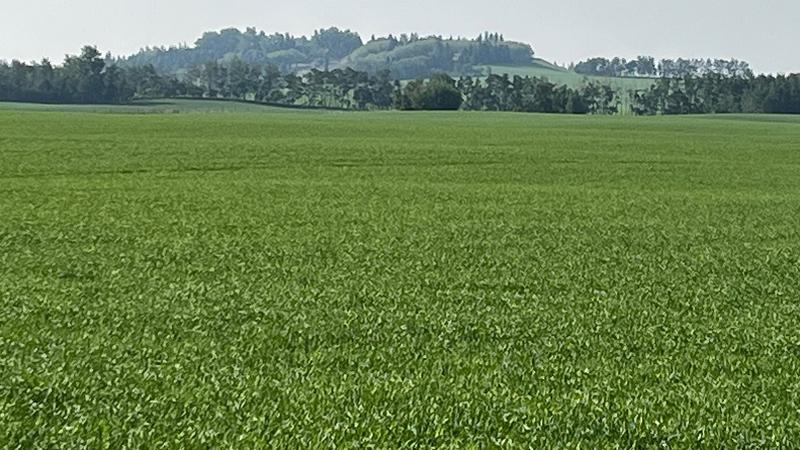
Little moisture was experienced throughout the central Alberta region as of June 13 that has left the Central Region mostly dry.

That according to the latest Alberta Crop Report from AFSC and the Government of Alberta, which indicates 23 per cent of all crops are rated at good to excellent, in the region, and 59 and 51 per cent behind the 5- and 10-year average, respectively.

The majority of spring seeded crops, meantime, are in the late stages of tillering and fall seeded crops are roughly half complete head emergence. About 53 per cent of canola, 38 per cent of dry peas, and 56 per cent of lentils are in 4-6 leaf/node stage.

Post-emergent spraying is said to be 57 per cent complete. Some areas reported grasshoppers, army cutworms and gophers as being over threshold.


Surface soil moisture is now rated at (sub-surface soil moisture ratings shown in brackets) 54(51) per cent poor, 28(31) per cent fair, 17(18) per cent good and 1(0) per cent excellent, with 0(0) per cent excessive.

Hay is starting to be cut as both forages and pastures are flowering and heading out in the dry and hot conditions. Currently, pasture is rated at (tame hay conditions in brackets) 43(53) per cent poor, 20(18) per cent fair, 34(23) per cent good, and 3(6) per cent excellent.

A provincial state of emergency was declared on May 6 due to the number of wildfires in the province, and ended on June 3. The wildfire situation in the northern areas of the province remains serious, however.

Light and sporadic showers experienced across the province have failed to be enough to boost crop condition ratings and soil moisture reserves as of June 13. Many areas continue to report hot and dry temperatures that have further depleted soil moisture conditions continuously since May 23.

The Peace Region has received the most moisture the past week with up to 60 mm (as well as select south west parts of the South Region), while the majority of the Central, North East and South Regions received 0-5 mm. Officials say this has caused crops across the province to show signs of stress and mature quicker than normal.

As of June 13, provincial crop growing conditions are rated as 43 per cent good to excellent conditions, 32 per cent below the 5-year average and 31 per cent below the 10-year average. Potatoes, lentils, chickpeas, and durum are rated in the best condition provincially, whereas canola and barley are rated the lowest.

While the Peace Region isn’t experiencing the same poor growing conditions (rated at 72 per cent of crops in good to excellent condition) thanks to adequate rain, the rest of the province is seeing the lowest ratings since 2009 and 2015. Currently, 56 per cent of all crops in the North East Region are rated as good to excellent, followed by the South (46 per cent), the Central (23 per cent) and the North West (18 per cent).

Last week, 93 per cent of crops had emerged. Currently, 55 per cent of broad leaf crops are in the 4-6 leaf/node stage moderately ahead of the 5-year average of 45 per cent and spring cereals are just entering stem elongation. While some fields are so dry that there are dormant seedlings struggling to get going, other cereals have already produced a flag leaf as they rush into heading.

Heavy precipitation in the near forecast will be needed to improve soil moisture conditions across majority of the province. Overall, good to excellent rated surface soil moisture conditions fell 2 per cent and sub-surface soil moisture ratings decreased 5 per cent over the past week. Overall, surface soil moisture (10-year average in brackets) is rated at 40(9) per cent poor, 32(19) per cent fair, 21(43) per cent good, 7(26) per cent excellent and less than one per cent (3) rated excessive.

The majority of the province is rated as extremely low (once in 25-50 year dry) to less than once-in-50-years dry. Currently, sub surface soil moisture (10-year average in brackets) is rated as 37(9) per cent poor, 32(23) per cent fair, 24(45) per cent good, 7(21) per cent excellent and 0(2) per cent excessive.

Even though pasture and tame hay conditions rated good to excellent increased by 4 and 3 per cent, respectively, conditions are still well below the 5- and 10-year averages. Tame hay is reported to be flowering, while pasture grass is heading out and as a result is being cut for hay and silage and rotated through grazing cycles sooner than normal.

First cut haying progress is reported to range from 2 per cent complete in the Peace to 12 per cent complete in the North West. Tame hay is rated as (10-year average in brackets) 39(10) per cent poor, 26(24) per cent fair, 31(51) per cent good, and 4(15) per cent excellent. Pasture conditions are rated as (10- year average in brackets) 37(13) per cent poor, 23(24) per cent fair, 38(51) per cent good and 2(13) per cent excellent.