Subscribe to the 100% free rdnewsNOW daily newsletter!
(rdnewsNOW / Sheldon Spackman)
July 29, 2022

Yield expectations high in latest Crop Report

Jul 29, 2022 | 4:18 PM

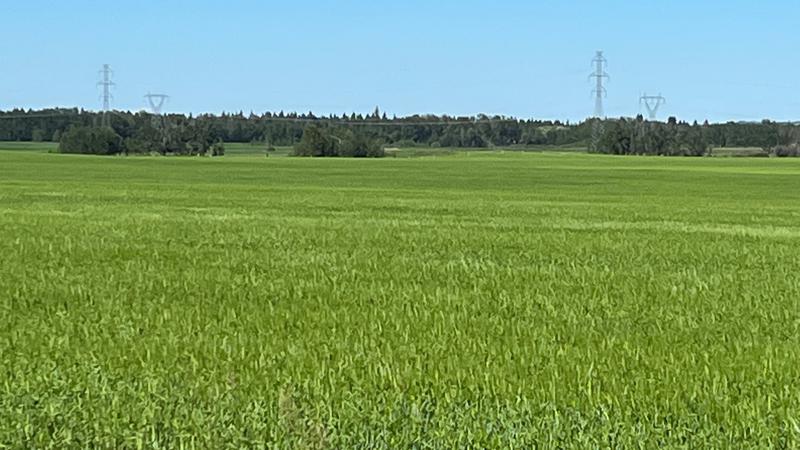
Continued precipitation and heat across large areas of the central Alberta region with localized hail damage is being reported.

According to Agriculture Financial Services Corporation (AFSC) and Alberta Agriculture, Forestry, and Rural Economic Development, their latest Crop Report indicates yield expectations are 116 per cent of the 10-year average.

First-cut dryland hay is yielding 1.5 tons/acre, while pastures are rated at 76 per cent good or excellent.

Surface soil moisture conditions (sub-surface shown in brackets) are rated as three (eight) per cent poor, 14 (18) per cent fair, 61 (56) per cent good, and 14 (14) per cent excellent, with seven (four) per cent excessive.

Officials say this week’s crop report is the first of the season with reporters submitting yield expectations. The highlights of the report are the above average expectations for both provincial crop growing conditions and yield.

On average across the province, major crops are rated as 74 per cent good to excellent growing conditions (compared to a 10-year average of 66 per cent) with yield expectations of 110 per cent of the 10-year provincial yield average. All regions of the province are reporting yield estimates relatively consistent with, or ahead of, long term normal.

Year-over-year June rainfall has made a significant difference. At this time last year only 20 per cent of all crops were rated as good or excellent and yield expectations were only 60 per cent of the 10- year average. However, areas of the Peace, North West and North East have experienced a dry July and are moving back to below long-term normal soil moisture levels.

With such low subsoil moisture levels at the beginning of the growing season, continued precipitation beyond what was received in June is said to be needed to keep soil moisture at normal levels for expanding areas of the province.

Officials say plant development for most crops is right in line with long-term averages. Province-wide, spring cereals are rated at 70 on the Zadok growth scale and right on track with the 71 10-year average. Podding of pulses is modestly behind long-term normal with dry peas at 74 per cent podding compared to 82 per cent on a 10-year average. This is largely said to be due to regional differences in development, with pulses in the North West and Peace delayed.

According to officials, the notable exception in crop development is canola. The provincial canola crop is at only 28 per cent podding compared to the 10-year average of 56 per cent for this time in the season. Comparing to other oilseed growth, mustard is 76 per cent podding, relatively normal for its 10-year average of 80 per cent.

Crop reporters are referencing a widely variable canola crop in quality and some are reporting field-specific lack of pod formation. Crop reporters are expected to continue monitoring and reporting on canola pod formation and even in the last two weeks are anecdotally commenting on the recent growth and resiliency of canola, albeit still highly variable and inconsistent.

First-cut of dryland hay is 71 per cent complete across the province with average yields reported at 1.6 tons/acre, modestly ahead of the 10-year average of 1.5 tons/acre. This yield is regionally variable with a low of 1.1 tons/acre reported in the South and a high of 2.3 tons/acre in the Peace.

Dry July conditions have been favorable for hay harvest and 75 per cent of this dryland first-cut hay is rated as good or excellent in quality. Irrigated first-cut is averaging 2.2 tons/acre, modestly behind 2.4 tons/acre on a 10-year average.

Pasture is rated as 54 per cent good or excellent across the province, compared to 58 per cent on a 10-year average. In the South region, pastures are notably struggling with 80 per cent rated as poor or fair.

Officials say flea beetles are the significant pest of concern so far in the season. Fifteen per cent of acres across the province are rated at moderate or over threshold levels for flea beetles. Normally this is reported at only one per cent on a five-year average. The over threshold reports of flea beetles are predominantly in the South.

Grasshoppers are so far not a reported concern but root maggots are being reported in the Peace where five per cent of land is over threshold.