
LOCAL NEWS THAT MATTERS, SENT TO YOU DIRECTLY. SUBSCRIBE FOR FREE!
Sponsored

Market Watch — Oct. 23, 2026

Oct 26, 2026 | 3:59 PM

Market highlights

  • AI jitters and Midde East tensions drive a volatile week
  • Sovereign bonds rally as lenders demand more for risk

Economic highlights

  • Energy lifts headline inflation as core pressures cool
  • Soft housing data suggest U.S. real estate market remains under pressure
  • Eurozone consumer confidence dips as economic sentiment weakens
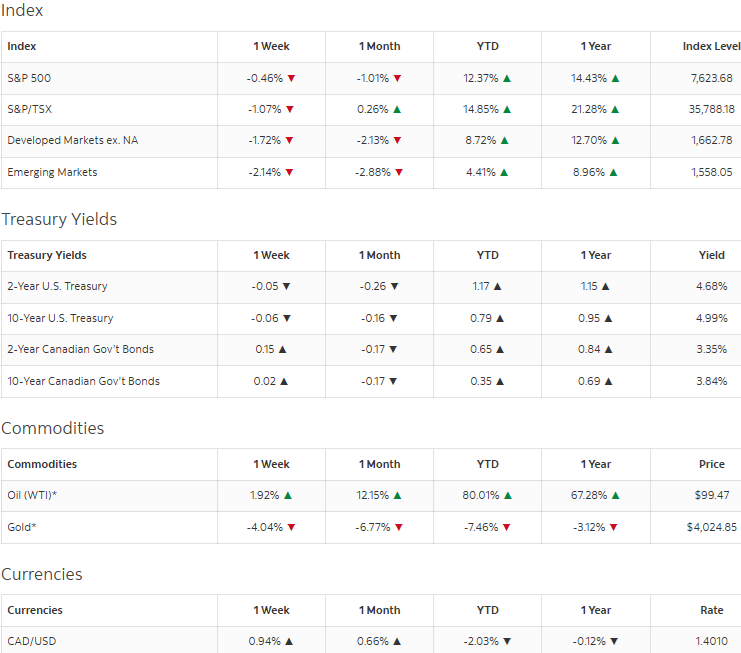
Friday, October 23, 2026 Source: Scotia Wealth Management Bloomberg * Price in USD

Week in review

AI jitters and Midde East tensions drive a volatile week

Middle East tensions framed the week as Houthi attacks on Saudi Arabia’s Yanbu port and strikes near the Strait of Hormuz lifted Brent Crude to its highest levels since May. In the U.S., an early chip rebound faded as Elice’s record-weak Seoul debut revived AI spending doubts, before SpaceX and Super Micro results lifted tech midweek. Lam Research’s disappointing outlook and escalating Middle East hostilities drove a sharp Thursday reversal, while the lowest jobless claims since July and hot Purchasing Managers’ Index (PMI) price gauges kept Federal Reserve (Fed) hike risk in focus. In Canada, a slightly softer-than-expected inflation report did little to temper Bank of Canada (BoC) hike bets after Governor Macklem’s hawkish weekend remarks, though an oil rally sparked by reduced Russian exports from the Baltic port of Primorsk supported the Toronto Stock Exchange (TSX) midweek. European equities lagged as French riots pushed the spread between French government bonds (OATs) and German Bunds to its widest since 2011, compounded by events including Carrefour’s profit warning and weak PMIs. In Asia, Elice whipsawed the Korea Composite Stock Price Index (KOSPI), while China lagged on soft domestic demand before rebounding Friday.

  • U.S. equities returned -0.46%¹, as resilient data complicated the AI-driven swings, with jobless claims hitting a three-month low and flash PMI data showing the fastest price gains since 2022, while Middle East escalation deepened Thursday’s tech selloff.
  • Canadian equities returned -1.07%² as a gasoline-driven rise in inflation to 3.1%, alongside softer core measures, did little to cool BoC hike bets, though lower Russian crude exports from Primorsk lifted oil and supported a midweek recovery.
  • European equities returned -1.72%³ as French social unrest widened the French-German bond spread to a 15-year high, while a Carrefour profit warning, surging natural gas and contracting French activity added pressure.
  • Emerging market equities returned -2.14%⁴ with Korea at the centre of AI volatility after Elice’s slump, while Chinese stocks struggled with weak property and investment data before finding support late in the week.

Sovereign bonds rally as lenders demand more for risk

Treasuries started the week under pressure as the selloff in French debt spread to other markets, with the Fed in its pre-meeting blackout and the 10-year yield holding above 5%. Demand for safe havens built through the week, ending in a powerful Thursday rally as AI concerns and Middle East escalation pulled investors back into government bonds. Canadian bonds fell Monday as Governor Macklem’s hawkish remarks outweighed a September inflation report that came in a touch below expectations, with core measures also easing, before rallying midweek and weakening Friday as pricing for an Oct. 28 hike firmed. In Europe, OATs were the clear outlier, as unrest and Carrefour’s warning pushed their spread over German Bunds to its widest since 2011, while hotter U.K. inflation locked in a November Bank of England (BoE) hike. In Asia, Japanese government bonds (JGBs) rallied late in the week, while the Bank of Korea held rates but signalled further tightening.

  • The 2- and 10-year U.S. Treasury yields were 5 bps and 6 bps lower, respectively. In Canada, the 2- and 10-year sovereign yields were 16 bps and 2 bps lower, respectively. Bond yields and prices move inversely to one another.
  • Government bonds held up as a portfolio hedge, with Treasurys, Canadian bonds and German Bunds rallying sharply in Thursday’s risk-off move, while French and Italian debt underperformed amid fiscal strain and persistent inflation.
  • Credit investors exacted a steeper price for risk as AI-related selling and higher oil prices pushed global corporate spreads to their widest since May 2025, with high yield (HY) lagging investment grade (IG) and CCC-rated issuers hit hardest.

Energy lifts headline inflation as core pressures cool

Canada’s headline inflation rose to 3.1% YoY in September from 3.0% in August, a touch below the 3.2% consensus, with energy accounting for nearly all of the increase. Gasoline prices accelerated and fuel oil costs rose sharply as crude climbed to its highest level since May. Excluding gasoline, inflation slowed to 2.2% from 2.4%. Grocery price growth eased to its slowest pace since May 2024 as fresh vegetables and confectionery became cheaper, while shelter inflation edged modestly higher. The Bank of Canada’s preferred core measures, CPI-median and CPI-trim, also came in slightly below expectations, suggesting underlying price pressures remain contained even as energy pushes the headline higher.

Highlights:

  • Energy prices rose 19.0% YoY, up from 15.4% in August, as gasoline climbed 27.8% and fuel oil and other fuels jumped 57.8%. Fuel oil costs hit Atlantic Canada households hardest.
  • Grocery inflation slowed to 1.7% from 2.8%, helped by lower prices for fresh vegetables (-2.9%) and sugar and confectionery (-2.7%), while beef inflation cooled to 8.7% from 11.0%.
  • CPI-median and CPI-trim eased to 1.9% and 1.8%, respectively, each 0.1 percentage points below expectations. Shelter inflation rose to 1.8% from 1.5%, driven by utilities, while rent was unchanged.

Soft housing data suggest U.S. real estate market remains under pressure

U.S. homebuilding activity weakened in September as higher borrowing costs continued to weigh on the housing sector, while pending home sales data provided a mixed picture of demand. According to the U.S. Census Bureau, privately owned housing units authorized by building permits were running at a seasonally adjusted annual rate of 1.40 million in September, down 0.2% from August and 3.0% below the level recorded a year earlier. Single-family permits declined 4.0% from the previous month to an annualized rate of 845,000, highlighting ongoing caution among builders. This latest data suggests the housing sector remains under pressure, with builders pulling back on new projects and buyers constrained by high financing costs. While rising inventory has improved choice, the market continues to struggle for sustained momentum.

Highlights:

  • Housing starts also softened. New residential construction began at a seasonally adjusted annual rate of 1.2 million units in September, a 5.2% decline from August and 7.4% below the pace seen in September 2025. Single-family starts fell 4.6% month-over-month to 859,000 units, while multifamily construction remained subdued.
  • The weakness in permits and starters suggest builders remain challenged by high mortgage rates, affordability pressures and softer demand. The declines extend a stretch of uneven housing activity as financing costs continue to weigh on prospective buyers.
  • Pending home sales also pointed to ongoing weakness in the resale market. According to the National Association of Realtors, contract signings remained below year-ago levels, while mortgage rates above 7% continued to erode affordability and dampen buyer demand.

Eurozone consumer confidence dips as economic sentiment weakens

Eurozone consumer confidence deteriorated further in October, underscoring growing caution among households as elevated energy costs and persistent economic uncertainty continue to weigh on sentiment across the currency bloc. The European Commission’s Consumer Confidence Indicator fell to -17.0 in October from -16.5 in September, marking a modest decline and remaining well below its long-term average. The consumer confidence report followed Tuesday’s ZEW survey, which showed a deterioration in investor sentiment toward the eurozone economy. The ZEW Economic Sentiment Index for the euro area fell to 18.5 in October from 25.8 in September, its lowest level in four months and below economists’ expectations.

Highlights:

  • The latest reading suggests households are becoming increasingly wary about their economic outlook. Survey participants also expressed concern that elevated oil and natural gas costs could keep inflation higher for longer while weighing on economic activity.
  • Assessments of current economic conditions, however, were little changed. The eurozone current-conditions gauge edged down to -14.8 from -13.9 in September, suggesting the economy remains sluggish but has not deteriorated sharply.
  • Together, the two surveys paint a picture of an economy struggling to build momentum heading into the final months of the year. Investors appear less optimistic about the growth outlook, while consumers remain cautious amid higher living costs and uncertainty surrounding energy markets.

1 S&P 500 Index CAD

2 S&P/TSX Composite Index CAD

3 Bloomberg Developed Markets ex N. America Large & Mid Cap Price Return Index CAD

4 Bloomberg EM Large & Mid Cap Price Return Index CAD