Sign up for our free daily newsletter!
(Image Credit: Scotia Wealth Management)
Sponsored

Market Watch — June 5, 2026

Jun 5, 2026 | 4:20 PM

This week’s highlights

  • Equity rally falters as investors weigh tighter policy conditions
  • Strong labour data drives a late-week rates selloff
  • Strong Canadian jobs data reinforce rate hike expectations
  • Markets revisit expectations for Fed’s policy rate after U.S. labour data release
  • Eurozone inflation reaccelerates as economic growth weakens

Week in review

Equity rally falters as investors weigh tighter policy conditions

U.S. equities started the week on firmer footing as AI-related momentum continued to support technology shares, helped by Nvidia’s planned launch of a new AI-focused CPU and follow-through strength in select AI infrastructure names. That optimism faded as renewed U.S.-Iran hostilities lifted oil prices and kept geopolitical risk central to the macro narrative. Midweek data pointed to a resilient economy, with ADP payrolls and ISM services reinforcing firm growth, but also complicating the rate outlook as price pressures persisted. By Friday, a stronger-than-expected nonfarm payrolls report pushed yields higher and prompted markets to revisit the risk of additional Fed tightening, weighing heavily on duration-sensitive technology shares and the semiconductor complex.

Canadian equities were steadier early in the week, with energy exposure helping cushion the broader risk-off tone, but softer commodity prices and rising domestic yields became headwinds. A much stronger labour-market report reinforced expectations that the Bank of Canada (BoC) could hike later this year, even as recent GDP weakness showed the economy had slipped into a technical recession.

European markets similarly found support early in the week from technology and financials, but gains were capped as Eurozone inflation accelerated and core price pressures firmed, reinforcing expectations for a June European Central Bank (ECB) rate hike. Hawkish commentary from ECB officials, alongside evidence of weaker business activity and persistent cost pressures, left investors weighing tighter policy against a deteriorating growth backdrop.

Chinese and broader emerging market technology shares rallied early on AI optimism before reversing as global risk appetite weakened and higher yields pressured the broader tech trade.

Highlights:

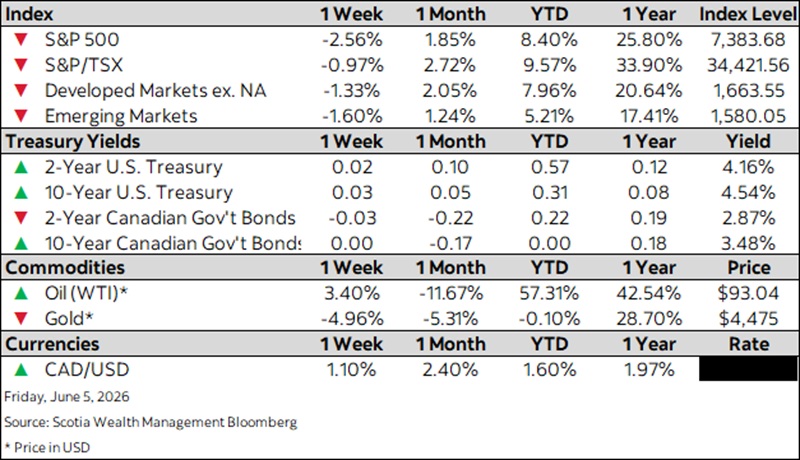
  • U.S. equities returned -2.56%1, with early AI-driven momentum giving way to selling pressure as Middle East tensions lifted oil prices and resilient labour and services data pushed yields higher. Technology and semiconductor shares bore the brunt of the move as sentiment weakened following Broadcom’s disappointing AI-related revenue guidance.
  • Canadian equities returned -0.97%2, holding up early in the week as energy exposure provided support before softer commodities, higher domestic yields and a strong jobs report that reinforced BoC hike expectations weighed on sentiment.
  • European stocks returned -1.33%3 as early gains from strength in technology and financials were moderated by firmer inflation, hawkish ECB commentary, and signs of weakening business activity that left investors balancing tighter policy risks against a softer growth backdrop.
  • Emerging markets declined -1.60%4, rallying early on renewed AI optimism in major technology names, before reversing as global risk appetite weakened and higher yields weighed on the broader technology trade.

Strong labour data drives a late-week rates selloff

U.S. Treasuries began the week under modest pressure as renewed U.S.-Iran tensions lifted oil prices, then briefly rallied as softer crude and a risk-off tone supported demand for duration. That relief faded by Friday, when stronger-than-expected payrolls pushed yields sharply higher and forced markets to reprice the risk of additional Fed tightening. Canadian government bonds largely tracked U.S. rates, though domestic pressure intensified after weak productivity, rising unit labour costs and a strong jobs report reinforced expectations for potential BoC hikes later this year.

European sovereign yields were pulled between safe-haven demand and a more hawkish ECB backdrop, with firmer Eurozone inflation and policymaker commentary supporting expectations for a June hike. Japanese government bonds were a notable outlier, supported by strong auction demand, domestic buying and policy anchoring; despite this, yields ultimately settled near where they began the week even as global yields moved higher.

Highlights:

  • The 2- and 10-year U.S. Treasury yields were up 2 basis points (bps) and 3 bps, respectively. In Canada, the 2- and 10-year yields were down 3 bps and flat, respectively. Bond yields and prices move inversely to one another.
  • Developed-market yields were whipsawed by geopolitics, energy prices and data, rallying on risk-off demand midweek before selling off after U.S. and Canadian jobs reports revived higher-for-longer policy concerns.
  • Corporate credit softened as higher yields, geopolitical risk and equity weakness weighed on sentiment, with investment grade pressured by rates and high yield more exposed to fading risk appetite.

Weekly dashboard


Strong Canadian jobs data reinforce rate hike expectations

Canada’s labour market posted a robust recovery in May, with the economy adding 87.8k jobs, well above the median consensus estimate and more than recovering the prior month’s 17.7k-job decline, according to the latest data. The unemployment rate fell 0.3 percentage points to 6.6%, while the participation rate held steady at 65% and hourly wage growth cooled to 3.2% year-over-year.

Highlights:

  • The strong hiring figures contrast with other recent economic releases that paint a more mixed picture of the monetary policy outlook. April consumer price index (CPI) inflation came in well below expectations, and first-quarter real gross domestic product (GDP) growth disappointed with a 0.1% annualized contraction, pushing the economy into technical recession.
  • The GDP decline, however, was notably small and distorted by a surge in imports and softer government investment, tempering concerns about the broader growth trajectory.
  • A separate report revealed that labour productivity fell in Q1 2026 and unit labour costs rose for a fourth consecutive quarter. Despite considerable uncertainty ahead, the combination of resilient hiring and persistent cost pressures means tighter monetary policy later this year cannot be ruled out.

    Markets revisit expectations for Fed’s policy rate after U.S. labour data release

    U.S. labour market data surprised to the upside in May, reinforcing the view that economic momentum has improved after a soft patch in late 2025 and early 2026. With the addition of 172k nonfarm jobs in May and the unemployment rate held at 4.3%, as expected, markets were led to reassess the path of U.S. Federal Reserve (Fed) policy and price in a Fed hike by its December meeting.

    Highlights:

    • The three-month average nonfarm payrolls increase of 179k was the highest since March 2024; the biggest gain in government payrolls since July 2024 (52k) and a decline of previous private job increases with 120k (in comparison with the 202k and the 177k increases in April and May). However, the data might not reflect the effects of the conflict in the Middle East in discretionary spending.
    • In the private job increases, the leisure and hospitality sector was the leading contributor (70k jobs gained), reflecting a rebound from their hiring levels since November. In contrast, the financial services industry trimmed positions by 22k, continuing the trend it has been following since June 2025.
    • A steady 4.3% unemployment rate and slowed year-over-year wage growth suggest labour conditions remain stable without signalling a renewed acceleration in wage pressures, supporting the view of a still-resilient but gradually rebalancing job market.

      Eurozone inflation reaccelerates as economic growth weakens
      Eurozone inflation accelerated in May, underscoring persistent price pressures across the currency bloc and complicating the outlook for monetary policy, according to Eurostat. Annual inflation in the euro area rose to 3.2% in May from 3.0% in April, the third straight month above the European Central Bank’s 2% target. The figures come against a softer growth backdrop. In the first quarter, euro area gross domestic product (GDP) contracted 0.2% from the previous quarter while employment still rose 0.1%, indicating a labour market that has held up better than output.

      Highlights:

      • Energy prices again led the increase, rising 10.9% year over year, while services inflation accelerated to 3.5% from 3.0%, pointing to firm domestic demand and ongoing wage pressures. Food, alcohol and tobacco inflation eased to 2.0%, and non-energy industrial goods edged up to 0.9%.
      • Core inflation also strengthened, climbing to 2.5% from 2.2%, suggesting price pressures are becoming more embedded across the broader economy.
      • Across the broader European Union, GDP fell 0.1% and employment was unchanged, a combination that highlights how stubborn inflation is colliding with weakening growth across the region.

        1  S&P 500 Index USD2 S&P/TSX Composite Index USD3 Bloomberg Developed Markets ex N. America Large & Mid Cap Price Return Index USD4 Bloomberg EM Large & Mid Cap Price Return Index USD