Subscribe to the 100% free rdnewsNOW daily newsletter!
Sponsored

Market Watch — April 10, 2026

Apr 10, 2026 | 4:11 PM

This week’s highlights

  • Ceasefire sparks relief rally as investors assess durability and impact
  • Fixed income markets rally, then stabilize, as central banks signal caution
  • Canada sees modest employment growth in March, jobless rate unchanged at 6.7%
  • U.S. consumer prices surge in March, lessening chances of interest-rate cut
  • Eurozone producer prices fall in February as energy costs ease

Week in review

Ceasefire sparks relief rally as investors assess durability and impact

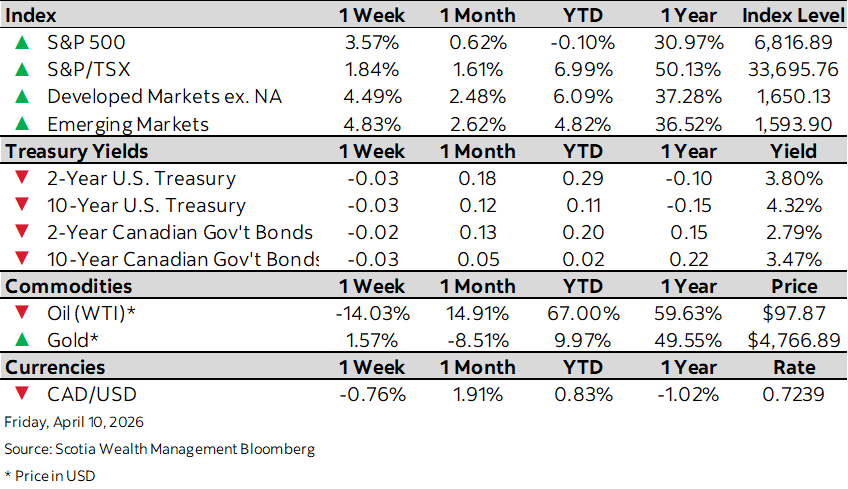
U.S. equities started the week cautiously as geopolitical tensions around the Strait of Hormuz weighed on sentiment. However, markets gapped higher on Wednesday after a temporary ceasefire eased energy supply fears and drove a risk-on rally, especially in large-cap technology. Since the ceasefire, U.S. and global markets have traded sideways to modestly higher, as investors weigh the durability of the agreement and its impact on energy prices and inflation as transit through the Strait remains blocked for most ships. Canadian markets mirrored U.S. moves, with oil price volatility and a modest jobs report shaping performance; TSX benefitted from improved risk appetite but lagged on weaker communi

cation services, info tech and energy. European equities surged midweek on relief over the ceasefire, with cyclicals and airlines outperforming, but retreated as renewed doubts about the agreement and higher energy prices revived inflation concerns. In China and emerging markets, stocks rallied on global risk-on flows and strong semiconductor earnings, but gains were tempered by persistent shipping disruptions and renewed hostilities late in the week.

Highlights:

  • U.S. equities returned 3.57%1 as geopolitical risks dominated early trading, then surged midweek on a ceasefire that eased energy concerns, with large-cap tech and AI themes leading gains before markets settled into a sideways pattern as investors digested implications.
  • Canadian equities returned 1.84%2, benefitting from improved global sentiment after the ceasefire, but were held back by oil price swings and a modest jobs report, with financials and energy sectors underperforming.
  • European stocks returned 4.49%3 on relief over the Strait reopening, driving outsized gains in cyclicals and airlines, but retreated and then traded sideways as renewed doubts about the ceasefire and higher energy prices revived inflation concerns.
  • Emerging markets rose 4.83%4, advancing on global risk-on flows and robust semiconductor earnings, but persistent shipping disruptions and renewed hostilities late in the week led to a more cautious, sideways trading pattern as investors assessed ongoing risks.

Fixed income markets rally, then stabilize, as central banks signal caution

U.S. fixed income markets began the week with muted moves as investors weighed strong nonfarm payrolls and persistent geopolitical risks, but rallied sharply Wednesday after a temporary ceasefire between the U.S. and Iran triggered a reversal in inflation hedges and drove yields lower across the curve. The release of Federal Open Market Committee (FOMC) minutes and Personal Consumption Expenditure (PCE) inflation data reinforced a cautious stance, with policymakers emphasizing the need for inflation to ease further before considering rate cuts, while renewed energy price volatility complicated the outlook. Canadian bonds tracked U.S. trends, with modest employment gains and stable rates, but were overshadowed by global risk sentiment and oil-driven inflation concerns. European sovereign debt outperformed midweek as easing geopolitical tensions reduced tightening expectations, but yields rose again as doubts resurfaced and energy prices rebounded.

Highlights:

  • The 2- and 10-year U.S. Treasury yields were both down 3 basis points (bps). In Canada, the 2- and 10-year yields were down 2 bps and 3 bps, respectively. Bond yields and prices move inversely to one another.
  • Sovereign bond yields swung sharply as a temporary U.S.–Iran ceasefire triggered a reversal in inflation hedges, but renewed energy price volatility and hawkish central bank signals kept investors cautious into week’s end.
  • Corporate bonds saw spreads tighten midweek as risk appetite improved on easing geopolitical tensions, but persistent inflation concerns and volatile oil prices led to selective buying in investment grade and defensive positioning in high yield.

Weekly dashboard


Canada sees modest employment growth in March, jobless rate unchanged at 6.7%

Canada’s job growth remained subdued in March while the unemployment rate remained unchanged at 6.7% from the prior month, signalling continued slack, or underutilized work force, in the labour market. According to Statistics Canada (StatCan), employment in March rose by a net of 14,100 jobs against a slump of 83,900 in the prior month. Analysts had forecast job gains of 15,000 in March and expected the unemployment rate to edge up to 6.8%.

Highlights:

  • The job gains in March were entirely led by part-time jobs which increased by 15,200. Full-time jobs dropped by 1,100, StatCan said.
  • The average hourly increase in permanent wages showed an increase of 5.1% in March on a year-on-year basis, the highest in the past 20 months.
  • The goods-producing sector, which is primarily the most exposed to U.S. tariffs, saw employment increase by 12,500 jobs while the services sector, where four out of every five Canadians are employed, reported a modest 1,700 job gains.

U.S. consumer prices surge in March, lessening chances of interest-rate cut

U.S. consumer prices increased by the most in nearly four years in March as the war with Iran boosted oil prices and the pass-through from tariffs persisted, further diminishing chances for an interest rate cut this year. According to the U.S. Labor Department’s Bureau of Labor Statistics, the consumer price index (CPI) jumped 0.9% last month, the largest increase since June 2022, when prices soared in response to the Russia-Ukraine war.

Highlights:

  • Consumer prices rose 0.3% in February. In the 12 months through March, the CPI advanced 3.3% after rising 2.4% in February. Economists had forecast the CPI accelerating 0.9% and increasing 3.3% year-on-year.
  • Excluding the volatile food and energy components, the CPI rose 0.2% last month after climbing 0.2% in February. That translated to a year-on-year increase of 2.6% in the so-called core CPI.
  • In the months ahead, economists expect the Middle East conflict to lift core prices through expensive jet fuel that will raise airline fares, and diesel, which will increase the cost of goods transported by road. Prices of fertilizer and plastics, among other goods, are also expected to rise.

Eurozone producer prices fall in February as energy costs ease
Producer price pressures across the euro area eased sharply in February, according to data published by Eurostat, reinforcing evidence that upstream inflation is cooling even as consumer prices show renewed firmness. Industrial producer prices fell 0.7% month on month in February, reversing a 0.8% increase in January and matching market expectations. On an annual basis, producer prices were 3.0% lower than a year earlier, marking the steepest year-on-year decline since October 2024. February’s figures may provide limited guidance on the near-term inflation outlook as recent volatility in energy markets could feed back into factory gate prices in coming months.

Highlights:

  • The monthly decline was largely driven by a sharp fall in energy prices, which dropped 2.4% compared with January and 11.7% on an annual basis. Excluding energy, producer prices edged 0.1% higher on the month, highlighting continued but subdued underlying cost pressures.
  • By sector, prices for intermediate goods rose 0.3%, while capital goods and durable consumer goods increased 0.3% and 0.2% respectively. Prices for non-durable consumer goods declined 0.2%.
  • National data showed particularly large monthly declines in Spain (-3.1%) and Ireland (-2.6%), while producer prices rose most strongly in Croatia (+3.8%) and Finland (+2.7%). In the euro area’s largest economies, prices edged down 0.5% in Germany and 0.2% in France.

1  S&P 500 Index USD

2 S&P/TSX Composite Index USD

3 Bloomberg Developed Markets ex N. America Large & Mid Cap Price Return Index USD

4 Bloomberg EM Large & Mid Cap Price Return Index USD

Disclaimer: This publication has been prepared by The Bank of Nova Scotia for Scotia Wealth Management clients. It is for general information purposes only and should not be considered or relied upon as personal and/or specific financial, tax, pension, insurance, legal or investment advice. We are not tax or legal advisors, and we recommend that individuals consult with their qualified advisors, including tax and legal advisors, before taking any action based upon the information contained in this publication. The opinions and projections contained in this publication are our own as of the date hereof and are subject to change without notice. Scotia Wealth Management is under no obligation to update this publication, and readers should assume the information contained herein will not be updated. While care and attention has been taken to ensure the accuracy and reliability of the material in this publication, neither The Bank of Nova Scotia nor any of its affiliates or any of their respective directors, officers or employees make any representations or warranties, express or implied, as to the accuracy or completeness of such material and disclaim any liability resulting from any direct or consequential loss arising from any use of this publication or the information contained herein. This publication may contain forward-looking statements based on current expectations and projections about future general economic factors. Forward-looking statements are subject to inherent risks and uncertainties which may be unforeseeable and such expectations and projections may be incorrect in the future. Forward-looking statements are not guarantees of future performance and you should avoid placing undue reliance upon them. This publication and all the information, opinions and conclusions contained herein are protected by copyright. This publication may not be reproduced in whole or in part without the prior express consent of The Bank of Nova Scotia. To the extent this document contains information or data obtained from third party sources, it is believed to be accurate and reliable as of the date of publication, but Scotia Wealth Management does not guarantee its accuracy or reliability.

® Registered trademark of The Bank of Nova Scotia, used under licence (where applicable). ™ Trademark of The Bank of Nova Scotia, used under licence (where applicable). Scotia Wealth Management® consists of a range of financial services provided by The Bank of Nova Scotia (Scotiabank®); The Bank of Nova Scotia Trust Company (Scotiatrust®); Scotia Jarislowsky Fraser, a service of 1832 Asset Management L.P.; 1832 Asset Management U.S. Inc.; Scotia Wealth Insurance Services Inc.; and ScotiaMcLeod®, a division of Scotia Capital Inc. Private banking services are provided by The Bank of Nova Scotia. Estate and trust services are provided by The Bank of Nova Scotia Trust Company. Portfolio management is provided by 1832 Asset Management L.P. and 1832 Asset Management U.S. Inc. Insurance services are provided by Scotia Wealth Insurance Services Inc. Wealth advisory and brokerage services are provided by ScotiaMcLeod, a division of Scotia Capital Inc. International investment advisory services are provided by Scotia Capital Inc. Financial planning services are provided by The Bank of Nova Scotia and ScotiaMcLeod. Scotia Capital Inc. is a member of the Canadian Investor Protection Fund and is regulated by the Canadian Investment Regulatory Organization. Scotia Wealth Insurance Services Inc. is the insurance subsidiary of Scotia Capital Inc., a member of the Scotiabank group of companies. When discussing life insurance products, ScotiaMcLeod advisors are acting as Life Insurance Agents (Financial Security Advisors in Quebec) representing Scotia Wealth Insurance Services Inc.

Scotia Wealth Management® in The Bahamas consists of a range of financial services provided by Scotiabank (Bahamas) Limited and The Bank of Nova Scotia Trust Company (Bahamas) Limited, which are entities licensed to operate within The Bahamas. International private banking and international investment advisory services are provided by Scotiabank (Bahamas) Limited. International wealth structuring solutions are provided by The Bank of Nova Scotia Trust Company (Bahamas) Limited. ® Registered trademark of The Bank of Nova Scotia, used under licence.

Scotia Wealth Management® in the Cayman Islands consists of a range of financial services provided by Scotiabank & Trust (Cayman) Ltd. International private banking services, international investment advisory services, and international wealth structuring solutions are provided by Scotiabank & Trust (Cayman) Ltd., an entity licensed by the Cayman Islands Monetary Authority. ® Registered trademark of The Bank of Nova Scotia, used under license.

Scotia Wealth Management® in Jamaica consists of a range of Private Banking services provided by the Scotiabank Group of companies (Scotiabank®). ®Registered trademark of The Bank of Nova Scotia, used under licence.