Subscribe to the 100% free rdnewsNOW daily newsletter!
(Image Credit: TSB)
safety message around autorotations

TSB: Weather, medical, mechanical issues ruled out in fatal helicopter crash near Red Deer

Feb 5, 2026 | 3:17 PM

The Transportation Safety Board of Canada (TSB) has released its final report into the fatal helicopter crash that killed one person near Red Deer on July 6, 2025.

Its chief message is for increased pilot consideration around performing a safety manoeuvre called an autorotation when passengers are on board. The report otherwise does not define a cause of the crash given the limited information available. That includes the absence of a cockpit voice reorder and a flight data recorder, neither of which were required by regulation.

On July 6, the report recaps, a commercially-registered Bell Helicopter Textron Canada Limited 206L-4, was conducting a private flight from The Lodge at Panther River, Alberta (just north of Banff), to the Hespero/Safron Residence Heliport (50 km west of Red Deer), with the pilot and one passenger on board.

RCMP shared last summer that the person who passed away was a 54-year-old woman from Benalto, while the pilot, who survived, was a 63-year-old man from Lacombe County.

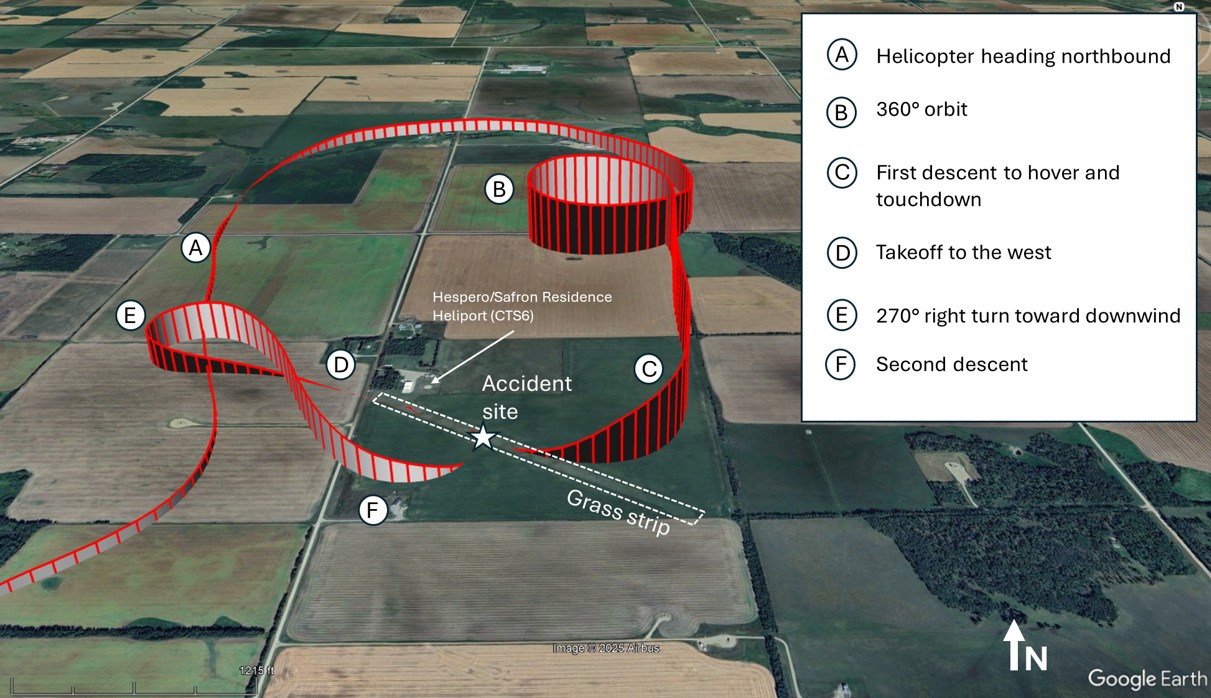
According to the TSB, at 12:13, after 34 minutes in the air, the helicopter flew over its destination, heading north.

The TSB’s report says the pilot then conducted a 360-degree turn, and from a height of about 700 feet, commenced a turning approach consistent with what’s called an autorotation.

Per the TSB:

“The approach consisted of a 123° track change and a rate of descent up to 3846 fpm. The pilot terminated the approach by conducting a power recovery2 before landing in the middle of a grass strip, which was oriented on a heading of 290° magnetic (M).3 The pilot then departed along the grass strip, on a northwest heading and conducted a 270° turn to the right, eventually turning downwind on the southwest side of the grass strip. He levelled off at a height of approximately 300 feet AGL, at approximately 80 knots indicated airspeed (KIAS), and on a heading of 140°. At 1218:29, he started a left turn that increased to 43° of bank toward a heading of 351° in another descent consistent with an autorotation (Figure 1). At 1218:41, the maximum rate of descent in the turn was recorded to be 2362 fpm at a height of 100 feet AGL. In the next 5 seconds, the helicopter pitched up to 14° and the rate of descent slowed to 125 fpm at a ground speed of 30 KIAS while the helicopter banked 9° to the right. Over the next 6 seconds, the rate of descent increased, and the pitch fluctuated.’


(Image Credit: TSB)

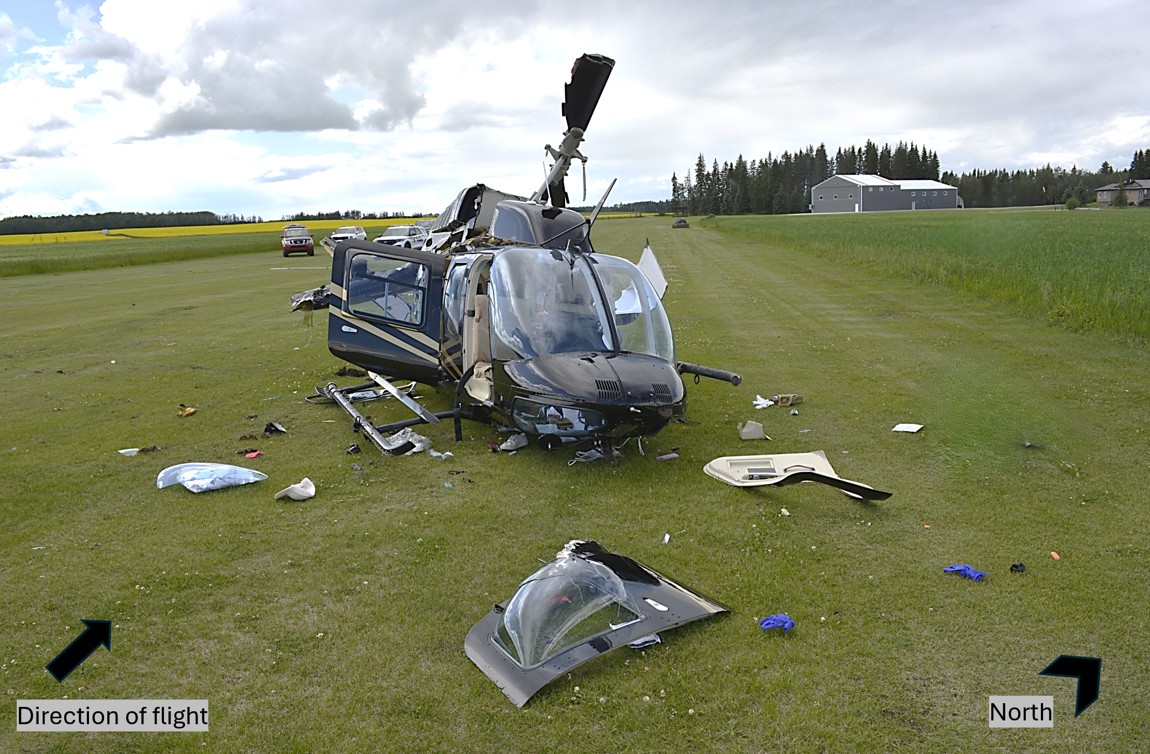
The helicopter then contacted the ground just before 12:19 p.m., the skid gear collapsed, and it came to rest facing the opposite direction of travel.

One main rotor blade impacted the tail boom, and the tail rotor was separated from the fuselage. The second rotor blade was found clear of the wreckage. There was no fire post-impact.

The passenger was fatally injured, and the pilot was seriously injured.

At the time, wind was reported from the Red Deer Regional Airport’s weather station at 12 knots, gusting to 18. There was a scattered layer of clouds. Weather is not considered to be a factor in the crash, the report says.

The TSB continues, noting the pilot had a commercial licence, and a valid medical certificate. He had successfully completed his pilot proficiency check, maintained a regular training schedule, and had 3,500 hours of rotary-wing flying, plus 1,800 hours flying the helicopter which crashed.

There is no indication the pilot’s performance was negatively affected by medical or physiological factors, including fatigue, the TSB says.


(Image Credit: TSB)

Additionally, no issues were identified related to the helicopter’s flight controls, systems, or engine that would have prevented them from operating normally during the occurrence flight.

On the subject of aurorotation training, the TSB notes:

“During autorotation training, helicopter pilots are taught to practise varying the direction, speed, and rotor rpm of the helicopter to reach a chosen landing spot.4 While it is considered vital5 that helicopter pilots be proficient with varying parameters, emphasis is placed on returning to a minimum rate of descent as early as possible, and no later than 200 feet AGL.6,7 The risk of the rate of descent increasing up to more than 2500 fpm8 while conducting a turning autorotation is highlighted and instructors are taught to emphasize that the skill and judgment to handle the aircraft at varying airspeeds and rates of descent “will only come from frequent practice.”9

“The U.S. Federal Aviation Administration (FAA) has published an advisory circular on best practices to mitigate the risks of autorotations during training, specifically while turning.10 The circular places emphasis on maintaining rotor rpm and airspeed, and states, “(d)o not allow the nose to pitch up or down excessively during the manoeuvre, as it may cause undesirable rotor rpm excursions.”11

“In Canada, there are regulations restricting emergency training with passengers during commercial operations but not during private operations.”

They go on, saying the investigation was unable to determine if the pilot was wearing his shoulder harness. They say neither pilot nor passenger was wearing a helmet, nor were they required to. The pilot did receive a head injury, it’s noted.

“While essential to helicopter pilot training, conducting practice autorotations can introduce risks that are higher than regular flight. Exposing passengers to these elevated risk levels should be carefully considered before pilots commence this exercise,” the TSB concludes.

“Pilots are reminded that the role of helmet use in preventing serious injury in helicopter accidents has been well documented.”

The report can be read in full here.

READ MORE: One deceased in helicopter crash west of Red Deer