Sign up for our free daily newsletter!
Sponsored

Market Watch – Dec. 12, 2025

Dec 12, 2025 | 4:20 PM

This week’s highlights

  • Late week value rotation trims Fed interest rate cut gains
  • Fed’s measured tone and BoC hold reinforce slower easing path
  • Bank of Canada holds interest rate at 2.25% in last decision of 2025
  • U.S. Federal Reserve cuts key rate by quarter-point, signals coming pause to cuts
  • Eurozone economy posts stronger growth on investment rebound

Week in review

Late week value rotation trims Fed interest rate cut gains

Global equities traded cautiously early in the week as investors awaited dual rate decisions from the Fed and BoC. With limited U.S. data, positioning was largely set ahead of Wednesday’s announcements. The Fed delivered a 25 basis points (bps) cut while the BoC held, sparking a brief tech-led rally before profit-taking drove a rotation into defensive stocks amid concerns over outsized AI spending and future monetization. The Fed’s move, alongside steady employment and sticky inflation, suggests a slower easing path ahead. European markets mirrored this pattern; flat early, then higher post-Fed before stabilizing as investors reassessed valuations and European Central Bank (ECB) commentary hinting at a prolonged rate cut pause and cautious optimism around corporate deal activity. Emerging markets were mixed: sentiment in Asia softened as weak domestic demand and property-sector stress overshadowed China’s strong November export rebound and record trade surplus; these dynamics underscore Beijing’s challenges in pivoting toward consumption-led growth amid global protectionism and sluggish local activity even as exports surge.

Highlights:

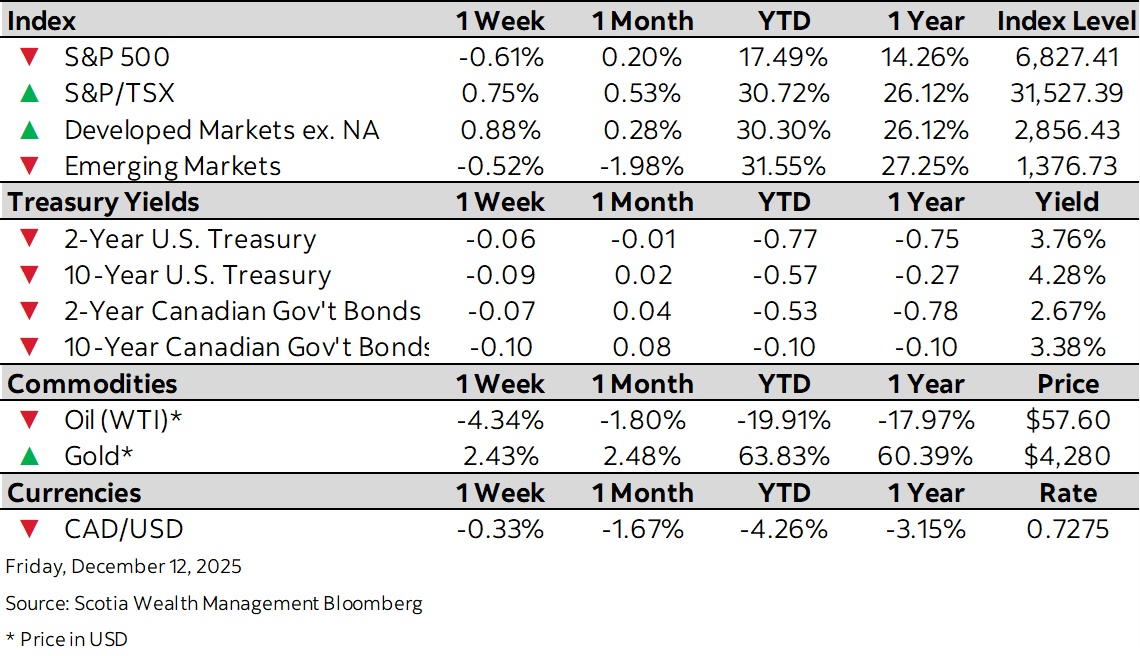
  • U.S. equities returned -0.61%1 as traders awaited the Fed’s final rate decision for the year, with a widely anticipated 25 bps cut sparking a brief tech rally before profit-taking set in, reflecting concerns over ever-growing AI spending.
  • Canadian equities edged higher for the week returning 0.75%2, with the bulk of net gains occurring on Thursday following the Fed cut and BoC hold. Gains moderated on Friday as investors digested the BoC’s guarded tone on future policy moves.
  • European stocks rose 0.88%3, mirroring North American trends. Flat early, gapping higher after the Fed’s cut, before stabilizing as investors reassessed valuations amid mixed macro signals including European Central bank commentary.
  • Emerging markets were -0.52%4 lower as sentiment in China remained subdued amid property-sector strain and weak domestic demand which overshadowed robust export growth and a record trade surplus.

Fed’s measured tone and BoC hold reinforce slower easing path

U.S. Treasury markets started the week under modest pressure as mixed labour signals and anticipation of the Fed’s decision drove yields higher. Rates rallied midweek after the Fed delivered a 25 bps cut and the BoC held, with markets still pricing in two cuts for 2026 despite Powell’s cautious tone and a divided dot plot. By Friday, front-end yields finished flat to lower as expectations for a slower easing cycle settled in. Canadian bonds mirrored this pattern, with strong jobs data and sticky inflation reinforcing the BoC’s hold before rallying alongside U.S. Treasuries. European curves followed suit, initially firm, then easing after weak U.K. GDP and steady ECB messaging, while Japanese bonds softened early before stabilizing post-Fed as positioning continued for next week’s expected BoJ hike. Credit spreads were largely unchanged, ticking slightly wider into Friday.

Highlights:

  • The 2- and 10-year U.S. Treasury yields fell 6 basis points (bps) and 9 bps, respectively. In Canada, the 2- and 10-year yields were down 7 bps and up 10 bps, respectively. Bond yields and prices move inversely to one another.
  • Government curves saw early-week bear steepening as markets priced in a slower global easing cycle, before Fed’s cautious tone and BoC’s hold tempered moves, leaving yields flat or lower on the front end despite ECB and BoE signals of prolonged pauses.
  • Investment-grade spreads tightened briefly on Fed-driven risk appetite, but heavy tech capex guidance and lingering macro uncertainty reversed momentum. High-yield sentiment softened as investors rotated toward defensives amid concerns over leverage and slowing growth.

Weekly dashboard

Bank of Canada holds interest rate at 2.25% in last decision of 2025

The Bank of Canada (BoC) held its benchmark interest rate steady, moving back to the sidelines for what financial markets expect to be an extended pause. As widely anticipated, the central bank kept its policy rate at 2.25%, following cuts in September and October. With the Canadian economy “proving resilient” in the face of U.S. tariffs, Bank of Canada Governor Tiff Macklem said that the policy rate was at “about the right level to keep inflation close to 2% while helping the economy through this period of structural adjustment.”

Highlights:

  • Macklem said, “In the months ahead, we will see some choppiness in headline inflation, reflecting the temporary GST/HST holiday on some goods and services a year ago. This is likely to push inflation temporarily higher in the near term.”
  • Overall, the BoC sees the economy surprisingly sturdy. After a steep contraction in the second quarter, led by a collapse in exports, Canadian gross domestic product grew at an annualized pace of 2.6% in the third quarter.
  • “We expect growth in final domestic demand to resume, but with an anticipated decline in net exports, GDP growth is likely to be weak in the fourth quarter before picking up in 2026,” Macklem said.

U.S. Federal Reserve cuts key rate by quarter-point, signals coming pause to cuts

The U.S. Federal Reserve (Fed) reduced its key interest rate by a quarter-point for the third time in a row but signalled that it may leave rates unchanged in the coming months. In a statement released after a two-day meeting, the Fed’s rate-setting committee suggested further rate cuts would depend on signs that the economy is faltering. And in a set of quarterly economic projections, Fed officials signalled they expect to lower rates just once next year. The cut reduces the rate to between 3.5% and 3.75%, a three-year low.

Highlights:

  • Three Fed officials dissented from the move, the most dissents in six years and a sign of deep divisions on a committee that traditionally works by consensus. Two officials voted to keep the Fed’s rate unchanged, while Stephen Miran, whom Trump appointed in September, voted for a half point cut.
  • At a press conference following the announcement, Fed Chair Jerome Powell signalled that the Fed’s key rate was close to a level that neither restricts nor stimulates the economy. As a result, officials can now take a step back and evaluate where the economy heads next.
  • Adding to the Fed’s challenges, job gains have slowed sharply this year and the unemployment rate has risen for three straight months to 4.4%. While that is still a low rate historically, it is the highest in four years.

Eurozone economy posts stronger growth on investment rebound
The eurozone economy grew at a faster pace than previously estimated in the three months through September, aided by a rebound in investment spending. Figures recently released by the European Union’s statistics agency showed gross domestic product (GDP) in the currency area was 0.3% higher than in the three months through June, and 1.4% up on a year earlier. Eurostat had previously estimated quarter-to-quarter growth at 0.2%. The revised figure is equivalent to an annualized growth rate of 1.1%.

Highlights:

  • The revision partly reflected faster growth in Italy, Austria and Lithuania than was previously estimated.
  • The pickup in growth from the previous quarter was driven by investment spending, which rose by 0.9%, having dropped by 1.7% in the three months through June.
  • However, consumer spending slowed slightly, while imports rose more rapidly than exports. Eurozone policymakers have been looking to a pickup in household spending to help offset cooling exports as higher U.S. tariffs bite.

1 S&P 500 Index USD
2 S&P/TSX Composite Index USD
3 Bloomberg Developed Markets ex N. America Large & Mid Cap Price Return Index USD
4 Bloomberg EM Large & Mid Cap Price Return Index USD