Subscribe to the 100% free rdnewsNOW daily newsletter!
(rdnewsNOW/Ian Gustafson)
Solutions

Red Deer mayoral candidates discuss homelessness

Oct 9, 2025 | 10:49 PM

Red Deer mayoral candidates discussed one of the most important issues to voters during an election forum on Thursday night

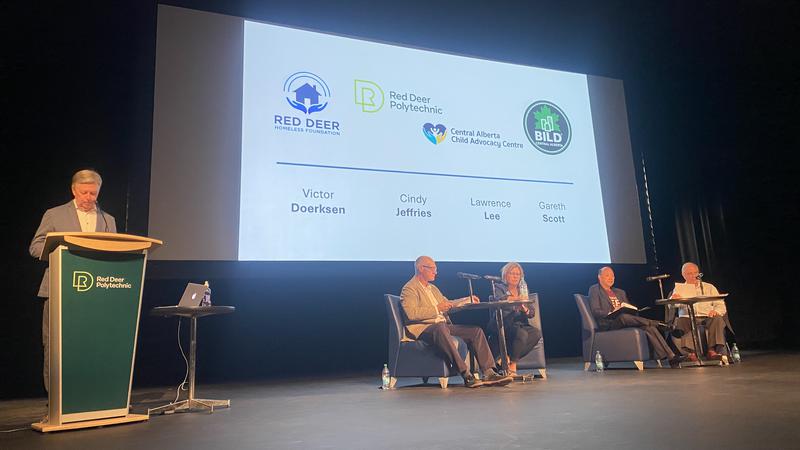
Put on by Red Deer Polytechnic, the Red Deer Homeless Foundation, the Central Alberta Child Advocacy Centre, and BILD Central Alberta, four candidates engaged in discussion on homelessness.

This included Victor Doerksen, Cindy Jefferies, Lawrence Lee, and Gareth Scott. Mayoral candidate John Gallagher was not in attendance.

All four candidates were given two minutes to answer five questions prepared in advance by the organizers. These questions were all related to homelessness, including public safety, capacity and prevention, mental health and addictions, and safe housing strategies.

After that, they answered three questions from the public, which were also selected ahead of time.

What guiding principle or philosophy would shape your overall approach to address homelessness if you were elected?

Victor Doerksen said it’s important to remember that people experiencing homelessness have families who know them and care for them. They are also homeless for a number of reasons.

He added that it is a complex issue with no single solution, but it’s important to start somewhere. His goal is to get more people off the streets.

“This is really a community challenge. It’s not up to a mayor to decide how we’re going to handle this. It’s not up even to a council,” he said. “This is going to take an effort from all of us.”

Cindy Jefferies said it’s important to understand that each person who is homeless in our community comes to that position for many reasons and that the solution is not one-size-fits-all.

She added that it’s a complex issue and that she’ll look to experts to find solutions.

“Sometimes I wonder if we’re trying to solve the right problem. Is it a problem that we have people on the streets and in encampments? Or is the problem actually in the system that serves us? I think there are some long-term solutions if we have a look at the systems and how we keep going round and round,” she said.

Lawrence Lee said his guiding principle is to listen to the community and to understand what everyone is thinking.

He also wants to tackle it from a data-driven approach that exposes service gaps and tracks early prevention.

“It’s an issue that doesn’t just impact Red Deer; it impacts this whole country, and there’s a reason for that. There are economic reasons, and there are a whole bunch of cultural and societal reasons that are happening,” he said. “I think we often lose sight that if there was one particular solution that we had, we’d have solved the problem.”

Gareth Scott said his guiding principle is to remember that homeless people are human beings who deserve respect. He also said the Red Deer Chamber’s report on homelessness is a road map.

“There are people right now who are putting their own money into supplying food every day, and clothing, and are working with the homeless, pointing them in the right direction,” he said. “Those people need credit, and those are the people that we should be going to find out what really can help.”

How would you balance bylaw enforcement and public safety with the rights and needs of people living with homelessness?

Jefferies said the city needs to be careful what it enforces and whether it actually helps the situation. She used an example of a homeless person receiving a ticket for living in an encampment; chances are, it will just cause them more stress and most likely will not be paid.

“I don’t think it’s correct for people to be living on public land, but when we have no other place for people to be, that’s the only solution,” she said. “That’s why we need to find better answers.”

Meantime, Lee said bylaws were created for those who are continuous offenders or to curb a behaviour in the community. He said that’s why this issue has escalated. There isn’t a level of understanding on both sides.

“I guarantee that if the statistics are true, many of you have come close to being homeless,” he said. “I hope that understanding is put into how we address the problem going forward. We have to address it.”

Scott said the criminals and predators who prey on the homeless community are the folks who need to be cleared off the street first. That’s where the law and the bylaw apply.

“In doing that, we can make the streets safer for everybody, including the general public,” Scott said.

Doerksen said the public attitude has shifted, and more people are more concerned about public safety than in the past. This includes stories he’s heard about people being accosted outside the Superstore.

“Is it the homeless people who are responsible for that? I don’t know, but there is an element of people, the perpetrators of criminal activity, in particular drug dealers. I don’t have any tolerance for drug dealers, and I wish we had less tolerance. Let’s try to remove some of those issues, and then we can work on the people who are truly trying to find a better life.”

What would be your top priorities across emergency shelters, transitional housing, supportive housing, and affordable housing? And how would you also work to prevent people from becoming homeless in the first place?

Lee said when it comes to emergency shelters, he wants them to do what they’re designed to do, which is to get people off the streets and housed within a month. In terms of transitional housing, he added that we don’t have the capacity for it. He added that the only way to create more affordable housing is to improve the economy by bringing more business to Red Deer.

Meanwhile, Scott said housing is foundational because if a person has a place to call home, they have an anchor. When you become homeless, you lose that.

“We do need to have transitional housing, we do need to have permanent affordable housing,” he said. “A stat that alarms me is that 40 per cent are working homeless. They have a job and that’s staggering to me,” he said, adding he wants to work with the local homeless foundation on that.

Doerksen said they’re all priorities, but council will have to go with where the opportunities are, including potential available land to build another shelter.

“They’re not neatly in order, you have to go with where the opportunities show up, and that’s how I think our priorities are going to be set,” he said.

Jefferies said the community needs to answer to all of them, and as a community, they need to ask how they can get that done. If resources are limited, they need to look to partnerships and also finish what has already been started.

“I think we need to try and do many of these things all at once, not wait until we finish one piece and then go to the next piece,” she said. “Let’s just get shovels in the ground and let’s make things happen and address the issues.”

Many frontline workers tell us that mental health challenges and addictions are deeply tied to homelessness. What role should the city of Red Deer take directly?

Scott said it falls on the federal and provincial governments to solve, but the city can advocate for more services in mental health and addictions. He said we have a shortage of psychologists in Red Deer. He added the Indigenous people are often the victim of that.

“We need to be respectful and help our Indigenous people in their mental issues and let them use their programs,” he said.

Doerksen said he doesn’t think it’s a city responsibility or a governance responsibility. He explained the city should play an advocacy role at the provincial level. However, he’s open to being educated on the topic.

Jefferies agreed and added that the city has an obligation to understand the challenges homeless people face and how the homeless are being served by agencies.

Lee also agreed but thinks there’s an opportunity for advocacy. He said it takes work from multiple agencies, like the work the Central Alberta Child Advocacy Centre has done.

How would you ensure the city’s response to homelessness is culturally appropriate, trauma-informed, especially for Indigenous people who are disproportionately affected? While also addressing the diverse needs of other cultural communities experiencing homelessness?

Doerksen said after working with care for newcomers, he got to see firsthand the challenges refugees and immigrants face.

He said there aren’t many newcomers who are a part of the homeless community, but that they face their own challenges by coming to Red Deer.

Jefferies said it’s sad that many Indigenous and other minorities face discrimination when they try to rent accommodation and are not welcome when there is a vacancy available.

“Work on that front happens daily, helping those understand the challenges and barriers to housing. And helping our community so that it can and should be different,” she said, adding it’s about leading the way with community conversations.

Lee said it’s important to understand where these people are coming from by learning about their experiences.

“Culture is different for everybody; it’s not a linear path,” he said.

Scott said he’s had firsthand experience learning about the damage of residential schools had on generations. He’s also seen how they handle the trauma.

“They know best how to take care of themselves. We need to respect that, support it, and promote it,” he said.