
Subscribe to the 100% free rdnewsNOW daily newsletter!
sponsored

Market Watch: Feb. 14, 2025

Feb 18, 2025 | 10:55 AM

This week’s highlights

  • Reaccelerating U.S. inflation, uncertain policy agenda creating volatility
  • Bond markets begin pricing in expectations for fewer U.S. rate cuts
  • Canada will strike back if U.S. imposes steel and aluminum tariffs
  • U.S. consumer, producer prices rise more than expected in January
  • China’s consumer inflation accelerated in January

Week in review

Reaccelerating U.S. inflation, uncertain policy agenda creating volatility

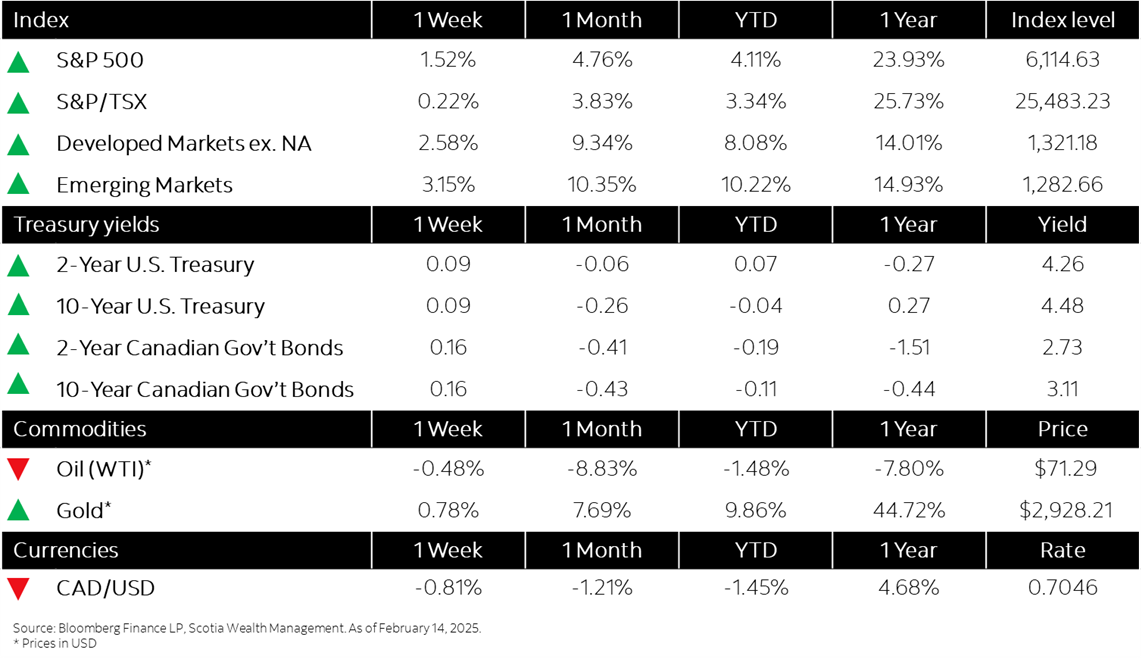
In the U.S., equity markets were initially buoyed by expectations of stable interest rates and positive economic data, but turned lower mid-week following stronger-than-expected inflation reports – for both consumers and producers – and renewed trade tensions from President Trump’s tariff announcements. With inflation remaining above the U.S. central bank’s 2% target, chances of a rate cut this year are diminishing, with rising uncertainty over the economic impact of the Trump administration’s fluid trade, immigration and fiscal policies complicating the outlook. Canadian markets mirrored U.S. trends, with economic resilience pushing rates higher early in the week, but later affected by U.S. trade policies targeting the Canadian steel and aluminium industries. In Europe, markets were weighed down by concerns over retaliatory tariffs from the EU and mixed economic data, particularly in the UK. China and emerging markets saw mixed performance; optimism from record financing in China was tempered by concerns over property market momentum and broader trade uncertainties.

Highlights:

  • U.S. markets returned 1.52%1 for the week, tempered by stronger-than-expected CPI and PPI reports, resilient labour market data, and renewed trade tensions leading to shifting rate cut expectations.
  • Canadian markets returned 0.22%2 for the week buoyed by resilient economic data including strong labour market reports.
  • European markets returned 2.58%3 for the week due to mixed economic data including higher-than-expected inflation reports and UK GDP figures that showed a surprising 0.1% growth in Q4.
  • Emerging markets closed 3.15%4 higher, influenced by record-high aggregate financing in China, which hit 7.1 trillion yuan in January, and mixed signals from the property market, with mortgage lending contracting after three months of growth.

Bond markets begin pricing in expectations for fewer U.S. rate cuts

U.S. fixed income markets experienced notable volatility throughout the week. Early in the week, bond yields rose in response to resilient labour market data and higher inflation expectations. However, mid-week, stronger-than-expected CPI and PPI reports indicated persistent inflationary pressures, leading to a further rise in yields. The Federal Reserve’s (Fed) stance on maintaining restrictive policy rates amid these inflation concerns added to the upward pressure on yields. Additionally, renewed trade tensions from President Trump’s tariff announcements contributed to market uncertainty, affecting investor sentiment. By the end of the week, the bond market was pricing in a more cautious outlook for rate cuts, with expectations shifting towards the latter part of the year.

Highlights:

  • The 2- and 10-year U.S. Treasury yields were both 9 basis points (bps) higher. In Canada, the 2- and 10-year yields were both up 16 bps. Bond yields and prices move inversely to one another.
  • Primary supply is running below expectations for the week amid increased volatility that prompted some issuers to stay on the sidelines. Next week could see better volumes, subject to improved market conditions.
  • Canadian January CPI is due on Tuesday along with the Federal Open Market Committee (FOMC) meeting minutes on Wednesday. A number of Fed speakers are also scheduled throughout the week.

Weekly dashboard

Canada will strike back if U.S. imposes steel and aluminum tariffs

Canadian Prime Minister Justin Trudeau said Canada will retaliate if the U.S. proceeds with what he called “entirely unjustified” tariffs on Canadian steel and aluminum. U.S. President Donald Trump followed through on his threat of imposing 25% levies on all imports of steel and aluminum starting March 12. “We will be working with the American administration over the coming weeks to highlight the negative impacts on Americans and Canadians of these unacceptable tariffs,” Trudeau said. “If that doesn’t work, the United States can expect a strong retaliatory response.”

Highlights:

  • Canada is the top supplier of steel and aluminum to the U.S. Around half of the steel produced in Canada and more than 90% of the aluminum are currently sent south across the border, with combined exports worth around $35 billion last year.
  • The tariff announcement is the latest sign that Trump intends to use levies on imports to force manufacturers to move their operations to the U.S. He previously threatened steep levies on all Canadian and Mexican imports but announced a 30-day pause after the countries made some concessions on border security.
  • The tariffs will be imposed under Section 232 of the Trade Expansion Act of 1962, which gives the President the authority to restrict trade on the grounds of national security. Trump used these powers in 2018 when he put 25% tariffs on steel and 10% tariffs on aluminum from Canada and other countries.

U.S. consumer, producer prices rise more than expected in January

U.S. consumer prices increased more than expected in January, reinforcing the U.S. Federal Reserve’s message that it was in no rush to resume cutting interest rates amid growing uncertainty over the economy. The consumer price index (CPI) jumped 0.5% last month after gaining 0.4% in December, the U.S. Labor Department’s Bureau of Labor Statistics reported. The producer price index (PPI) – the Fed’s preferred gauge of inflation – also rose 0.4% month-over-month in January, with notable upward revisions to December’s figures, indicating persistent inflationary pressures.

Highlights:

  • In the 12 months through January, the CPI increased 3.0% after advancing 2.9% in December. Economists had forecast the CPI gaining 0.3% and rising 2.9% year-on-year.
  • Some of the rise probably reflected businesses pushing through price increases at the start of the year. Businesses could also have pre-emptively raised prices in anticipation of higher and broad tariffs on imported goods.
  • On a year-over-year basis, headline and core PPI inflation rose 3.5% and 3.6%, respectively. Both measures exceeded estimates and saw upward revisions to their December prints.

China’s consumer inflation accelerated in January
China’s consumer inflation accelerated in January as food and service prices climbed ahead of the Lunar New Year holiday, official data showed. The consumer-price index (CPI) rose 0.5% from a year earlier in January, up from 0.1% in December, the National Bureau of Statistics said. Food prices rose 0.4% on year in January, rebounding from a 0.5% decline in December. Non-food prices increased 0.5% in January, also speeding up from December’s 0.2% growth.

Highlights:

  • Core CPI, which excludes volatile food and energy prices, increased 0.6% year-over-year in January, higher than the 0.4% rise in December.
  • China’s core CPI, which economists have watched as a gauge for domestic demand, steadily climbed for the fourth consecutive month in January, signalling a tentative recovery of demand after Beijing’s stimulus measures.
  • Among prices that drove up headline CPI, pork prices rose 13.8% on year in January, while prices of movie and performance tickets increased 11.0% and airline tickets rose 8.9%, the statistics bureau said.

1 S&P 500 Index CAD
2 S&P/TSX Composite Index CAD
3 Bloomberg Developed Markets ex N. America Large & Mid Cap Price Return Index CAD
4 Bloomberg EM Large & Mid Cap Price Return Index CAD