Subscribe to the 100% free rdnewsNOW daily newsletter!
SPONSORED

Market Watch: August 16

Aug 19, 2024 | 12:18 PM

This week’s highlights

  • Equity markets advance amid strong economic data
  • Bond yields relatively stable given ebullient sentiment
  • Real estate insolvencies in Canada set to surpass levels of global financial crisis
  • U.S. inflation slowed again in July, clearing way for rate cuts
  • U.K. services inflation eases, keeping door open for more rate cuts
  • In the news: Starbucks announces a new CEO amidst growing sales challenges

Week in review

Equity markets advance amid strong economic data

This week was a marked departure from the former when markets reeled following a range of concerns and Japan’s largest market drop in 35 years. While some of those concerns still linger as a result of restrictive monetary policy, investors have largely cast them aside following a slew of positive economic data that showed inflation moderating and consumers – who make up the bulk of economic activity – continue to be resilient. Both the U.S. Producer Price Index (PPI) and Consumer Price Index (CPI) readings came in either slightly below or in line with expectations and indicated that inflation continues to moderate. In addition, retail sales picked up in July while small business optimism rose. All of these were constructive for not only the U.S. but also global markets as investors continue to closely monitor the impact and timing of future Federal Reserve (Fed) interest rate cuts.

Highlights

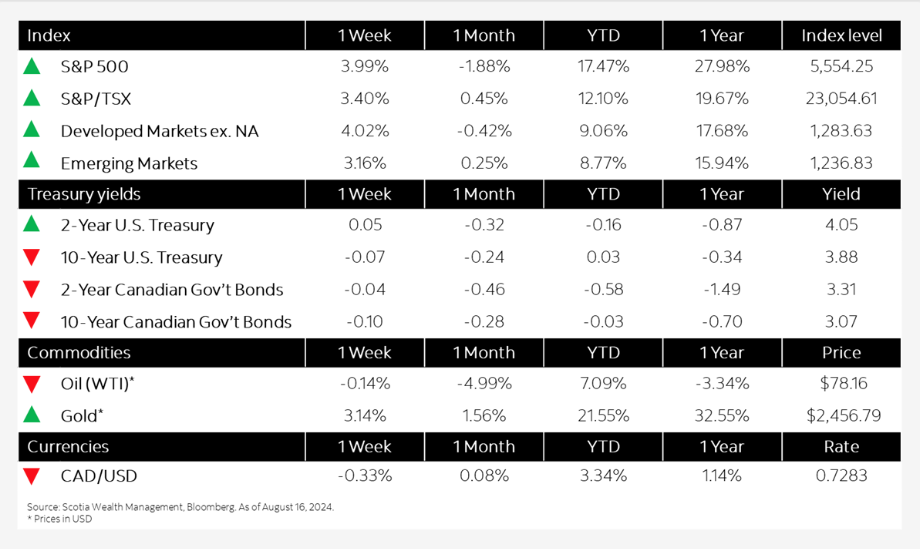
  • U.S. markets were 3.99 per cent1 higher for the week as moderating inflation and a resilient economy supported the case for a soft-landing which led to a risk on sentiment.
  • Canadian markets advanced 3.40 per cent2 with all sectors but communication services solidly in the black. A notable outlier is the materials sector that returned 6.86 per cent for the week, outpacing all other sectors.
  • European markets returned 4.02 per cent3 for the week, notching one of their largest weekly gains of the year as positive global economic data eased concerns over the state of the economy.
  • Despite China’s key growth indicators waning including weak domestic demand and an ongoing property market downturn, Emerging markets followed their developed market peers to return 3.16 per cent4 for the week.

Bond yields relatively stable given ebullient sentiment

Bond yields moved slightly lower for the week even as rate volatility remains at elevated levels as the scenario for a resilient economy that might introduce inflationary pressures is gaining traction. Monetary policy expectations for a rate cut from the Fed in September have toned down following the report but markets still largely expect a cut at the next meeting. Credit spreads are trading tighter on Friday amid somewhat lower primary supply during the last two trading sessions and a risk-on sentiment.

Highlights

  • The 2-year U.S. Treasury yield was 5 basis points (bps) higher, while the 10-year yield was down 7 bps. In Canada, the 2- and 10-year yields 7 bps.
  • According to data compiled by Bloomberg, July rating actions, as measured by upgrade-to-downgrade ratios, were mixed with Moody’s remaining pessimistic while S&P and Fitch took more optimistic view.
  • Sector wise, S&P was most pessimistic on consumer staples and cyclicals while energy and financials saw the most upgrades. Moody’s actions on the other hand were uniformly spread across all categories, according to Bloomberg.

Weekly dashboard

Real estate insolvencies in Canada set to surpass levels of global financial crisis

Residential property developers are facing rising insolvencies as they struggle with higher borrowing and construction costs, and industry experts warn that the trend is likely to worsen as interest expenses remain elevated. The number of insolvent real estate companies and projects has been rapidly climbing over the past year. It is now on track to surpass levels of the global financial crisis, according to data from the federal Office of the Superintendent of Bankruptcy. From January to May this year, there was an average of 20 real estate, rental or leasing insolvencies in Canada every month. Companies either sought bankruptcy protection or filed creditor proposals to make managing their debts easier under the Bankruptcy and Insolvency Act.

Highlights

  • At this pace, Canada is on track to reach about 240 real estate insolvencies this year, 57 per cent higher than in 2023 and 13 per cent higher than in 2009, when a wide swath of businesses ran into problems due to the financial crisis and global recession.
  • So far this year, the real estate sector has accounted for 55 per cent of the receiverships recorded by Insolvency Insider Canada, a website that tracks the largest insolvencies in the country. That compares to 30 per cent last year and 33 per cent in 2022.
  • According to Statistics Canada data, residential construction costs are 81 per cent higher across Canada’s major cities compared to 2017 and more than double (up 107 per cent) in the Toronto region.

U.S. inflation slowed again in July, clearing way for rate cuts

Year-over-year inflation reached its lowest level in more than three years in July, the latest sign that the worst price spike in four decades is fading and setting up the Fed for an interest rate cut in September. This week’s report from the U.S. Labor Department showed that consumer prices rose just 0.2 per cent from June to July after dropping slightly the previous month for the first time in four years. Measured from a year earlier, prices rose 2.9 per cent, down from 3 per cent in June. It is the mildest year-over-year inflation figure since March 2021. The government said nearly all the increase last month reflected higher rental prices and housing costs, a trend that, according to real-time data, is easing.

Highlights

  • Excluding the volatile food and energy categories, so-called core prices climbed 0.2 per cent from June to July, after a 0.1 per cent increase the previous month.
  • Core inflation rose 3.2 per cent compared to a year ago, down from 3.3 per cent in June, the lowest since April 2021. Economists closely watch core prices because they typically provide a better read of inflation’s direction.
  • Fed Chair Jerome Powell has said he is seeking additional evidence of slowing inflation before the Fed begins cutting its key interest rate. Economists widely expect the Fed’s first rate cut to occur in mid-September.

U.K. services inflation eases, keeping door open for more rate cuts

Inflation rebounded in the U.K. last month, but a slowdown in services prices makes it likely that the Bank of England (BoE0 will move to lower its key interest rate again over the coming months. Consumer prices were 2.2 per cent higher than a year earlier in July, rising slightly from June. However, prices in the services sector eased to 5.2 per cent; the services inflation rate was last lower in May 2022. The BoE and many economists expect services prices, a key focus, to continue to slow, helping return inflation to the central bank’s target toward the end of next year and likely allowing the bank to continue with rate cuts.

Highlights

  • Services inflation can be volatile, but the trend should continue to prove encouraging as the year goes on, allowing the BoE to cut rates in November and perhaps again in December.
  • Economists had forecast the pickup in headline inflation, mainly driven by energy prices that have been on a roller-coaster ride since Russia’s invasion of Ukraine. Having driven a surge in inflation during 2022, energy prices cooled to lead to a decline in inflation over the past 18 months.
  • Core inflation, which strips out the effects of energy prices as well as those of food, stood at its lowest level since September 2021, helping to convince the BoE that domestic trends are looking less liable to push inflation higher for longer.

In the news: Starbucks announces a new CEO amidst growing sales challenges

Starbucks announced that Brian Niccol, the current chairman and CEO of Chipotle, will assume the role of chair and CEO on September 9, replacing Laxman Narasimhan 17 months after his appointment. Following this announcement, Starbucks Corp. shares surged by more than 20 per cent earlier on Tuesday. Narasimhan, a former PepsiCo executive, became Starbucks’ chief executive in March 2023. However, since then, the company has faced challenges this year with weak sales in its two largest markets, the U.S. and China. Niccol is expected to address these issues by revitalizing sales and enhancing the in-store customer experience to re-establish Starbucks as a destination where customers are willing to pay premium prices.

Behind the headline

  • In the U.S., Starbucks has faced challenges balancing mobile order demand and faster service with its traditional upscale cafe experience, while in China, its second-largest market with 6,500 stores, customers have been increasingly choosing lower-cost competitors.
  • Brian Niccol has been credited for transforming Chipotle since becoming its CEO in 2018, emphasizing menu innovation, operational excellence, and digital transformation. Before joining Chipotle, Niccol served as the CEO of Taco Bell.
  • Niccol faces significantly larger challenges at Starbucks, with its 38,000 global stores, compared to Chipotle’s 3,500 U.S.-based locations., as he must attract inflation-conscious customers for its premiumly priced drinks.

1 S&P 500 Index CAD
2 S&P/TSX Composite Index CAD
3 Bloomberg Developed Markets ex N. America Large & Mid Cap Price Return Index CAD
4 Bloomberg EM Large & Mid Cap Price Return Index CAD

For local news delivered daily to your email inbox, subscribe for free to the rdnewsNOW newsletter by visiting rdnewsNOW.com. You can also download the rdnewsNOW mobile app on Google Play and the Apple App Store for all the latest updates on this and other stories.