
Subscribe to the 100% free rdnewsNOW daily newsletter!
OLYMPUS DIGITAL CAMERA
Sponsored

Market Watch: November 24

Nov 24, 2023 | 4:35 PM

This week’s highlights

  • Major indices rise for fourth straight week
  • Treasury yields hit multi-month lows
  • Canadian core and headline inflation decelerated in October
  • U.S. initial unemployment claims decline by most since June
  • Chinese advisors target steady growth in 2024, more stimulus
  • In the news: OpenAI CEO fired and rehired within span of a week

Week in review

Major indices rise for fourth straight week

With the prospect of a soft landing becoming more likely, most major global indices were set for their fourth week of positive gains. Economic data continues to trend in a positive direction while investors’ expectations for interest rate volatility declines. The labour market remains tight, consumer spending strong, corporate earnings largely positive, and inflation trending towards target. Higher interest rates are still however weighing on both businesses and consumers alike as debt financing remains higher than it otherwise would putting a damper on growth.

Highlights:

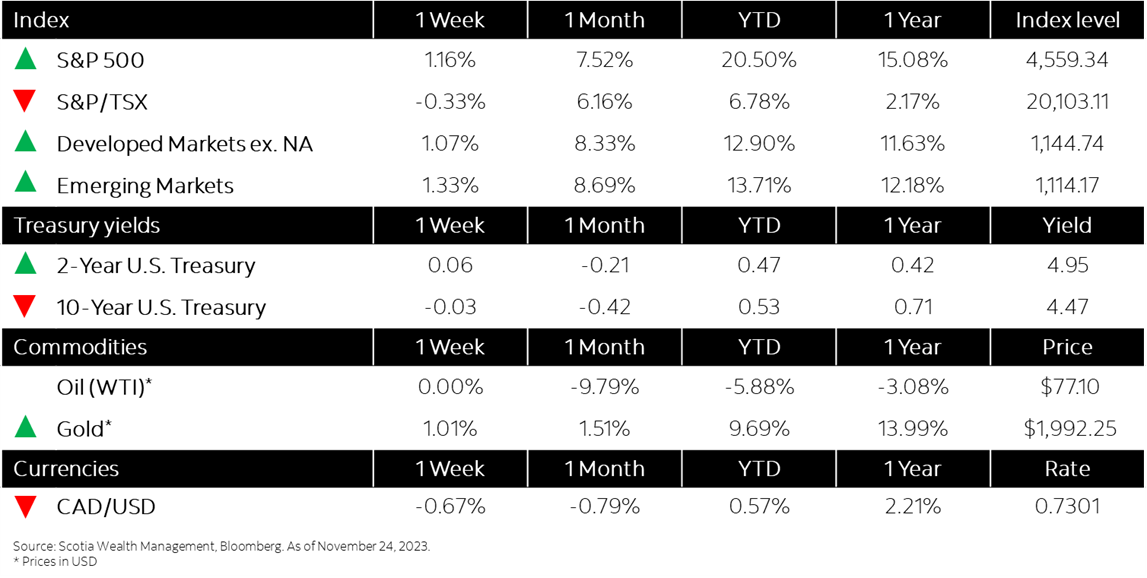
  • S. markets closed early on Friday for Thanksgiving, rising 1.16 per cent1 as bond yields trend lower amid the prospect of peak interest rates for the current cycle.
  • Canadian equities were -0.33 per cent2 lower despite a positive CPI report that indicated a decline in both headline and core inflation. The consumer discretionary sector was the largest detractor, down -2.02 per cent for the week.
  • Despite preliminary Purchasing Manager’s Index (PMI) data indicating a slight decline in euro zone business activity, European equities closed 1.07 per cent3
  • Emerging markets experienced a weekly gain of 1.33 per cent4 as losses across a broad swath of Latin America were offset by strong returns from Argentina which experienced its best week ever following the election of Javier Milei.

Treasury yields hit multi-month lows

As inflation cools on the back on tighter monetary policy conditions so too do government bond yields. While the most recent Federal Open Market Committee (FOMC) minutes indicate little appetite for cutting interest rates anytime soon, fed funds futures markets are indicating no probability that they will raise rates again this cycle, and have even begun to price in cuts in early-2024. Credit spreads continued to compress toward 12-month lows. Activity slowed significantly towards the end of the week with the early close in the U.S. for Thanksgiving.

Highlights:

  • The two-year U.S. Treasury yield rose six basis points (bps) while the 10-year yield was down three bps. In Canada, the two-year yield was down one bps and 10-year yield up four bps.
  • “Participants continued to judge that it was critical that the stance of monetary policy be kept sufficiently restrictive to return inflation to the Committee’s two percent objective,” said officials in the most recent FOMC meeting minutes.
  • There is a relatively busy week ahead on the macro front along with a few U.S. Federal Reserve (Fed) speakers, including Chair Powell, scheduled to present next Friday.

Weekly dashboard

(Market Watch — Scotia Wealth Management website)

Canadian core and headline inflation decelerated in October

Canada’s headline Consumer Price Index (CPI) rose 3.1 per cent year-over-year (YoY) in October, down from September’s increase of 3.8 per cent and in line with the median consensus estimate. The decline was mainly driven by lower gasoline prices. The October report supports the Bank of Canada’s (BoC) decision to keep rates unchanged at five per cent, indicating that monetary policy settings may be sufficiently restrictive to restore price stability. Evidence is mounting that higher borrowing costs are beginning to weaken the economy, with gross domestic product (GDP) unexpectedly contracting in the second quarter. The labour market is also showing signs of softening, with the unemployment rate increasing recently.

Highlights:

  • Mortgage interest costs, groceries, and rent were the largest contributors to price gains. Services also continued to pressure CPI, increasing 4.6 per cent YoY from 3.9 per cent in the previous month.
  • Canadians continued to feel the impact of rising rent prices, which accelerated in October to 8.2 per cent from 7.3 per cent in September. In addition, the increase in property taxes (4.9 per cent) was the largest since October 1992.
  • The BoC tracks to two other inflation metrics, CPI-trim and CPI-median, which filter out components exhibiting volatile price movements. The average of the two metrics eased to 3.6 per cent YoY from 3.8 per cent.

U.S. initial unemployment claims decline by most since June

While expectations are unchanged that the labour market is gradually slowing as higher interest rates continue to weigh on the economy, the number of Americans filing new claims for unemployment benefits fell more than expected last week. Fed meeting minutes indicated that policymakers believe the labour market “remained tight” while noting that conditions “had eased since earlier in the year, partly as a result of recent increases in labour supply”.

Highlights:

  • Weekly new jobless claims dropped 24,000 to 209,000, while continuing claims declined by 22,000 to 1.840m. While weekly new jobless claims have declined, they remain near 2023 highs.
  • Jobless claims tend to be particularly volatile around the holidays due to seasonal employment. The 4-week moving average of initial claims which smooths out some of that volatility moved lower to 220,000.
  • Fed officials have said they’re looking for conditions to soften further before easing monetary policy.

Chinese advisors target steady growth in 2024, more stimulus

Amid efforts to shore up the economy and keep long-term development goals on track, government advisors will recommend economic growth targets between 4.5 – 5.5 per cent for 2024 at the upcoming annual policymakers’ meeting. To achieve these targets, a significant increase in fiscal stimulus is likely necessary, considering the influence of COVID-19 lockdown on current growth figures. On the monetary policy side of the equation, economists largely expect that China will wait until early-2024 to cut policy rates to support the economy while implementing other forms of easing such as trimming shorter-term rates or reserve ratios in the meantime.

Highlights:

  • While recent growth forecasts have been revised upwards, China’s economy only grew three per cent in 2022 – a near half century low – and is expected to grow five per cent in 2023 and 4.5 per cent in 2024.
  • The difficulties of the post-COVID-19 recovery have prompted some economists to recommend shifting the drivers of growth away from property and infrastructure investment and towards household consumption while implementing market-oriented reforms.
  • To that end, Beijing has been redirecting more resources towards high-tech manufacturing and environmentally friendly industries. However, it has faced challenges in instilling confidence in both consumers and investors.

In the news: OpenAI CEO fired and rehired within span of a week
There was much ado about something in the Artificial Intelligence (AI) space over the last week as Sam Altman, the 38-year-old CEO of OpenAI, was fired by the Board of Directors last Friday on the back of a review stating that he was “not consistently candid in his communications” and had lost confidence in his ability to lead the company. On Monday, Microsoft, which owns 49 per cent of OpenAI, hired Altman to lead a new AI research team within Microsoft. Subsequently, it was announced early on Wednesday that Altman would return as the CEO of OpenAI with a few changes being made to the Board.

Behind the headline:

  • Hundreds of OpenAI employees, including the proposed interim CEO Mira Murati, protested Altman’s removal by signing a letter demanding the resignation of the Board and reinstatement of Altman as the CEO, failing which they would follow him to Microsoft which opened its doors to any employees who wanted to join them.
  • As the pressure from employees and investors grew, it put the entire organization’s future in jeopardy.
  • Considering that Altman and OpenAI are leaders in the AI space, this episode has thrown a renewed spotlight on the ongoing dialogues and concerns regarding ethical commercial adoption and governance of a rapidly expanding technology.

1 S&P 500 Index CAD
2 S&P/TSX Composite Index CAD
3 Bloomberg Developed Markets ex N. America Large & Mid Cap Price Return Index CAD
4 Bloomberg EM Large & Mid Cap Price Return Index CAD

® Registered trademark of The Bank of Nova Scotia, used under licence. Scotia Wealth Management® consists of a range of financial services provided by The Bank of Nova Scotia (Scotiabank®); The Bank of Nova Scotia Trust Company (Scotiatrust®); Private Investment Counsel, a service of 1832 Asset Management L.P.; 1832 Asset Management U.S. Inc.; Scotia Wealth Insurance Services Inc.; and ScotiaMcLeod®, a division of Scotia Capital Inc. Private banking services are provided by The Bank of Nova Scotia. Estate and trust services are provided by The Bank of Nova Scotia Trust Company. Portfolio management services are provided by 1832 Asset Management L.P. and 1832 Asset Management U.S. Inc. Insurance services are provided by Scotia Wealth Insurance Services Inc. Wealth advisory and brokerage services are provided by ScotiaMcLeod, a division of Scotia Capital Inc. International investment advisory services are provided by Scotia Capital Inc. Financial planning services are provided by The Bank of Nova Scotia and ScotiaMcLeod. Scotia Capital Inc. is a member of the Canadian Investor Protection Fund and the Investment Industry Regulatory Organization of Canada. Scotia Wealth Insurance Services Inc. is the insurance subsidiary of Scotia Capital Inc., a member of the Scotiabank group of companies. When discussing life insurance products, ScotiaMcLeod advisors are acting as Life Insurance Agents (Financial Security Advisors in Quebec) representing Scotia Wealth Insurance Services Inc. Scotia iTRADE®(Order-Execution Only Accounts) is a division of Scotia Capital Inc. (“SCI”). SCI is a member of the Investment Industry Regulatory Organization of Canada and the Canadian Investor Protection Fund. Scotia iTRADE does not provide investment advice or recommendations and investors are responsible for their own investment decisions.

This publication has been prepared by Scotia Capital Inc. and is intended as a general source of information only and should not be considered as personal and/or specific financial, tax, pension, legal or investment advice. We are not tax or legal advisors and we recommend that individuals consult with their qualified advisors before taking any action based upon the information contained in this publication. Opinions and projections contained in this publication are our own as of the date hereof and are subject to change without notice. While care and attention has been taken to ensure the accuracy and reliability of the material in this publication, neither Scotia Capital Inc. nor any of its affiliates make any representations or warranties, express or implied, as to the accuracy or completeness of such material and disclaim any liability resulting from any direct or consequential loss arising from any use of this publication or the information contained herein. This publication and all the information, opinions and conclusions contained herein are protected by copyright. This publication may not be reproduced in whole or in part without the prior express consent of Scotia Capital Inc.