
Subscribe to the 100% free rdnewsNOW daily newsletter!
Sponsored

Market Watch: August 18

Aug 21, 2023 | 11:40 AM

WEEK IN REVIEW

HIGH INTEREST RATES, GROWTH CONCERNS BITE AS MARKETS TURN LOWER

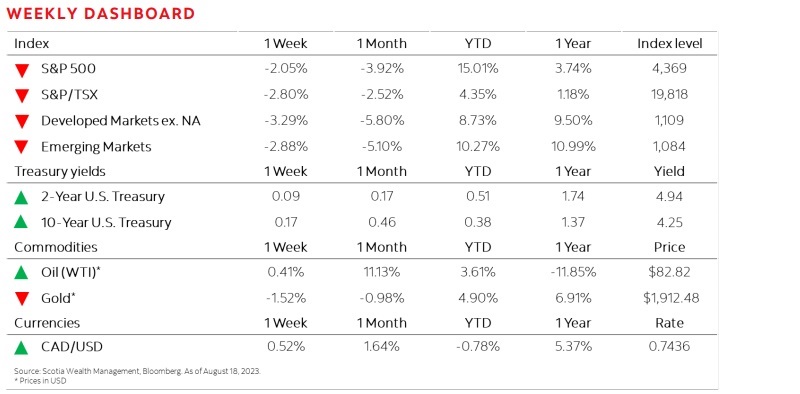
Equity markets grappled with a confluence of worries that weighed heavily on investor sentiment, setting markets on track for their worst week since March.

Concerns centered primarily around two events: first, the U.S. Federal Reserve (Fed) pointed to “upside risks” to inflation with the committee remaining open to further interest rate hikes as inflation remains high, and second were concerns over growth in the worlds second-largest economy as yet another embattled property developer – Evergrande Group – filed for bankruptcy protection.

Highlights:

• U.S. markets closed -2.05%1 lower following the release of Fed minutes, with most major indices heading for a third consecutive week of losses. The Dow Jones Industrial Average closed below its 50-day moving average, typically a bearish signal for investors.

• In Canada, markets also closed -2.80%2 lower, with sentiment turning negative following an uptick in July’s inflation reading. The materials sector (-5.90%) was by far the largest detractor, with health care (+1.89%) being the only positive contributor.

• European markets closed -3.29%3 lower as warning signs emerged about consumer spending. A big drop in U.K. retail sales (-1.2% actual vs. -0.5% expected) showed that consumers are feeling the hit from 14 back-to-back interest rate hikes.

• Evergrande filing for bankruptcy led to broad declines in the Asia-Pacific region that pushed emerging market equities -2.88%4 lower for the week.

BOND MARKET SHIFT FROM LOW-RATE ERA PUSHES TREASURYS NEAR 16-YEAR HIGH

U.S. and Canadian sovereign bond yields spiked higher last week following the release of Fed minutes that showed policymakers are open to further interest rate hikes. Both U.S. and Canadian inflation readings ticked higher in July, reflecting the diminishing effect of monetary policy and the difficulty that has been expected to fully rein in price growth. The surge in yields reflects investors’ expectations that central banks will likely keep interest rates higher for longer in a bid to bring inflation down to the 2% target.

Highlights:

• The 2-year U.S. Treasury yield rose 9 basis points (bps) while the 10-year yield rose 17 bps. The yield curve again steepened in Canada, with the 2-year yield up 14 bps and 10-year up 18 bps.

• The sell-off in bonds wasn’t just confined to North America. 10-year yields on U.K. gilts and German bunds hit their highest levels since 2008 and 2011, respectively.

• Until August, yields on 10-year U.S. Treasurys had struggled to stay above 4%, a level common prior to the 2008 financial collapse when interest rates were cut to all-time lows.

ECONOMIC SNAPSHOT

CANADIAN INFLATION JUMPS IN JULY, RAISING PROSPECT OF ANOTHER INTEREST RATE HIKE

According to Statistics Canada (StatCan), Canada’s annual inflation rate surged more than expected to 3.3% in July as core measures eyed by the central bank remained stubbornly high, increasing the likelihood of another interest rate increase. StatCan said the rise in headline inflation was mainly attributable to a base-year effect in gasoline prices, as a large monthly decline in July 2022 was no longer affecting the 12-month movement. The Bank of Canada projected in July that inflation would hover around 3% for about a year, before creeping down to its 2% target by the middle of 2025.

Highlights:

• Grocery prices rose 8.5% in July, the slowest pace in more than a year, mainly due to prices for fresh fruit and, to a lesser extent, bakery products.

• Excluding food and energy, prices rose 3.4% compared with a 3.5% rise in June. Services prices rose 4.3% annually in July, while the price of goods increased 2.3%.

• The Bank of Canada, after its last rate hike in July, said it would study data closely before moving again. It will have second-quarter gross domestic product data, due on September 1 to consider before its next rate announcement on September 6.

U.S. SHOPPERS BOOST RETAIL SALES FOR FOURTH STRAIGHT MONTH

Americans increased their retail spending in July for the fourth month in a row, a sign the strong labour market is continuing to encourage consumers to open their wallets. According to the U.S. Commerce Department, retail sales, a measure of spending at stores, online and in restaurants, rose a seasonally adjusted 0.7% last month from the month before. This was a faster pace than in June and was higher than the 0.2% increase in consumer prices last month, a sign that Americans’ spending is outpacing inflation.

Highlights:

• In July, shoppers increased their outlays at bars and restaurants, grocery and hardware stores. They also spent significantly in back-to-school categories, such as at clothing and bookstores.

• Sales declined at auto dealerships and electronics and furniture stores, which are sensitive to higher borrowing costs.

• Gasoline sales rose 0.4% in July. Gasoline prices ticked up to US$3.76 at the end of July from US$3.54 at the start of the month, according to energy-data provider OPIS.

JAPAN’S ECONOMY GROWS AT 6% PACE IN SECOND QUARTER

Japan’s economy expanded at a much faster pace than expected in the April-June quarter thanks to robust exports. Japan’s real gross domestic product increased 1.5% in the three months to June from the previous quarter, compared with 0.9% growth in the January-March period. This marked a rare case in which the world’s third-largest economy grew faster than its bigger counterparts, U.S. and China.

Highlights:

• It was the fastest quarterly growth in Japan since 2015, not counting a period of pandemic-induced gyrations in 2020. The Japanese economy grew for a third straight quarter and finally surpassed its pre-pandemic size in real terms.

• One reason was strength in car exports, which had struggled until recently because supply-chain problems made it hard for Japan’s car factories to meet customer demand. Overall, exports rose 3.2% from the previous quarter.

• A surge in foreign visitors to Japan also helped increase spending.

IN THE NEWS

FURTHER WOES FOR CHINA’S REAL ESTATE SECTOR

China’s heavily indebted property developer Evergrande Group filed for Chapter 15 bankruptcy protection on Thursday, more than two years after it defaulted on its debt. The company’s troubles came to a head in 2021, followed by defaults of smaller developers, and precipitated the slow decline of China’s real estate sector that now looks to pose a systemic risk to the country’s economy. This comes on the heels of another large developer, Country Garden, facing down a default of its own after recently missing two debt payments while holding $200bn USD in unpaid bills.

Behind the headline:

• Troubles in China’s real estate sector largely began in 2020 and have been getting progressively worse following a government crackdown on excessive borrowing that was fueling speculative investing in the property market.

• Buyers frequently took out mortgages to purchase pre-construction property which provided developers with a steady stream of revenue, but as the market slowed left buyers saddled with debt and no home.

• In filings, Evergrande says it presold 720,000 apartments that it had yet to complete at the end of 2022, while Country Garden has yet to complete nearly 1,000,000 apartments across hundreds of cities.

DISCLAIMER

This publication has been prepared by The Bank of Nova Scotia for Scotia Wealth Management clients and may not be redistributed. It is for general information purposes only and should not be considered or relied upon as personal and/or specific financial, tax, pension, insurance, legal or investment advice. We are not tax or legal advisors and we recommend that individuals consult with their qualified advisors, including tax and legal advisors, before taking any action based upon the information contained in this publication. Opinions and projections contained in this publication are our own as of the date hereof and are subject to change without notice. Scotia Wealth Management is under no obligation to update this commentary and readers should assume the information contained herein will not be updated. While care and attention has been taken to ensure the accuracy and reliability of the material in this publication, neither The Bank of Nova Scotia nor any of its affiliates or any of their respective directors, officers or employees make any representations or warranties, express or implied, as to the accuracy or completeness of such material and disclaim any liability resulting from any direct or consequential loss arising from any use of this publication or the information contained herein. This commentary may contain forward-looking statements based on current expectations and projections about future general economic factors. Forward-looking statements are subject to inherent risks and uncertainties which may be unforeseeable and such expectations and projections may be incorrect in the future. Forward-looking statements are not guarantees of future performance and you should avoid placing undue reliance upon them. This publication and all the information, opinions and conclusions contained herein are protected by copyright. This publication may not be reproduced in whole or in part without the prior express consent of The Bank of Nova Scotia. To the extent this document contains information or data obtained from third party sources, it is believed to be accurate and reliable as of the date of publication, but 1832 Asset ManagementL.P. does not guarantee its accuracy or reliability.

Scotia Wealth Management® consists of a range of financial services provided by The Bank of Nova Scotia (Scotiabank®); The Bank of Nova Scotia Trust Company (Scotiatrust®); Private Investment Counsel, a service of 1832 Asset Management L.P.; 1832 Asset Management U.S. Inc.; Scotia Wealth Insurance Services Inc.; and ScotiaMcLeod®, a division of Scotia Capital Inc. Private banking services are provided by Scotiabank. Estate and trust services are provided by The Bank of Nova Scotia Trust Company. Portfolio management is provided by 1832 Asset Management L.P. and 1832 Asset Management U.S. Inc. Insurance services are provided by Scotia Wealth Insurance Services Inc. Wealth advisory and brokerage services are provided by ScotiaMcLeod, a division of Scotia Capital Inc. International investment advisory services are provided by Scotia Capital Inc. Financial planning services are provided by Scotiabank and ScotiaMcLeod. Scotia Capital Inc. is a member of the Canadian Investor Protection Fund and the Canadian Investment Regulatory Organization. Scotia Wealth Insurance Services Inc. is the insurance subsidiary of Scotia Capital Inc., a member of the Scotiabank group of companies. When discussing life insurance products, ScotiaMcLeod advisors are acting as Life Insurance Agents (Financial Security Advisors in Quebec) representing Scotia Wealth Insurance Services Inc.

© Copyright 2023 The Bank of Nova Scotia. All rights reserved.

1 S&P 500 Index CAD

2 S&P/TSX Composite Index CAD

3 Bloomberg Developed Markets ex N. America Large & Mid Cap Price Return Index CAD

4 Bloomberg EM Large & Mid Cap Price Return Index CA