Subscribe to the 100% free rdnewsNOW daily newsletter!
OLYMPUS DIGITAL CAMERA
Sponsored

Market Watch: July 28

Jul 28, 2023 | 4:39 PM

WEEK IN REVIEW

Equity markets continue to deliver gains

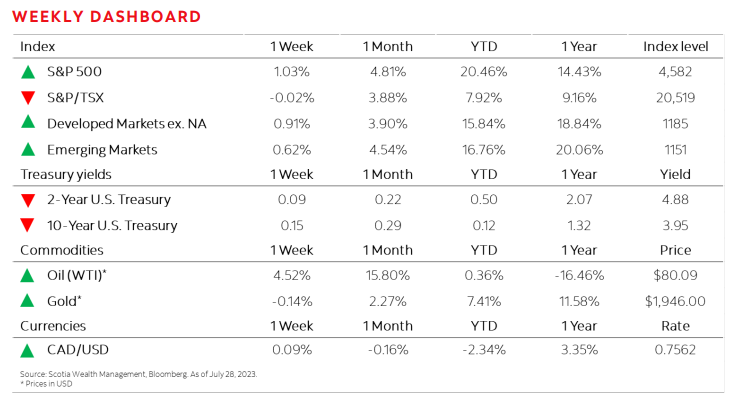
U.S. equities posted a third consecutive week of gains and returned 1.03 per cent1 on strong corporate earnings. Core personal consumption expenditures price index (PCE), a key inflation metric followed by the Federal Reserve (Fed), also fell to the lowest annual level in nearly two years. Canadian markets returned -0.02 per cent2 as key economic data indicated that the Canadian economy contracted in June. European markets marginally edged lower on Friday and posted a weekly gain of 0.91 per cent despite the European Central Bank (ECB) lifting rates 0.25 per cent, completing a third straight week of positive returns. Despite the growing geopolitical and growth risks, emerging markets closed 0.62 per cent4 for the week fuelled by real estate and consumer discretionary sectors.

Highlights:

  • In the U.S., the strong earnings season continued fuel index gains as Intel beat analysts’ estimates and posted robust earnings and provided an upbeat outlook. Similarly, Roku beat expectations on revenue and income as the streaming web giant cut its loss and substantially grew its user base. While core PCE (excluding food and energy costs) rose 4.1 per cent, the lowest annual increase since September 2021, the headline PCE inflation (including food and energy costs) increased 0.2 per cent month-on-month and three per cent on an annual basis. The yearly growth rate for headline PCE was the lowest since March 2021. This tame inflation data was noteworthy as the Fed increased the interest rates earlier in the week.
  • In Canada, market sentiment softened as preliminary estimates suggested that the Gross Domestic Product (GDP) had contracted by 0.2 per cent in June. This marks the first shrinkage of the year, driven by declines in the wholesale and manufacturing sectors. June’s contraction in output comes on the heels of a 0.3 per cent expansion in May, culminating in an annualized second-quarter growth rate of one per cent.
  • As European markets are navigating a season of mixed earnings reports and the most recent interest rate hike by the ECB, GDP data from two of the largest European counties added to the economic uncertainty in the region. While the German economy stagnated, France’s economy grew 0.5 per cent quarter-on-quarter, up from 0.1 per cent.

Sovereign bonds remain steady on mixed markets signals

U.S. Treasury yields rose through most of the week on the back of the Fed’s interest rate decision to increase policy rates and a hawkish stance of the Bank of Japan (BoJ). However, on Friday, yields declined slightly as the Fed’s preferred inflation gauge indicated cooling inflation in June. Credit spreads traded slightly tighter across the board after the Fed delivered a somewhat dovish message earlier this week. Borrowers raised approximately US$15 billion in the primary market this week, well below dealer estimates, taking the total for July to US$68 billion.

Highlights:

  • The two-year U.S. Treasury yield rose nine bps to 4.88 per cent, while the 10-year yield rose 15 bps to 3.95 per cent. In Canada, the two- year yield rose 15 bps to 4.69 per cent, while the 10-year yield rose 12 bps at 3.52 per cent.
  • BoJ left its policy rate unchanged at -0.1 per cent but surprised markets by introducing a monetary policy that allows more flexibility to its yield-curve control policy. The move came in after Tokyo’s Consumer Price Index (CPI) increased more than expected, and the BoJ revised its inflation outlook for 2023 to 3.2 per cent from 2.5 per cent. Japan’s interest-rate moves impact global bond markets, considering Japanese financial institutions and investors are major investors in government and corporate bonds.
  • Investment grade (IG) bonds marginally outperformed their high yield (HY) counterparts for the week. Credit spreads remained unchanged across all sectors, leaving most returns coming from Treasuries’ performance.

ECONOMIC SNAPSHOT

Canadian retail sales up 0.2 per cent to $66 billion in May, boosted by new car sales

Canadian shoppers showed signs of cooling as Statistics Canada (StatCan) reported retail sales in May rose less than its early estimate for the month and that its initial estimate for June suggested retail sales for that month were unchanged, but cautioned the figure would be revised.

A report by the Canadian Chamber of Commerce suggested that Canadian consumers kept spending in the second quarter, however, it said the spending turned a corner after the Bank of Canada resumed its interest-rate hikes in early June. Looking ahead, Chamber chief economist Stephen Tapp said he expects consumer spending to slow noticeably in the second half of the year as people cut back on discretionary purchases.

Highlights:

  • StatCan reported retail sales rose 0.2 per cent to $66 billion in May. In volume terms, retail sales rose 0.1 per cent.
  • Sales at motor vehicle and parts dealers gained 0.8 per cent, helped higher by a 0.7 per cent sales gain at new car dealers and a 5.5 per cent increase in the other motor-vehicle dealers category.
  • Sales at food and beverage retailers rose one per cent as sales at supermarkets and grocery stores gained 1.4 per cent.
  • Sales at clothing, clothing accessories, shoes, jewellery, luggage and leather-goods retailers fell 0.8 per cent in May while building material and garden equipment and supplies dealers dropped 1.5 per cent. • Core retail sales, which exclude gas stations and fuel vendors, along with motor vehicle and parts dealers, were unchanged in May.

U.S. federal reserve raises interest rates, leaves door open to another hike

The Fed raised interest rates by a quarter of a percentage point, citing still elevated inflation as a rationale for what is now the highest U.S. central bank policy rate in 16 years.

Though inflation data since the Fed’s meeting in June has been weaker than expected, policymakers have been reluctant to alter their hawkish stance until there is more progress in reducing price pressures. Key measures of inflation remain more than double the Fed’s target, and the economy, by many measures, including a low 3.6 per cent unemployment rate, continues to outperform expectations given the rapid increase in interest rates.

Highlights:

  • The rate hike, the Fed’s 11th in its last 12 meetings, set the benchmark overnight interest rate in the 5.25 -5.50 per cent range, and the accompanying policy statement left the door open to another increase.
  • “The (Federal Open Market) Committee will continue to assess additional information and its implications for monetary policy,” said the Fed in its statement and left the bank’s policy options open as it searches for a stopping point to the current tightening cycle.
  • As it stated in June, the Fed said it would watch incoming data and study the impact of its rate hikes on the economy “in determining the extent of additional policy firming that may be appropriate” to reach its two per cent inflation target.

IMF raises 2023 global economic growth forecast slightly

The International Monetary Fund (IMF) raised its 2023 global growth estimates slightly, given resilient economic activity in the first quarter but warned that persistent challenges were dampening the medium-term outlook. The IMF, in its latest World Economic Outlook, said inflation was coming down, and acute stress in the banking sector had receded, but the balance of risks facing the global economy remained tilted to the downside and credit was tight.

“We’re on track, but we’re not out of the woods,” said IMF chief economist Pierre-Olivier Gourinchas. “What we are seeing when we look five years out is a significant slowdown compared to what we had pre-COVID.” This was also related to the aging of the global population, especially in countries like China, Germany and Japan, he said. New technologies could boost productivity in the coming years, but that, in turn, could be disruptive to labour markets.

Highlights:

  • The IMF now projects global real GDP growth of three per cent in 2023, up 0.2 per cent from its April forecast, but left its outlook for 2024 unchanged, also at three per cent.
  • The 2023-24 growth forecast remains weak by historical standards, well below the annual average of 3.8 per cent seen between 2000 to 2019, mainly owing to weaker manufacturing in advanced economies, and it could stay at that level for years.

IN THE NEWS: EARNINGS SPOTLIGHT – AUTOMAKERS

Three of the U.S.’ largest automakers – Ford, General Motors and Tesla – reported strong second-quarter earnings per share and revenue, with Ford and General Motors upping their full-year profit forecasts. It was also a historic quarter of vehicle sales, with sales rising for all three companies reflecting strong consumer demand.

Ford had robust sales of gasoline-powered trucks and SUVs, which more than offset losses on electric models. General Motors’ quarterly results largely resulted from stronger-than-expected pricing, demand and capital discipline. Tesla, despite lower margins from reduced average sales prices and the additional cost of ramping up battery production, benefitted from strong overall sales, with its crossover Model Y being the best-selling vehicle worldwide in the first quarter.

Behind the headline:

  • Financials: Ford beat EPS expectations by 34.28 per cent ($0.72 vs. $0.54) and revenue by 2.68 per cent ($42.34 billion vs. $41.32 billion). General Motors beat EPS expectations by 4.09 per cent ($1.91 vs. $1.83) and revenue by 6.72 per cent ($44.75 billion vs. $41.93 billion). Tesla beat EPS by 11.12 per cent ($0.91 vs. $0.82) and revenue by 0.81% ($24.93 billion vs. $24.73 billion).
  • Sales of electric vehicles remained strong, but there are indications that demand is softening, with both Ford and Tesla recently cutting prices and wait times dropping from last year.
  • Major auto manufacturers, including BMW, General Motors, Honda, Hyundai, Kia, Mercedes-Benz and Stellantis, announced a plan to produce 30,000 fast chargers, nearly doubling the number currently available in North America.
  • Automakers have a strong incentive to ensure the adoption of electric vehicles, investing billions in manufacturing, battery production and establishing supplier networks.
    (Supplied)

DISCLAIMER

This publication has been prepared by The Bank of Nova Scotia for Scotia Wealth Management clients and may not be redistributed. It is for general information purposes only and should not be considered or relied upon as personal and/or specific financial, tax, pension, insurance, legal or investment advice. We are not tax or legal advisors and we recommend that individuals consult with their qualified advisors, including tax and legal advisors, before taking any action based upon the information contained in this publication. Opinions and projections contained in this publication are our own as of the date hereof and are subject to change without notice. Scotia Wealth Management is under no obligation to update this commentary and readers should assume the information contained herein will not be updated. While care and attention has been taken to ensure the accuracy and reliability of the material in this publication, neither The Bank of Nova Scotia nor any of its affiliates or any of their respective directors, officers or employees make any representations or warranties, express or implied, as to the accuracy or completeness of such material and disclaim any liability resulting from any direct or consequential loss arising from any use of this publication or the information contained herein. This commentary may contain forward-looking statements based on current expectations and projections about future general economic factors. Forward-looking statements are subject to inherent risks and uncertainties whichmay be unforeseeable and such expectations and projections may be incorrect in the future. Forward-looking statements are not guarantees of future performance and you should avoid placing undue reliance upon them. This publication and all the information, opinions and conclusions contained herein are protected by copyright. This publication may not be reproduced in whole or in part without the prior express consent of The Bank of Nova Scotia. Scotia Wealth Management® consists of a range of financial services provided by The Bank of Nova Scotia (Scotiabank®); The Bank of Nova Scotia Trust Company (Scotiatrust®); Private Investment Counsel, a service of 1832 Asset Management L.P.; 1832 Asset Management U.S. Inc.; Scotia Wealth Insurance Services Inc.; and ScotiaMcLeod®, a division of Scotia Capital Inc. Private banking services are provided by Scotiabank. Estate and trust services are provided by The Bank of Nova Scotia Trust Company. Portfolio management is provided by 1832 Asset Management L.P. and 1832 Asset Management U.S. Inc. Insurance services are provided by Scotia Wealth Insurance Services Inc. Wealth advisory and brokerage services are provided by ScotiaMcLeod, a division of Scotia Capital Inc. International investment advisory services are provided by Scotia Capital Inc. Financial planning services are provided by Scotiabank and ScotiaMcLeod. Scotia Capital Inc. is a member of the Canadian Investor Protection Fund and the Canadian Investment Regulatory Organization. Scotia Wealth Insurance Services Inc. is the insurance subsidiary of Scotia Capital Inc., a member of the Scotiabank group of companies. When discussing life insurance products, ScotiaMcLeod advisors are acting as Life Insurance Agents (Financial Security Advisors in Quebec) representing Scotia Wealth Insurance Services Inc. © Copyright 2023 The Bank of Nova Scotia. All rights reserved.

1. S&P 500 Index CAD
2. S&P/TSX Composite Index CAD
3. Bloomberg Developed Markets ex N. America Large & Mid Cap Price Return Index CAD
4. Bloomberg EM Large & Mid Cap Price Return Index CAD