Subscribe to the 100% free rdnewsNOW daily newsletter!
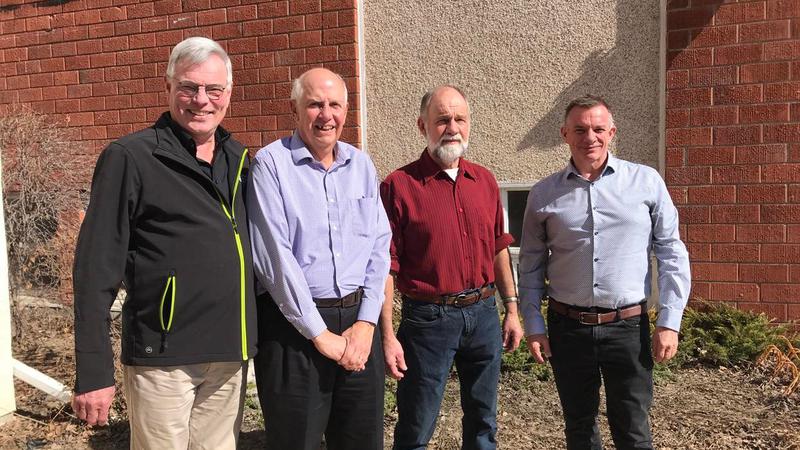
(L-R) Ary Vreeken, Canadian Foodgrains Bank (CFB) Regional Representative for Alberta; Doug Maas, 23-year committee member of the Central Alberta Foodgrains Growing Project; Vic Bergen, co-founder for the project; and Andy Harrington, CFB Executive Director, at the St. Andrew's United Church in Lacombe City on Thursday. (rdnewsNOW/Alessia Proietti)
Central Alberta Foodgrains Growing Project

Lacombe County-based project to feed hungry announces land for this year’s crop

Mar 24, 2023 | 12:26 PM

The Central Alberta Foodgrains Growing Project celebrated their 28th anniversary on Thursday in Lacombe, announcing their land for this year’s crop donation to the Canadian Foodgrains Bank (CFB).

Each year, the project sends all crop proceeds to the CFB to feed the hungry internationally.

Doug Maas, member of the project’s committee for 23 years, said 150 people attended their “25 plus three” celebration event at Lincoln Hall (41319 AB-792), as their 25th year anniversary was postponed due to the pandemic.

While he doesn’t know all the details just yet, Maas says the land is approximately 85 acres and adjacent to the Town of Bentley on the south side near the cemetery. Over the years, the committee says they have grown crops in 20 different districts and this year will be their second time near the town.

Maas said it has been increasingly difficult for farmers to donate land due to rising costs. While they used to receive roughly 160 acres for the project, they had just 58 acres last year, but still managed to raise $120,000 from the harvest as well as funds from sponsorships in urban cities and local farmers who donated their own canola crops.

READ: Thousands raised for the hungry in local canola crop harvest

“I think we sometimes need to keep that bigger picture in mind,” he said, explaining that while Canadians are also struggling, they have financial and health supports from government that other people do not have in the world.

“I often thought if I was one of those people in Somalia that was starving and didn’t know if I was going to eat for two or three days, I’d always want the feel that there was somebody in the world that cared about me and would help me.”

He says on harvest days, he has seen 17 combines work on the field while 350 community members gathered to watch, play games and cook burgers on the barbeque together.

“We’re not only helping the international community; we’re building our own community. We’re building community spirit with all these people coming together to make a difference.”

While there are 218 grain projects across the country and several in the province, the Lacombe County based project has provided over $1,500,000 to the CFB since 1996, says Maas.

Vic Bergen, local retired farmer and one of the co-founders, said while he used to donate, he wanted to create something where more people could participate.

“A lot of people, I think, who want to be involved, don’t know how. In the farming community, or the community in general, these projects enable people that might not otherwise do anything, [and] enable them to so something they’re comfortable doing.”

CFB Executive Director Andy Harrington, alongside Ary Vreeken, CFB Regional Representative for Alberta, said the central Alberta project has made incredible achievements.

“As well as the incredible community that I’ve experienced here in central Alberta that has been built, my friends here have been literally saving the lives of what would actually amount to tens of thousands of people around the world,” he said.

Since 1983, the CFB has donated over $1 billion in food related assistance to more than 70 countries and in 2022, was placed in the Ten Top Charities list by Charity Intelligence Canada, for the fifth year in a row.

The CFB is a partnership between 15 church and church-based agencies. Harrington said they work on over 115 projects per year, with their latest projects providing emergency food assistance in crises like the earthquake in Turkiye and Syria and the war in Ukraine, the historic draught in the horn of Africa in countries like Somalia, South Sudan, north Kenya, and Ethiopia, and helping small farmers achieve long term food severity. He said one mother he met in Ethiopia had to choose each day which of her children would not eat.

He says while there are currently many crises in the world, hunger is number one as it is driven by the others such as climate change which impacts farmers, conflict like the Russian-Ukraine war, and economic disruptions like the COVID-19 pandemic.

Harrington states that in 2019, 680 million people were severely hungry, having briefly reduced before returning to slow increase that year. However, in 2021, he says the number drastically increased to 828 million, according to the United Nations, and he believes those numbers will continue to rise. He says 50 million are on the edge of famine and 42 per cent of child deaths are due to malnutrition.

With rising inflation, Harrington says it has increased costs for their food baskets in Ethiopia by 38 per cent in a five-month period. He quoted David Beasley, Executive Director for the United Nations World Food Programme, who said ‘we’re taking from the hungry to give to the starving.’

However, even with the economic challenges, he says there has been a rise in charitable giving amongst Canadians.

He adds that with one million people helping in their projects last year, every person’s actions help make a difference, no matter how small. He urged everyone to remember each human is valuable as there are no ‘others’ in the world, just ‘us’ as one group of humans.