Subscribe to the 100% free rdnewsNOW daily newsletter!
(rdnewsNOW/Sheldon Spackman)
As of Aug. 9, 2022

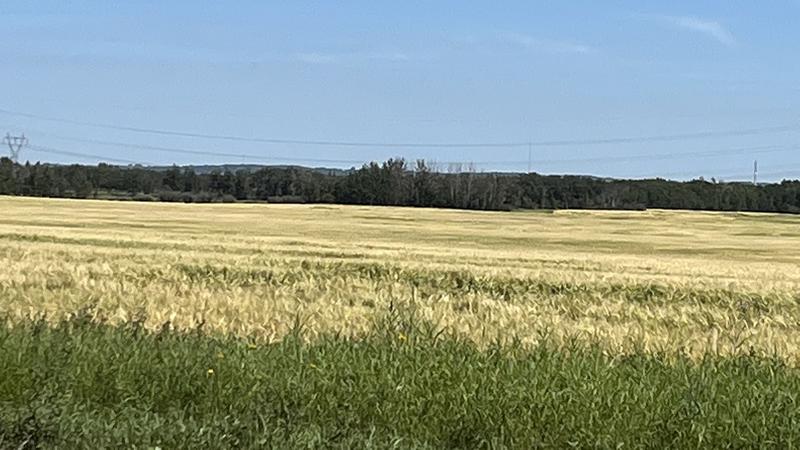
Local crops in good condition but more moisture still needed

Aug 12, 2022 | 2:58 PM

Crops in most areas of central Alberta are still in good conditions, but more rain is needed to improve soil moisture and fill the crops.

That, according to the latest Crop Report from Agriculture Financial Services Corporation (AFSC) and Alberta Agriculture, Forestry and Rural Economic Development.

Officials say hot weather benefited crops that were behind due to the dry spring, although some canola fields are still in late the flowering stage. A hail storm on August 1, however, caused severe damage in a few counties. Haying and silaging have been progressing quickly though to build up feed reserves.

Producers are wrapping up first cut hay, with 90 per cent completion for both dryland and irrigated hay, slightly behind normal. For dryland, first cut average yield is estimated at 1.5 tons per acre, and for irrigated, at 2.3 tons per acre (both above the 5-year averages). Quality is rated as 81 per cent good to excellent for dryland hay and 85 per cent good or excellent for irrigated.

Pasture growing conditions (tame hay conditions shown in brackets) are reported as 12 (10) per cent poor, 23 (21) per cent fair, 61 (64) per cent good and 4 (5) per cent excellent.

Surface soil moisture is rated (sub-surface soil moisture ratings shown in brackets) at 13 (11) per cent poor, 26 (31) per cent fair, 45 (41) per cent good, and 12 (13) per cent excellent, with 4 (4) per cent excessive.

Over the past two weeks, precipitation in the central and northern parts of the province has been variable, but even the driest areas have received 10 to 20 mm, and for many widely scattered areas, well over 30 mm. In contrast, several areas in the South Region and the southern half of the Central Region have received less than 10 mm, with some receiving less than 5 mm of moisture.

During this period, temperatures in Alberta have generally remained above normal, which contributed to crop development and drying out the wet areas throughout the central and northern parts of the province. However, conditions across the south have dried significantly. From beginning of July, crop development was accelerated by the above normal temperatures and, at this point, is on par with the 5-year averages.

Spring seeded cereals across the province are mostly in the beginning of the dough development growth stage, while fall seeded crops are in the ripening stage. About 90 per cent of canola and 99 per cent of dry peas, lentils and chickpeas are in the podding stage. Harvest operations have begun for fall-seeded crops and pulses in the South and Central Regions.

Provincial crop growing condition ratings declined slightly from the previous report (conditions as of July 26). Currently, 70 per cent of crops in Alberta are in good or excellent condition, compared to the 5-year average of 56 per cent. While crop growing conditions in all regions remained above their 5-year averages, compared to the previous report, growing condition ratings dropped for all regions, except for the North West. As some excessive moisture in the North West Region dried out, crop growing condition ratings in this region improved and are now the highest among regions, with 83 per cent of crops in good or excellent conditions.

Yield estimates are above both the 5-year and 10-year averages in all regions. Provincially, the estimated dryland 5-year yield index is 115.1, indicating that provincial yields are estimated at 15 per cent above the 5-year averages. Regionally, the 5-year yield index is the best in the Peace Region (estimating yields 23 per cent above the 5-year averages), followed by the South Region (estimating 20 per cent above the 5-year averages). Estimated yields in the Central and North East Regions are respectively 15 and 12 per cent above their regional averages. The lowest yield estimates are reported in the North West Region, where expected yields are only six per cent above the 5-year average. These estimates are preliminary and subject to change, but will be updated bi-weekly.

Provincial surface and sub-surface soil moisture reserves deteriorated from the last report (respectively by 22 and eight per cent), as a result of less precipitation, above normal temperatures and wind. Currently, surface soil moisture is rated at 39 per cent good, 8 per cent excellent and 2 per cent excessive, while 51 per cent is rated as poor or fair. However, compared to the long-term, soil moisture reserves remain at least normal for most of the province.

Pasture growing condition ratings across the province declined by five per cent from two weeks ago and are now rated as 10 per cent poor, 41 per cent fair, 46 per cent good and 3 per cent excellent. First cut haying is 94 per cent complete across the province, ahead of the 5-year average of 89 per cent, and second cut is underway in some areas.

Yield for first cut dryland hay is estimated at 1.6 tons per acre (above the 5-year average of 1.4 tons per acre), with quality rated as 5 per cent poor, 22 per cent fair, 61 per cent good and 12 per cent excellent. For irrigated hay, yield is reported at 2.2 tons per acre, below the 5-year average of 2.4 tons per acre.

Quality is rated at 3 per cent poor, 30 per cent fair, 62 per cent good and 5 per cent excellent.

Additionally, producers are silaging a number of cereal acres, as feed reserves were depleted last season.