LOCAL NEWS THAT MATTERS, SENT TO YOU DIRECTLY. SUBSCRIBE FOR FREE!
Sponsored

Market Watch — August 21, 2026

Aug 21, 2026 | 4:36 PM

This week’s highlights

  • Semis, oil, and tariffs steer equities lower despite late-week bounce
  • Long-dated global sovereign yields spike before US Treasury increased buyback plan somewhat steadies rates
  • Canadian inflation edges higher keeping tightening risks alive
  • U.S. business activity accelerates in August as services offset manufacturing softness
  • Eurozone activity firms in August on the strongest manufacturing growth in years

Week in review

Semis, oil, and tariffs steer equities lower despite late-week bounce

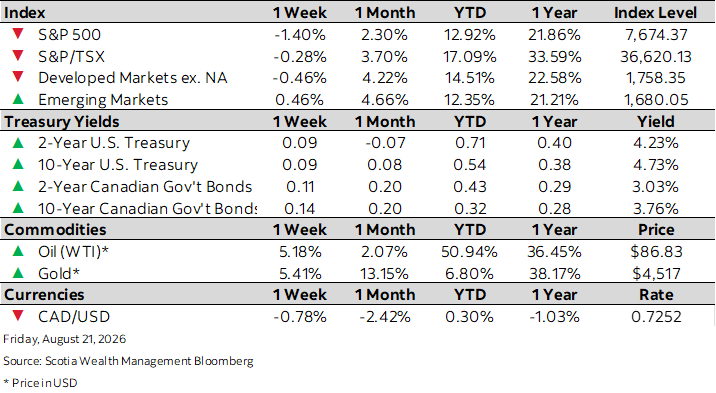
U.S. equities spent much of the week on the back foot as firmer oil revived inflation concerns that weighed on richly valued tech and AI names, with a semiconductor-led selloff driving Tuesday’s sharp drop. A brief mid-week rally on the Treasury’s buyback announcement faded as Walmart’s soft results and hawkish Fed minutes lingered, and though Friday’s strong PMIs steadied the tape, equities closed the week in the red.

Canadian equities also finished lower amid sizable intraday swings. Stocks slid from early-week highs as they tracked U.S. risk-off sentiment, before spiking Wednesday on news of the tariff delay and U.S. Treasury’s buyback plans. The bounce was short-lived, however with markets drifting lower again into Thursday. A sharp Friday rebound, helped by a firm domestic retail sales report, recovered much of the damage, with commodity prices lending support to resource sectors throughout. Still, a hotter-than-expected CPI print that lifted Bank of Canada (BoC) hike expectations and uncertainty around the delayed U.S. tariff deadline, now set for midnight tonight, kept a lid on further gains.

European equities spent most of the week grinding lower, with regional benchmarks falling for seven consecutive sessions in nearly their longest losing streak since 2016 as weak risk sentiment and fiscal concerns weighed. A very modest Friday rebound on stronger-than-expected eurozone manufacturing PMIs did little to offset the week’s declines, while France remained a persistent laggard as an extreme summer heat wave weighed on services activity.

Chinese equities finished lower in a volatile week, advancing through Tuesday before a sharp Wednesday selloff as a crowded technology and semiconductor trade unwound, with only modest recovery into Friday despite fresh signals of fiscal support from Beijing. The broader emerging-market complex fared better, ending higher as a rebound in Korean semiconductors following SK Hynix’s buyback and record-setting EM currencies lifted sentiment, though Japanese exporters lagged on a firmer yen.

Highlights:

  • U.S. equities closed -1.40%1 lower as firmer oil, a semiconductor-led decline, Walmart’s earnings miss and hawkish Fed minutes outweighed a mid-week buyback-driven rally and Friday’s resilient flash PMIs.
  • Canadian equities finished -0.28%² lower in choppy trading, as a hotter inflation print that lifted Bank of Canada hike bets and tariff-deadline uncertainty offset firm commodity prices, a Wednesday tariff-delay pop and a retail-sales-driven Friday bounce.
  • European equities slid -0.46%3 with regional indices sliding for seven straight sessions on soft risk appetite and fiscal concerns before a very modest Friday recovery driven by robust eurozone manufacturing data.
  • Emerging market equities ended 0.46%⁴ higher, lifted by a Korean chip recovery and record-setting EM currencies, though Chinese equities bucked the trend and finished lower as an unwind in crowded tech and semiconductor positions drove losses that Beijing’s support pledges only partly cushioned, while a stronger yen pressured Japanese exporters.

Long-dated global sovereign yields spike before US Treasury increased buyback plan somewhat steadies rates

Long end U.S. Treasuries sold off aggressively early in the week, with 10- and 30-year yields reaching their highest levels since 2025 and 2007, respectively, on fiscal sustainability worries, heavy issuance (both government and AI-related corporate) and energy driven inflation concerns. Treasury Secretary Bessent surprised the bond market Wednesday by announcing a plan to double the size of the department’s long-dated buyback operations and sparking a sharp rally in yields. However, oil’s renewed climb largely unwound the rally in yield by Thursday and coupled with a strong US PMI report Friday, yields were largely back to the levels before Bessent spoke. Canadian bonds bear-steepened in sympathy, pressured further by a warm CPI (July) report that lifted the Bank of Canada rate hike expectations. European sovereigns underperformed as fiscal concerns and record yielding German and French issuance drove borrowing costs higher, though UK Gilts outperformed on in-line U.K. inflation. Japanese government bonds whipsawed, while record setting emerging market currencies underpinned demand for carry.

Highlights:

  • The 2- and 10-Year U.S. Treasury yields both rose 9 basis points (bps) for the week. In Canada, the 2- and 10-year sovereign yields were 11 bps and 14 bps higher, respectively. Bond yields and prices move inversely to one another.
  • Developed-market sovereign yields pushed to multi-decade highs midweek on fiscal and supply pressures before the U.S. buyback expansion and stronger eurozone PMIs helped stabilize the long end into Friday.
  • A record-pace corporate supply calendar compounded the long-end selloff, with heavy investment-grade issuance adding to duration pressure amid thin August liquidity conditions.

Weekly dashboard


Canadian inflation edges higher keeping tightening risks alive

Canada’s July inflation report came in slightly firmer than expected, reinforcing the view that inflation progress remains uneven and keeping the possibility of further Bank of Canada tightening on the table. Headline inflation accelerated modestly, while core inflation measures also surprised slightly to the upside, suggesting underlying price pressures have not fully dissipated. Although several categories contributed to the stronger reading, inflation remains relatively contained overall, with key core measures still hovering around the Bank of Canada’s target range. The data prompted markets to modestly increase expectations for future rate hikes and supports the narrative that policymakers will remain cautious as they assess whether recent strength in economic activity and employment could translate into more persistent inflation pressures.

Highlights:

  • Canadian CPI rose 3.0% year-over-year in July, up from 2.8% previously and above the 2.9% consensus forecast. Monthly prices increased 0.5%, exceeding expectations for a 0.4% gain.
  • Price pressures were broad based, with six of eight major categories accelerating. Transportation costs were a key contributor as gasoline prices rose 25.7% year-over-year and 3.6% month-over-month, while air transportation inflation reached 12%.
  • Some areas provided offsetting relief. Shelter inflation slowed to 1.3% from 1.5%, while food inflation eased to 3.0% from 3.5%, reaching its lowest pace since June 2025 and helping temper overall inflation pressures.

U.S. business activity accelerates in August as services offset manufacturing softness

U.S. private-sector growth picked up sharply in August, driven by the strongest services expansion in nearly two years, which more than offset a modest slowdown in manufacturing and pointed to a firming economic backdrop heading into the second half of the year. Flash data released Friday by S&P Global showed the Composite Output Index rising to 56.0, its highest level since April 2022, up from 54.5 in July, with the survey suggesting third-quarter growth is tracking close to 3.0% annualized, roughly double the 1.5% pace seen in the second quarter.

Highlights:

  • The services PMI rose to 56.8, the highest since December 2024 and well above both the July reading of 54.6 and the 54.0 consensus, with new business growth the fastest since December 2024 and services hiring expanding the most in 19 months.
  • Manufacturing eased to a five-month low of 53.2, down from 53.9 in July and below expectations for an unchanged reading, as reduced safety-stock building and supply disruptions from the U.S.-Iran war weighed on factory output, which grew at its slowest pace in 13 months. Order growth slowed for a fourth consecutive month.
  • Price pressures receded somewhat but remained elevated, with input costs and selling prices still growing and the average cost increase so far in Q3 slightly exceeding the second quarter. S&P Global cautioned that price pressures remain prone to renewed upside should energy prices rise again.

Eurozone activity firms in August on the strongest manufacturing growth in years
Eurozone business activity gained momentum in August, with the region’s factory sector posting its strongest growth in more than four years, helping offset softness in its two largest economies and tempering expectations for near-term European Central Bank easing. Flash data from S&P Global showed the composite PMI edging up to 52.1 from 52.0 in July, ahead of the 51.7 consensus, as manufacturing strength and improving new orders pointed to broadening resilience across the bloc despite headwinds from elevated energy prices and the U.S.-Iran conflict.

Highlights:

  • The manufacturing PMI rose to 52.8 from 51.9, the highest reading since May 2022 and a seventh consecutive month of expansion, while services held steady at 51.7, above the 51.5 consensus. New orders climbed to 52.2 from 50.7, their highest level since March 2022.
  • Germany’s composite PMI dipped to 51.0 from 51.3, missing consensus, but manufacturing surged to 54.1 from 52.2 — its best reading since May 2022 — with new orders jumping to 55.1. Services remained the weak spot, falling to 48.5 and marking a fifth straight month of contraction.
  • France remained the region’s laggard, with its composite PMI unexpectedly slipping to 48.8 from 49.4 as an extreme summer heat wave weighed on services, which fell to 48.4 — an eighth consecutive month of contraction. Manufacturing offered a bright spot, improving to 51.5.

1  S&P 500 Index USD

2 S&P/TSX Composite Index USD

3 Bloomberg Developed Markets ex N. America Large & Mid Cap Price Return Index USD

4 Bloomberg EM Large & Mid Cap Price Return Index USD

Disclaimer: This publication has been prepared by The Bank of Nova Scotia for Scotia Wealth Management clients. It is for general information purposes only and should not be considered or relied upon as personal and/or specific financial, tax, pension, insurance, legal or investment advice. We are not tax or legal advisors, and we recommend that individuals consult with their qualified advisors, including tax and legal advisors, before taking any action based upon the information contained in this publication. The opinions and projections contained in this publication are our own as of the date hereof and are subject to change without notice. Scotia Wealth Management is under no obligation to update this publication, and readers should assume the information contained herein will not be updated. While care and attention has been taken to ensure the accuracy and reliability of the material in this publication, neither The Bank of Nova Scotia nor any of its affiliates or any of their respective directors, officers or employees make any representations or warranties, express or implied, as to the accuracy or completeness of such material and disclaim any liability resulting from any direct or consequential loss arising from any use of this publication or the information contained herein. This publication may contain forward-looking statements based on current expectations and projections about future general economic factors. Forward-looking statements are subject to inherent risks and uncertainties which may be unforeseeable and such expectations and projections may be incorrect in the future. Forward-looking statements are not guarantees of future performance and you should avoid placing undue reliance upon them. This publication and all the information, opinions and conclusions contained herein are protected by copyright. This publication may not be reproduced in whole or in part without the prior express consent of The Bank of Nova Scotia. To the extent this document contains information or data obtained from third party sources, it is believed to be accurate and reliable as of the date of publication, but Scotia Wealth Management does not guarantee its accuracy or reliability.

® Registered trademark of The Bank of Nova Scotia, used under licence (where applicable). ™ Trademark of The Bank of Nova Scotia, used under licence (where applicable). Scotia Wealth Management® consists of a range of financial services provided by The Bank of Nova Scotia (Scotiabank®); The Bank of Nova Scotia Trust Company (Scotiatrust®); Scotia Jarislowsky Fraser, a service of 1832 Asset Management L.P.; 1832 Asset Management U.S. Inc.; Scotia Wealth Insurance Services Inc.; and ScotiaMcLeod®, a division of Scotia Capital Inc. Private banking services are provided by The Bank of Nova Scotia. Estate and trust services are provided by The Bank of Nova Scotia Trust Company. Portfolio management is provided by 1832 Asset Management L.P. and 1832 Asset Management U.S. Inc. Insurance services are provided by Scotia Wealth Insurance Services Inc. Wealth advisory and brokerage services are provided by ScotiaMcLeod, a division of Scotia Capital Inc. International investment advisory services are provided by Scotia Capital Inc. Financial planning services are provided by The Bank of Nova Scotia and ScotiaMcLeod. Scotia Capital Inc. is a member of the Canadian Investor Protection Fund and is regulated by the Canadian Investment Regulatory Organization. Scotia Wealth Insurance Services Inc. is the insurance subsidiary of Scotia Capital Inc., a member of the Scotiabank group of companies. When discussing life insurance products, ScotiaMcLeod advisors are acting as Life Insurance Agents (Financial Security Advisors in Quebec) representing Scotia Wealth Insurance Services Inc.

Scotia Wealth Management® in The Bahamas consists of a range of financial services provided by Scotiabank (Bahamas) Limited and The Bank of Nova Scotia Trust Company (Bahamas) Limited, which are entities licensed to operate within The Bahamas. International private banking and international investment advisory services are provided by Scotiabank (Bahamas) Limited. International wealth structuring solutions are provided by The Bank of Nova Scotia Trust Company (Bahamas) Limited. ® Registered trademark of The Bank of Nova Scotia, used under licence.

Scotia Wealth Management® in the Cayman Islands consists of a range of financial services provided by Scotiabank & Trust (Cayman) Ltd. International private banking services, international investment advisory services, and international wealth structuring solutions are provided by Scotiabank & Trust (Cayman) Ltd., an entity licensed by the Cayman Islands Monetary Authority. ® Registered trademark of The Bank of Nova Scotia, used under license.

Scotia Wealth Management® in Jamaica consists of a range of Private Banking services provided by the Scotiabank Group of companies (Scotiabank®). ®Registered trademark of The Bank of Nova Scotia, used under licence.