LOCAL NEWS THAT MATTERS, SENT TO YOU DIRECTLY. SUBSCRIBE FOR FREE!
Sponsored

Market Watch — Aug. 14, 2026

Aug 14, 2026 | 6:33 PM

This week’s highlights

  • Markets ride softer inflation, eye consumer slowdown
  • Benign inflation, disappointing U.S. retail sales drive front-end yields lower
  • Canada-U.S. trade talks approach key deadline
  • U.S. consumer inflation eases while producer prices hold steady
  • Eurozone economy picks up speed as second-quarter growth accelerates

Week in review

Markets ride softer inflation, eye consumer slowdown

U.S. equities began the week supported by record-high momentum, resilient AI enthusiasm and encouraging small-business sentiment, but investors remained focused on inflation and Middle East-related energy risks. As the week progressed, benign CPI and PPI readings reinforced expectations that the U.S. Federal Reserve (Fed) would stay on hold, helping extend the technology-led rally and lifting AI-linked stocks. By Friday, weaker-than-expected retail sales tempered enthusiasm by raising questions about consumer resilience, though softer growth and inflation data further reduced expectations for additional policy tightening.

Canadian equities generally outperformed early in the week as elevated oil prices and commodity strength supported resource-heavy sectors, while attention remained fixed on U.S.-Canada trade negotiations ahead of the August tariff deadline. As inflation data cooled and risk sentiment improved globally, Canadian stocks participated in the broader rally, although gains moderated alongside concerns about softer U.S. consumer demand later in the week.

European equities were supported by a stronger-than-expected earnings season at the start of the week and later benefited from global easing in inflation concerns. While investors weighed U.K. growth data and the outlook for higher energy costs, improving risk appetite and supportive earnings trends helped regional markets grind higher.

Chinese equities lagged broader global markets as higher oil prices weighed on energy-importing economies and concerns around domestic demand persisted. Although markets briefly rebounded alongside improving global sentiment, disappointing credit and loan-growth data later in the week reinforced concerns over the durability of China’s recovery, while Korea continued to recover on renewed AI and semiconductor optimism.

Highlights:

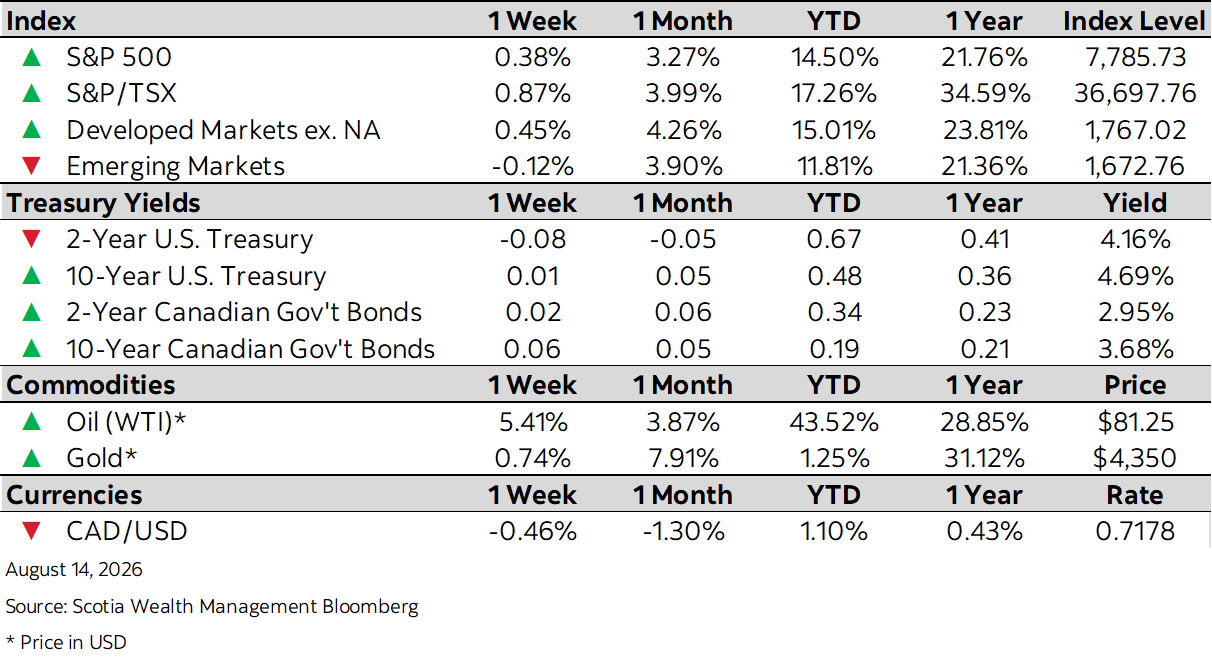
  • U.S. equities returned 0.38%,1 driven by a combination of cooling inflation, strong AI-related earnings and fading Fed hike expectations, although a late-week retail sales disappointment introduced concerns that consumer spending momentum may be starting to soften.
  • Canadian equities returned 0.87%,2 benefitting from firm commodity prices, a supportive backdrop for resource sectors and improving global risk appetite, while investors monitored U.S.-Canada trade negotiations and the implications of softer U.S. economic data.
  • European equities advanced 0.45%,3 supported by better-than-expected earnings and improving global sentiment as inflation concerns eased, with investors also assessing U.K. growth data and the broader impact of elevated energy prices.
  • Chinese and emerging market equities returned -0.12%4 as Chinese shares remained constrained by weak domestic demand signals and disappointing credit data, while broader emerging markets were lifted by technology and semiconductor strength, particularly in Korea’s AI-linked sectors.

Benign inflation, disappointing U.S. retail sales drive front-end yields lower

U.S. short-term bond yields moved lower during the week as both Consumer Price Index (CPI) and Producer Price Index (PPI) data came in broadly in line with expectations, providing no material upside surprises. The front end of the yield curve continued to respond to incoming economic data and its implications for the U.S. Federal Reserve’s (Fed) next rate decision, while longer-term yields remained comparatively less sensitive. Yields edged higher on Friday, partially unwinding Thursday’s rally. As of this writing, markets are pricing in roughly a 70% probability that the Fed will leave rates unchanged at its next meeting. However, with another month of economic data still to come, expectations may shift before policymakers make their final decision.

Canadian sovereign yields followed in suit with their U.S. counterparts with Canadian economic data being light this week. European yields digested improving U.K. GDP data amid a backdrop of geopolitical uncertainty that leave the future direction of inflation and central bank rates less certain.

Highlights:

  • The 2-year U.S. Treasury yields declined 8 basis points (bps) while 10-year U.S. Treasury yields were up 1 basis point (bps). In Canada, the 2- and 10-year sovereign yields were 2 bps and 6 bps higher, respectively. Bond yields and prices move inversely to one another.
  • Sovereign bond markets were primarily influenced by U.S. data with Canada light on economic data this week.
  • Credit spreads remained essentially unchanged, while corporate bond yields declined in tandem with government bond yields.

Weekly dashboard


Canada-U.S. trade talks approach key deadline

Canadian-U.S. trade negotiations are entering an important period as both countries work toward a potential agreement ahead of the August 19 deadline for additional U.S. tariffs on certain Canadian imports. Discussions are focused on whether a deal can be reached that reduces trade-related uncertainty and avoids further escalation. Reports suggest negotiations may involve targeted Canadian concessions in exchange for tariff relief in affected sectors, although the details and durability of any agreement remain uncertain. The commentary notes that Canada enters these discussions with several supportive factors, including recent economic momentum, a stronger labour market relative to the U.S., growing export diversification, increased foreign investment and a stable federal majority government. These developments could influence the negotiating environment as both sides weigh the economic and political implications of a potential trade agreement.

Highlights:

  • The key near-term milestone is the August 19 deadline for potential U.S. Section 338 tariffs on approximately $20 billion of Canadian imports, with Canada indicating that retaliatory measures remain under consideration if tariffs proceed.
  • Reported Canadian concessions could include reducing some retaliatory tariffs, revisiting the ban on U.S. alcohol in participating provinces, making further adjustments to dairy quotas and modifying certain procurement policies.
  • The commentary points to several factors supporting Canada’s position, including a federal majority mandate through at least October 2029, a Canadian dollar about $0.20 lower versus the U.S. dollar since 2021 and rising foreign direct investment led by countries other than the U.S.

U.S. consumer inflation eases while producer prices hold steady

U.S. inflation pressures showed mixed signals this week, as consumer price growth eased modestly while producer-level inflation remained elevated, reinforcing expectations that the U.S. Federal Reserve will continue to watch incoming data closely before making further policy moves. Data released Wednesday by the U.S. Bureau of Labor Statistics showed the Consumer Price Index (CPI) rose 0.1% in July from the previous month, after a 0.4% decline in June. On an annual basis, consumer prices increased 3.4%, down from 3.5% in June.

Highlights:

  • Shelter costs rose 0.1% during the month and accounted for roughly two-thirds of the overall increase, while food prices also climbed 0.1%. Energy prices, meanwhile, fell 1.5%, helping to moderate headline inflation. Core CPI, which excludes volatile food and energy prices, increased 0.2% in July and was up 2.5% from a year earlier.
  • Thursday’s producer inflation report showed underlying price pressures remain. The Producer Price Index was unchanged in July as higher services costs were offset by lower goods prices, but producer prices were still up 4.7% from a year earlier.
  • The latest readings suggest inflation is gradually cooling, though underlying pressures remain. Falling energy prices helped temper consumer inflation, while services costs and producer-price data pointed to a more uneven path back to price stability.

Eurozone economy picks up speed as second-quarter growth accelerates
The eurozone economy regained momentum in the second quarter, with new data from Eurostat showing growth accelerated from the start of the year despite ongoing geopolitical and trade-related uncertainties. According to Eurostat’s latest estimate, gross domestic product (GDP) in the 20-country currency bloc rose 0.4% in the second quarter from the previous three months, following flat growth in the first quarter. On an annual basis, the economy expanded 1.0%, up from 0.5% in the first quarter.

Highlights:

  • The figures suggest the region remains on a modest growth path after a sluggish start to 2026, helped by resilient domestic demand and improving activity across several of the bloc’s largest economies.
  • Among the eurozone’s major economies, Spain continued to lead the way, posting growth of 0.7% during the quarter. Germany, France and Italy each recorded expansions of 0.2%, while growth was stronger in some smaller economies, including the Netherlands and Lithuania.
  • Labour market conditions remained relatively stable. Eurostat reported employment in the euro area rose 0.1% from the previous quarter and was 0.5% higher than a year earlier, pointing to continued, albeit modest, job creation alongside stronger economic output.

1  S&P 500 Index USD

2 S&P/TSX Composite Index USD

3 Bloomberg Developed Markets ex N. America Large & Mid Cap Price Return Index USD

4 Bloomberg EM Large & Mid Cap Price Return Index USD

Disclaimer: This publication has been prepared by The Bank of Nova Scotia for Scotia Wealth Management clients. It is for general information purposes only and should not be considered or relied upon as personal and/or specific financial, tax, pension, insurance, legal or investment advice. We are not tax or legal advisors, and we recommend that individuals consult with their qualified advisors, including tax and legal advisors, before taking any action based upon the information contained in this publication. The opinions and projections contained in this publication are our own as of the date hereof and are subject to change without notice. Scotia Wealth Management is under no obligation to update this publication, and readers should assume the information contained herein will not be updated. While care and attention has been taken to ensure the accuracy and reliability of the material in this publication, neither The Bank of Nova Scotia nor any of its affiliates or any of their respective directors, officers or employees make any representations or warranties, express or implied, as to the accuracy or completeness of such material and disclaim any liability resulting from any direct or consequential loss arising from any use of this publication or the information contained herein. This publication may contain forward-looking statements based on current expectations and projections about future general economic factors. Forward-looking statements are subject to inherent risks and uncertainties which may be unforeseeable and such expectations and projections may be incorrect in the future. Forward-looking statements are not guarantees of future performance and you should avoid placing undue reliance upon them. This publication and all the information, opinions and conclusions contained herein are protected by copyright. This publication may not be reproduced in whole or in part without the prior express consent of The Bank of Nova Scotia. To the extent this document contains information or data obtained from third party sources, it is believed to be accurate and reliable as of the date of publication, but Scotia Wealth Management does not guarantee its accuracy or reliability.

® Registered trademark of The Bank of Nova Scotia, used under licence (where applicable). ™ Trademark of The Bank of Nova Scotia, used under licence (where applicable). Scotia Wealth Management® consists of a range of financial services provided by The Bank of Nova Scotia (Scotiabank®); The Bank of Nova Scotia Trust Company (Scotiatrust®); Scotia Jarislowsky Fraser, a service of 1832 Asset Management L.P.; 1832 Asset Management U.S. Inc.; Scotia Wealth Insurance Services Inc.; and ScotiaMcLeod®, a division of Scotia Capital Inc. Private banking services are provided by The Bank of Nova Scotia. Estate and trust services are provided by The Bank of Nova Scotia Trust Company. Portfolio management is provided by 1832 Asset Management L.P. and 1832 Asset Management U.S. Inc. Insurance services are provided by Scotia Wealth Insurance Services Inc. Wealth advisory and brokerage services are provided by ScotiaMcLeod, a division of Scotia Capital Inc. International investment advisory services are provided by Scotia Capital Inc. Financial planning services are provided by The Bank of Nova Scotia and ScotiaMcLeod. Scotia Capital Inc. is a member of the Canadian Investor Protection Fund and is regulated by the Canadian Investment Regulatory Organization. Scotia Wealth Insurance Services Inc. is the insurance subsidiary of Scotia Capital Inc., a member of the Scotiabank group of companies. When discussing life insurance products, ScotiaMcLeod advisors are acting as Life Insurance Agents (Financial Security Advisors in Quebec) representing Scotia Wealth Insurance Services Inc.

Scotia Wealth Management® in The Bahamas consists of a range of financial services provided by Scotiabank (Bahamas) Limited and The Bank of Nova Scotia Trust Company (Bahamas) Limited, which are entities licensed to operate within The Bahamas. International private banking and international investment advisory services are provided by Scotiabank (Bahamas) Limited. International wealth structuring solutions are provided by The Bank of Nova Scotia Trust Company (Bahamas) Limited. ® Registered trademark of The Bank of Nova Scotia, used under licence.

Scotia Wealth Management® in the Cayman Islands consists of a range of financial services provided by Scotiabank & Trust (Cayman) Ltd. International private banking services, international investment advisory services, and international wealth structuring solutions are provided by Scotiabank & Trust (Cayman) Ltd., an entity licensed by the Cayman Islands Monetary Authority. ® Registered trademark of The Bank of Nova Scotia, used under license.

Scotia Wealth Management® in Jamaica consists of a range of Private Banking services provided by the Scotiabank Group of companies (Scotiabank®). ®Registered trademark of The Bank of Nova Scotia, used under licence.