Weather warnings may be in place around central Alberta!
Sponsored

Market Watch — August 7, 2026

Aug 7, 2026 | 4:19 PM

This week’s highlights

  • Earnings strength and falling rate expectations support global equities
  • Treasuries lead global bond rally as Fed expectations reprice lower
  • Canada’s labour market strength continues with hiring beating expectations
  • U.S. labour market weakens as payrolls fall in July, participation rate slips
  • Eurozone business activity strengthens and producer prices ease

Week in review

Earnings strength and falling rate expectations support global equities

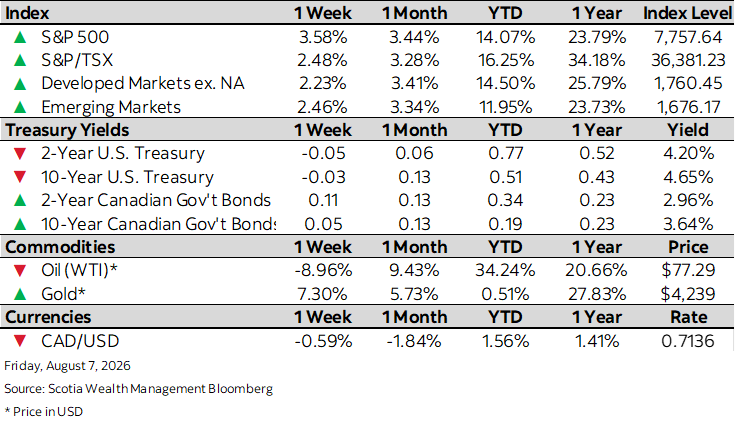
U.S. equities advanced early in the week as strong corporate earnings, particularly across AI-related technology companies, reinforced confidence in the earnings outlook, while optimism surrounding a potential reopening of the Strait of Hormuz helped ease energy-driven inflation concerns. Sentiment remained constructive through midweek as softer ADP and JOLTS labour market data increased expectations for a more patient Federal Reserve, while resilient ISM services data pointed to continued economic expansion. Later in the week, mixed semiconductor earnings tempered enthusiasm, but a sharply weaker-than-expected nonfarm payrolls report ultimately drove a significant repricing of Fed tightening expectations and supported risk assets. Canadian equities benefited from the same supportive rate backdrop and were further supported on Friday by a much stronger-than-expected employment report.

European equities were supported by strong earnings, particularly in technology, industrial and healthcare sectors, while lower oil prices and easing inflation concerns helped indices reach record highs. Chinese equities were supported by stronger-than-expected export growth and continued demand for AI-related technology, though sentiment was tempered by Beijing’s tighter drone export controls and other measures responding to expanding U.S. technology restrictions. Across Japan, South Korea and Taiwan, semiconductor stocks remained a key driver of performance, with strong AI-related demand supporting markets despite heightened earnings-related volatility.

Highlights:

  • U.S. equities returned 3.58%1 as strong earnings and resilient economic data supported equities early in the week, while softer labour market data culminated in a weak payrolls report that lowered Fed tightening expectations acting as a tailwind through into the week’s end.
  • Canadian equities returned 2.48%2 , benefitting from easing rate concerns and additional support from a stronger-than-expected employment report that underscored labour market resilience.
  • European equities advanced 2.32%3 on strong corporate earnings and easing inflation concerns, with lower oil prices helping support record-high index levels.
  • Chinese and Emerging Market equities returned 2.57%4 supported by strong export growth and AI-related technology demand, though U.S.-China technology tensions weighed on sentiment. Semiconductor stocks remained a key driver across Japan, South Korea and Taiwan, with earnings-related volatility creating sizable intra-day swings.

Treasuries lead global bond rally as Fed expectations reprice lower

U.S. Treasury markets began the week on a firmer footing as easing concerns around the Strait of Hormuz and lower energy prices reduced inflation fears and prompted investors to scale back expectations for additional Federal Reserve tightening. Midweek, softer ADP and JOLTS data reinforced the view that labour market conditions were cooling, while resilient ISM services data suggested economic activity remained on solid footing, leaving markets to balance slowing hiring against still-healthy growth. By Friday, a weaker-than-expected nonfarm payrolls report drove a significant repricing of Fed expectations and a broad rally in Treasuries. Canadian government bonds largely tracked moves in the U.S., with stronger domestic employment data having limited influence on yields. European sovereign bonds benefited from easing inflation concerns and softer global growth expectations, while Asian bond markets were supported by lower energy-price pressures and a generally more cautious outlook for global policy tightening.

Highlights:

  • The 2- and 10-year U.S. Treasury yields declined 5 basis points (bps) and 3 bps, respectively. In Canada, sovereign yields were 11 bps and 5 bps higher, respectively. Bond yields and prices move inversely to one another.
  • Sovereign bond markets were driven by shifting expectations for central bank policy, with cooling U.S. labour market data and easing energy-price pressures supporting duration and contributing to lower yields across most developed markets.
  • Credit markets were supported by solid corporate earnings, resilient economic activity and improving risk sentiment, with spreads remaining broadly stable as investors looked through softer growth data and focused on a less restrictive policy outlook.

Weekly dashboard


Canada’s labour market strength continues with hiring beating expectations

Canada’s labour market recorded stronger-than-expected growth in July. Employment increased by 75,000, while the unemployment rate declined to 6.4%, its lowest level since July 2024. The report follows several months of improving labour market indicators, with employment up 181,000 since April and the unemployment rate down 0.5 percentage points over the same period. Job gains were concentrated in service-producing industries and were led by Ontario and British Columbia, while labour force participation increased modestly. Average hourly wages for permanent employees rose 3.0% year over year, down from 3.7% in June. According to Scotia Economics, the combination of employment growth, a lower unemployment rate, rising participation, and stronger hours worked suggests labour market conditions remained firm in July and were consistent with ongoing economic growth through the third quarter.

Highlights:

  • Employment increased by 75,000 (+0.4%) in July, exceeding the consensus expectation of roughly 20,000 jobs. The unemployment rate declined to 6.4%, down from 6.5% in June and the lowest level since July 2024.
  • Employment gains were led by wholesale and retail trade (+21,000), finance, insurance, real estate and leasing (+18,000), professional, scientific and technical services (+17,000), and construction (+16,000).
  • Ontario added 52,000 jobs and British Columbia added 18,000, while the participation rate increased to 65.1%. Average hourly wages for permanent employees rose 3.0% year over year, down from 3.7% growth in June.

U.S. labour market weakens as payrolls fall in July, participation rate slips

The U.S. labour market unexpectedly contracted in July, with employers shedding 23,000 jobs, the first monthly decline in nonfarm payrolls in several months and a sign that hiring momentum is continuing to cool. The U.S. Bureau of Labor Statistics reported that nonfarm payroll employment fell by 23,000 in July, well below economists’ expectations for a 83,000 gain. Despite the drop in employment, the unemployment rate edged down to 4.1% from 4.2% in June. The decline, however, reflected a shrinking labour force rather than stronger job creation, as fewer Americans were actively looking for work.

Highlights:

  • The labour force participation rate fell to 61.4%, continuing a downward trend that has seen participation weaken throughout 2026.
  • Job losses were concentrated in local government education and retail trade, while health care continued to add positions, although at a slower pace than its recent average. Financial activities also recorded employment declines.
  • The U.S. Labor Department also revised down employment figures for prior months. June payroll growth was cut to 20,000 from a previously reported 57,000, while May gains were also revised lower. The downward revisions reinforce the view of a labour market that is gradually losing momentum.

Eurozone business activity strengthens and producer prices ease
The eurozone economy received an encouraging set of signals this week, as survey data pointed to strengthening private-sector activity while producer price pressures moderated. Data released by S&P Global showed the eurozone Manufacturing Purchasing Managers’ Index (PMI) held at 51.9 in July, remaining above the 50-point threshold that separates expansion from contraction. While the reading was slightly below expectations, it indicated that manufacturers continued to report improving business conditions despite lingering uncertainty surrounding global trade and demand.

Highlights:

  • Further evidence of economic momentum emerged when S&P Global’s Composite PMI, which combines activity across the manufacturing and services sectors, rose to 52.0 from 50.0 in June. The result was slightly above expectations and marked the strongest reading in more than two years.
  • At the same time, inflation pressures at the factory gate continued to soften. Figures released by Eurostat showed that eurozone industrial producer prices fell 0.3% in June from the previous month, reversing a 0.2% increase in May. The decline was driven largely by a 1.5% drop in energy prices, while prices excluding energy continued to edge higher.
  • Taken together, the latest data suggest the eurozone economy is entering the second half of 2026 on firmer footing. Stronger business activity alongside easing producer price pressures could support expectations that inflation will remain contained while economic growth gradually strengthens across the currency bloc.