Weather warnings may be in place around central Alberta!
(Image Credit: Medicine River Wildlife Centre)
lots to learn

Six-pack of moose under great care at Medicine River Wildlife Centre

Aug 2, 2026 | 9:01 AM

A higher number of moose orphans have come into the care of the Medicine River Wildlife Centre this summer.

Executive Director Carol Kelly says that for the most part, they end up needing care when their mother is struck and killed on Alberta roads.

This year, they’ve had nine come in for care and treatment, though sadly, three have passed away due to what Kelly says is called ‘capture myopathy.’

Capture myopathy is, in a nutshell, stress-induced death caused by a combination of the parent dying and the need to be transported.

Kelly explains it usually occurs in young moose who are a bit older, whereas the closer to newborn calves do travel better. These moose were all born in about May, but came in at different times, she says.

“These moose have come to us from the Whitecourt area, all the way down to Red Deer. Two of them were from just east of Rocky Mountain House. In one case, the mother had drowned in a farm dugout,” she shares.

“One of the calves that died, we think, may have also been hit and had a fracture. To catch them, Fish and Wildlife unfortunately have to tranquilize, and sometimes with the travel, it’s just too much for them.”

While at the rehabilitation centre, which is located near Spruce View, southwest of Red Deer, the youngsters get to bond, recover, and prepare for a safe re-introduction to the wild. That will happen sometime in September.

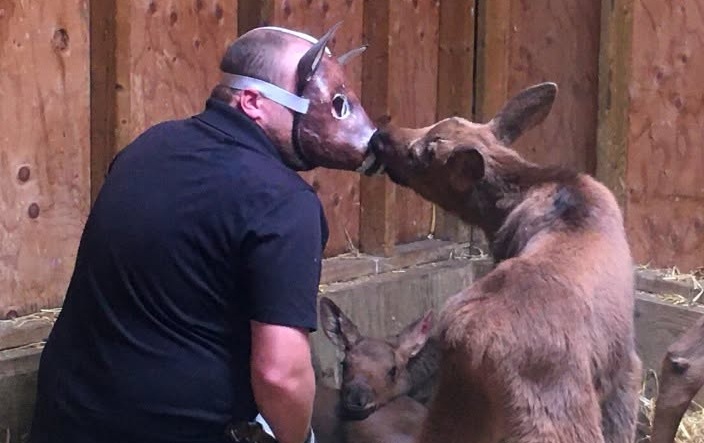
“They stick together, but I’m very adamant that staff don’t make them friendly. We go to some pretty extreme lengths. There’s no talking to them, and when interacting, they have to wear a mask that looks like a moose so it takes away the human visual, and they don’t get used to us,” says Kelly.


(Image Credit: Medicine River Wildlife Centre)

“If I go in there without a mask, anywhere near them, they take one look at me and run.”

Release will occur at the time the wildlife centre expects adult moose to be coming near their property for breeding/rutting season.

There are usually a couple cows (females) and bulls (males), and when they start to be on our property is when we open the door and let ours kind of assimilate into the herd,” she says.

“Last year, we had two little females, and they immediately hooked up with a single cow; we saw them together the rest of the winter.”

When moose or any other animals are in the care of the MRWC, it is an opportunity to learn about behaviours and new ways to treat.

Kelly shares that they’re currently trialling a new product that gets mixed into the milk/formula they give the moose. The product prevents the calves from having diarrhea, which is another symptom that can occur due to the stress of being moved.

Kelly says they’ve had a tremendous response from the public, with monetary donations coming in that help pay for formula, as well as donations of branches and trees for the moose to graze on.

The need continues, Kelly notes, and if you’d like to help, you can type in ‘Moose Formula’ when you donate online.

“Everyone loves the moose, and I think they’re my favourite of all the animals we deal with. They’re adorable, and I think that’s partially why we’ve had so much response to help us pay for things. I think people are just fascinated with moose, and I know our students love working with them,” Kelly says.

“There is something to learn with almost everything we ever have here. We observe, and at the end of the season, we sit down and ask ourselves what we could have done better, and we can change protocol.”

You can follow the moose’s journey here, and visit the MRWC at 4104 Township Road 360.