Follow our top 10 countdown of the most memorable stories of the last decade, as reported by rdnewsNOW!
(Image Credit: Scotia Wealth Management)
Sponsored

Market Watch — June 19, 2026

Jun 22, 2026 | 3:22 PM

This week’s highlights

  • Early optimism in equity markets gives way on hawkish shift in Fed tone
  • Bond rally reverses amid central bank repricing
  • Higher Canadian retail sales mask underlying weakness
  • Fed’s hawkish reset puts rate cut hopes on hold
  • Bank of England holds rates steady, balancing sticky inflation and soft growth

Week in review

Early optimism in equity markets gives way on hawkish shift in Fed tone

U.S. equities gapped higher to start the week as easing geopolitical tensions and falling oil prices on news of a final U.S.–Iran deal supported sentiment. Markets then slowly trended lower throughout the rest of the week, briefly turning negative after a hawkish Federal Reserve (Fed) policy shift under Chair Warsh drove yields higher and strengthened the dollar. They recovered the same day and ultimately closed in the green for the week. Canadian equities tracked the global tone, rising early alongside improved risk sentiment, but later softened as commodities remained under pressure, global rate expectations repriced higher, and mixed domestic retail data reinforced a more cautious backdrop.

European equities advanced relatively steadily throughout the week amid declining energy prices and improved sentiment, before becoming choppier late week as investors digested central bank uncertainty, including a hawkish shift from the Fed, while the Bank of England held steady but maintained a cautious stance as inflation remained sticky while growth remained soft. In emerging markets, China led the regional narrative, with early gains fading into underperformance as weak retail sales, ongoing property market declines, and softer domestic demand offset steadier industrial output and exports; elsewhere in emerging markets, Brazil saw policy easing continue, with its central bank expected to cut rates further amid still-elevated inflation, reinforcing a measured and data-dependent outlook.

.

Highlights:

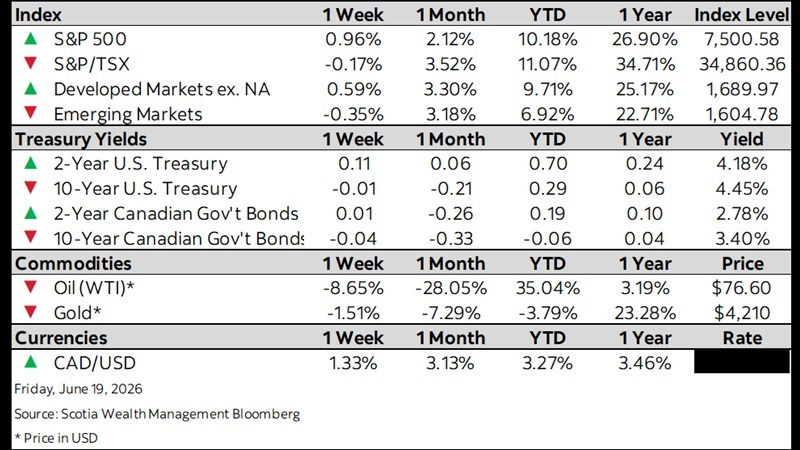
  • U.S. equities returned 0.96%1, rallying early on easing geopolitical tensions and lower oil, before drifting lower after a hawkish Fed drove yields higher and pressured risk sentiment despite strong retail sales.
  • Canadian equities returned -0.17%2, rising alongside early risk-on sentiment but faded as weaker commodities, higher yields, and mixed retail data reinforced a more cautious backdrop.
  • European stocks returned 0.59%3, lifted by falling energy prices early, then becoming choppier as Fed-driven volatility and a cautious Bank of England grappled with sticky inflation and a still-soft growth backdrop.
  • Emerging markets declined -0.35%4, with China weighing on the region as weak consumption and property pressures drove underperformance, while Brazil’s ongoing rate-cutting cycle reflected a measured, data-dependent policy path.

Bond rally reverses amid central bank repricing

U.S. Treasury yields declined early in the week on reduced inflation concerns, with Canadian and European curves moving in tandem, before markets turned more cautious into midweek ahead of key central bank decisions and mixed global data; short-term yields then shifted higher following a hawkish Federal Reserve outcome under Chair Warsh, which reinforced a higher-for-longer policy path, strengthened the dollar, and drove a broad repricing across developed markets. The long end of the curve held up better, finishing the week largely unchanged. In Europe, the early move lower in yields reversed as global rate volatility picked up and the Bank of England held rates with a cautious bias, while in China and broader emerging markets, soft domestic demand contrasted with continued policy easing in Brazil, underscoring a more uneven and divergent rates backdrop.

Highlights:

  • The 2- and 10-year U.S. Treasury yields were up 11 basis points (bps) and down 1 bps, respectively. In Canada, the 2- and 10-year yields were up 1 bp and down 4 bps, respectively. Bond yields and prices move inversely to one another.
  • Sovereign bond markets rallied early on easing geopolitical tensions and falling oil prices, before reversing midweek as a hawkish Fed drove a sharp repricing in rate expectations and pushed global yields higher.
  • Credit markets navigated a similar shift, with IG and HY spreads initially supported by improving risk sentiment before coming under pressure as rising yields, Fed-driven volatility, and renewed uncertainty tempered investor demand for risk.

Weekly dashboard


Higher Canadian retail sales mask underlying weakness

Canadian retail sales pointed to headline resilience masking softer underlying demand, with gains largely driven by higher gasoline prices rather than broad-based spending strength. While overall receipts continued to rise, the mix of growth suggests consumers are becoming more selective, with discretionary categories showing clear weakness as higher energy costs weigh on purchasing power. In volume terms, spending was essentially flat, reinforcing the idea that price effects, particularly at the pump, are doing much of the heavy lifting. Forward-looking indicators were somewhat more constructive, with early estimates pointing to a rebound in May; however, the broader signal from the report is that underlying consumption momentum remains subdued despite continued topline growth.

Highlights:

  • Headline retail sales rose 0.5% month-over-month (MoM) to ~$73 billion in April, slightly below expectations, marking a fifth consecutive increase but one largely supported by higher gasoline prices.
  • Gasoline sales surged 5.1% and autos rose 1.7%, while core retail sales fell -0.7% for a second straight month, led by declines in food (-2.0%) and general merchandise (-1.7%).
  • Volumes were flat overall, while advance estimates point to a ~1.0% MoM gain in May, suggesting some near-term stabilization but with spending still heavily influenced by energy costs.

    Fed’s hawkish reset puts rate cut hopes on hold

    The U.S. Federal Reserve’s (Fed) first policy decision under Chair Kevin Warsh delivered a hawkish surprise, shifting market attention from expected rate cuts to the possibility of renewed policy tightening. A notably brief statement and a press conference focused on price stability reinforced the message that inflation remains the Fed’s priority, while updated projections showed the median participant no longer anticipating cuts this year. Markets reacted quickly: Treasury short yields rose, the U.S. dollar strengthened and equities came under pressure as investors recalibrated expectations for the path of rates. Strategically, the decision matters because it challenges the market’s earlier assumption that easier policy was imminent and suggests investors may need to prepare for a more volatile policy backdrop, where communication, inflation data and the Fed’s evolving framework play a larger role in shaping asset prices.

    Highlights:

    • Policy expectations shifted sharply. Markets moved from pricing meaningful cuts earlier in the year to assigning higher odds of rate hikes after the Fed emphasized price stability and policymakers’ projections turned more hawkish.
    • The short FOMC statement was brief, but impactful. Though it offered limited details, it made the commitment to delivering price stability stand out as the most important signal for investors.
    • The dot plot showed a divided outlook; while the median projection moved higher, dispersion across policymakers’ views remained wide, reinforcing that the path of rates is still uncertain and data dependent.

      Bank of England holds rates steady, balancing sticky inflation and soft growth
      The Bank of England (BoE) left its benchmark interest rate unchanged, opting to maintain a cautious stance as policymakers navigate persistent inflation risks and an uncertain global backdrop. The Monetary Policy Committee (MPC) voted 7-2 to hold the bank rate at 3.75%, where it has stood since late 2025. The decision was widely anticipated by markets following fresh data showing U.K. inflation holding steady at 2.8% in May, still above the central bank’s 2% target but lower than recent peaks.

      Highlights:

      • Governor Andrew Bailey and his colleagues emphasized that volatility in global energy markets, linked in part to geopolitical tensions in the Middle East, continues to cloud the outlook. While oil prices have retreated from earlier highs, they remain above pre-conflict levels, keeping “inflationary pressure in the pipeline.”
      • The bank also pointed to signs of a cooling labour market and subdued economic growth, factors that argued against tightening policy further for now. Recent data showed the U.K. economy contracted slightly in April, underscoring the fragile growth environment confronting policymakers.
      • For now, the Bank signaled it is in no rush to adjust policy, preferring to monitor incoming data closely. Its “active hold” approach reflects a balancing act between containing inflation and avoiding unnecessary damage to an already softening economy.

      1  S&P 500 Index USD2 S&P/TSX Composite Index USD3 Bloomberg Developed Markets ex N. America Large & Mid Cap Price Return Index USD4 Bloomberg EM Large & Mid Cap Price Return Index USD