Subscribe to the 100% free rdnewsNOW daily newsletter!
Sponsored

Market Watch — April 24, 2026

Apr 27, 2026 | 10:01 AM

This week’s highlights

  • Earnings and AI themes offset growing energy concerns
  • Rates caught between inflation risks and steady activity
  • Canada’s inflation rate hits 2.4% in March fuelled by gas prices
  • U.S. jobless claims rise, surpassing economists’ expectations
  • Eurozone business activity unexpectedly contracted in April

Week in review

Earnings and AI themes offset growing energy concerns

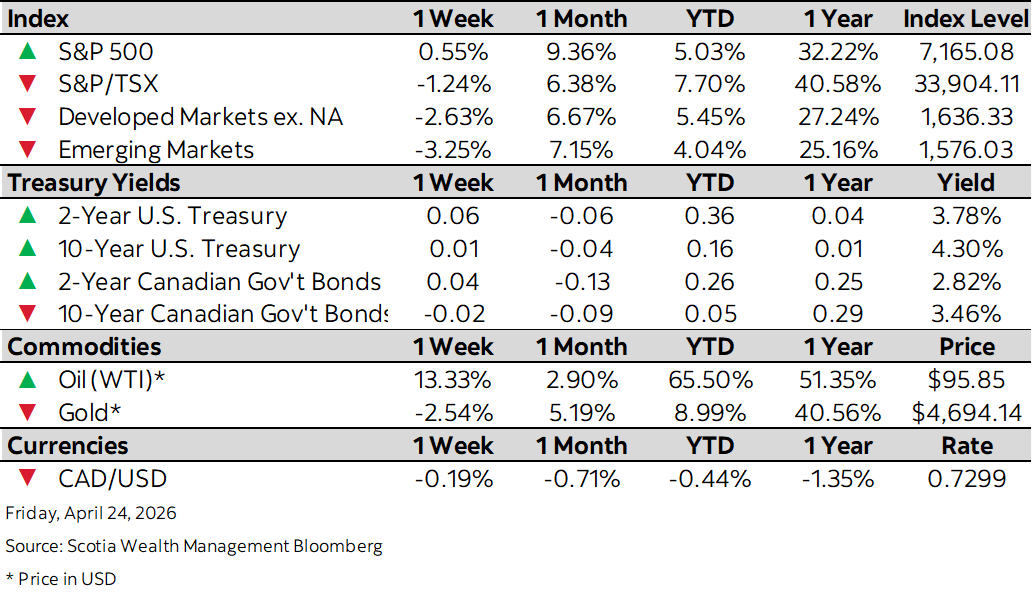
U.S. equities were volatile early as renewed U.S.–Iran tensions and the closure of the Strait of Hormuz continued to weigh on sentiment, before mid‑week gains emerged on stronger earnings, AI‑related corporate announcements, and a tenuous but indefinite extension of the ceasefire. Late‑week trading increasingly favoured technology and semiconductors, supported by upbeat guidance from names such as Intel and Taiwan Semiconductor Manufacturing Co., while largely steady jobless claims reinforced expectations that the U.S. labour market remains resilient despite broader macro uncertainty. Canadian equities broke with global sentiment for the week; despite some support from resilient domestic data and energy price strength, the potential for tighter monetary policy conditions remained a key concern that ultimately pushed the main index well into the black. European equities lagged as energy-driven inflation concerns, mixed earnings, and weak Purchasing Manager Index (PMI) data, particularly a contraction in Eurozone services, weighed on sentiment despite selective strength in technology. China and Emerging Market equities were choppy, with early resilience fading as energy costs, geopolitical uncertainty, and uneven regional data pressured risk appetite, leaving China lagging regional peers.

Highlights:

  • U.S. equities returned 0.55%1, initially dipping on Middle East headlines, but strong earnings, AI-driven investment announcements, and easing ceasefire concerns ultimately supported risk appetite, driving late‑week leadership from technology and semiconductor stocks.
  • Canadian equities returned -1.24%2 as support from resilient domestic data and elevated energy prices was ultimately outweighed by concerns around tighter monetary policy conditions.
  • European stocks returned -2.63%3 amid intensifying energy-led inflation pressures, weaker services activity reflected in PMI data, and mixed earnings, with macro uncertainty limiting gains despite pockets of strength in select technology and industrial names.
  • Emerging markets rose -3.25%4 as initial optimism gave way to concerns over higher energy prices, while Chinese equities trailed regional peers amid softer sentiment and renewed caution around growth momentum as energy supply pressures begin to bite.

Rates caught between inflation risks and steady activity

U.S. fixed income markets were driven by shifting geopolitical risk and resilient domestic data, with yields initially pressured by Middle East‑related inflation concerns and stronger retail sales, before stabilizing mid‑ to late‑week as ceasefire headlines eased and PMI data showed ongoing economic expansion with only modest employment gains, reinforcing expectations for steady policy. Canadian bonds outperformed early after CPI undershot forecasts, reducing near‑term hike pricing, before tracking U.S. moves as firm consumption data pointed to solid underlying demand. European fixed income lagged as energy‑driven inflation pressures persisted, services activity slipped into contraction, and front‑end yields rose amid tightening expectations in Germany, France and the U.K.

Highlights:

  • The 2- and 10-year U.S. Treasury yields were up 6 basis points (bps) and 1 bps, respectively. In Canada, the 2- and 10-year yields were up 4 bps and down 2 bps, respectively. Bond yields and prices move inversely to one another.
  • Global sovereign bonds were shaped by Middle East‑driven inflation concerns and mixed growth data, with U.S. yields reacting to strong retail sales, Canada supported by a CPI undershoot, and Europe pressured by sticky inflation and weak services PMIs.
  • Investment‑grade credit remained supported by resilient fundamentals and steadier rates late week, while high yield lagged as elevated energy prices, geopolitical uncertainty, and dispersion in earnings kept risk appetite selective rather than broad‑based.

Weekly dashboard


Canada’s inflation rate hits 2.4% in March fuelled by gas prices

Canada’s inflation rate jumped in March as consumers faced the largest monthly gas-price increase on record, owing to the Iran war, which has throttled deliveries of crude oil and other commodities through the critical Strait of Hormuz. According to Statistics Canada (StatCan), the annual inflation rate hit 2.4% last month, accelerating from 1.8% in February. Despite the quickening of inflation, the figures came in weaker than analyst’s expectations of 2.6%. Gasoline prices have risen sharply in recent weeks because of the Middle Eastern conflict.

Highlights:

  • Prices at the pump surged by 21.2% in March from February, the largest monthly increase recorded by Statscan. Excluding gas, the consumer price index (CPI) rose by an annual 2.2% in March, versus 2.4% in February.
  • Food costs rose 4.4% year-over-year in March, up slightly from February’s rate increase. The price of fresh vegetables saw the largest increase since August 2023, with the reading coming in at a 7.8% increase year-over-year.
  • On the core CPI front, steady trim and median measures on a year-over-year basis at a 2.3% average contrasted with a month-over-month acceleration to 0.2% from 0.1% with these narrower prices measures perhaps gathering speed after slowing in the latter part of 2026.

U.S. jobless claims rise, surpassing economists’ expectations

The number of Americans filing initial claims for unemployment benefits increased by 6,000 to a seasonally adjusted 214,000 for the week ending April 18, according to data from the U.S. Department of Labor. Economists had forecast roughly 210,000 claims, making the latest figure modestly higher than anticipated. Despite the uptick, claims remain within a historically low range, underscoring a labour market that continues to show resilience even as broader economic pressures mount.

Highlights:

  • The rise in claims comes at a time when employers appear cautious but not panicked. Layoffs remain limited, and many businesses are holding on to workers despite uncertainty tied to global geopolitical tensions and elevated input costs.
  • Continuing claims, representing the number of people still receiving unemployment benefits after an initial week of aid, also rose by 12,000 to 1.821 million. This increase may reflect a combination of slower rehiring and some workers exhausting their benefits.
  • Despite these headwinds, the four-week moving average of jobless claims, a metric used to smooth out weekly volatility, edged up only slightly to 210,750, suggesting that the broader trend remains stable.

Eurozone business activity unexpectedly contracted in April
The eurozone economy stumbled in April as private‑sector activity slipped back into contraction, according to the latest S&P Global Purchasing Manager’s Index (PMI) survey. The Composite PMI fell sharply to 48.6, down from 50.7 in March, marking the first reading below the growth threshold of 50 since late 2024. Economists had expected only a mild slowdown, but the data revealed a deeper than anticipated hit to demand across the bloc. Analysts attribute much of the strain to the ongoing conflict in the Middle East, which has pushed energy prices sharply higher and disrupted supply chains across Europe.

Highlights:

  • The downturn was driven overwhelmingly by the services sector, which saw activity fall to 47.4, its weakest level since late 2023. New business in services declined at the fastest pace in more than a year, reflecting growing consumer caution as inflationary pressures intensified.
  • Manufacturing, however, continued to expand. The sector’s PMI rose to 52.2, indicating continued expansion and outperforming expectations.
  • Across the eurozone’s largest economies, both Germany and France recorded contractions in private‑sector activity, highlighting the broad‑based nature of the slowdown. Business confidence across the bloc fell to its lowest level since late 2022, reflecting mounting uncertainty about the economic outlook.

1  S&P 500 Index USD

2 S&P/TSX Composite Index USD

3 Bloomberg Developed Markets ex N. America Large & Mid Cap Price Return Index USD

4 Bloomberg EM Large & Mid Cap Price Return Index USD

Disclaimer: This publication has been prepared by The Bank of Nova Scotia for Scotia Wealth Management clients. It is for general information purposes only and should not be considered or relied upon as personal and/or specific financial, tax, pension, insurance, legal or investment advice. We are not tax or legal advisors, and we recommend that individuals consult with their qualified advisors, including tax and legal advisors, before taking any action based upon the information contained in this publication. The opinions and projections contained in this publication are our own as of the date hereof and are subject to change without notice. Scotia Wealth Management is under no obligation to update this publication, and readers should assume the information contained herein will not be updated. While care and attention has been taken to ensure the accuracy and reliability of the material in this publication, neither The Bank of Nova Scotia nor any of its affiliates or any of their respective directors, officers or employees make any representations or warranties, express or implied, as to the accuracy or completeness of such material and disclaim any liability resulting from any direct or consequential loss arising from any use of this publication or the information contained herein. This publication may contain forward-looking statements based on current expectations and projections about future general economic factors. Forward-looking statements are subject to inherent risks and uncertainties which may be unforeseeable and such expectations and projections may be incorrect in the future. Forward-looking statements are not guarantees of future performance and you should avoid placing undue reliance upon them. This publication and all the information, opinions and conclusions contained herein are protected by copyright. This publication may not be reproduced in whole or in part without the prior express consent of The Bank of Nova Scotia. To the extent this document contains information or data obtained from third party sources, it is believed to be accurate and reliable as of the date of publication, but Scotia Wealth Management does not guarantee its accuracy or reliability.

® Registered trademark of The Bank of Nova Scotia, used under licence (where applicable). ™ Trademark of The Bank of Nova Scotia, used under licence (where applicable). Scotia Wealth Management® consists of a range of financial services provided by The Bank of Nova Scotia (Scotiabank®); The Bank of Nova Scotia Trust Company (Scotiatrust®); Scotia Jarislowsky Fraser, a service of 1832 Asset Management L.P.; 1832 Asset Management U.S. Inc.; Scotia Wealth Insurance Services Inc.; and ScotiaMcLeod®, a division of Scotia Capital Inc. Private banking services are provided by The Bank of Nova Scotia. Estate and trust services are provided by The Bank of Nova Scotia Trust Company. Portfolio management is provided by 1832 Asset Management L.P. and 1832 Asset Management U.S. Inc. Insurance services are provided by Scotia Wealth Insurance Services Inc. Wealth advisory and brokerage services are provided by ScotiaMcLeod, a division of Scotia Capital Inc. International investment advisory services are provided by Scotia Capital Inc. Financial planning services are provided by The Bank of Nova Scotia and ScotiaMcLeod. Scotia Capital Inc. is a member of the Canadian Investor Protection Fund and is regulated by the Canadian Investment Regulatory Organization. Scotia Wealth Insurance Services Inc. is the insurance subsidiary of Scotia Capital Inc., a member of the Scotiabank group of companies. When discussing life insurance products, ScotiaMcLeod advisors are acting as Life Insurance Agents (Financial Security Advisors in Quebec) representing Scotia Wealth Insurance Services Inc.

Scotia Wealth Management® in The Bahamas consists of a range of financial services provided by Scotiabank (Bahamas) Limited and The Bank of Nova Scotia Trust Company (Bahamas) Limited, which are entities licensed to operate within The Bahamas. International private banking and international investment advisory services are provided by Scotiabank (Bahamas) Limited. International wealth structuring solutions are provided by The Bank of Nova Scotia Trust Company (Bahamas) Limited. ® Registered trademark of The Bank of Nova Scotia, used under licence.

Scotia Wealth Management® in the Cayman Islands consists of a range of financial services provided by Scotiabank & Trust (Cayman) Ltd. International private banking services, international investment advisory services, and international wealth structuring solutions are provided by Scotiabank & Trust (Cayman) Ltd., an entity licensed by the Cayman Islands Monetary Authority. ® Registered trademark of The Bank of Nova Scotia, used under license.

Scotia Wealth Management® in Jamaica consists of a range of Private Banking services provided by the Scotiabank Group of companies (Scotiabank®). ®Registered trademark of The Bank of Nova Scotia, used under licence.