Sign up for our free daily newsletter!
(Image Credit: Scotia Wealth Management)
Sponsored

Market Watch: January 30

Feb 2, 2026 | 3:10 PM

This week’s highlights

  • Tech earnings gains tempered by policy uncertainty
  • Sovereign curves anchored by Fed and BoC holds
  • Bank of Canada holds benchmark interest rate steady amid trade uncertainty
  • Federal Reserve holds rates steady, citing still-high inflation and solid growth
  • Eurozone business confidence jumps at start of year

Week in review

Tech earnings gains tempered by policy uncertainty

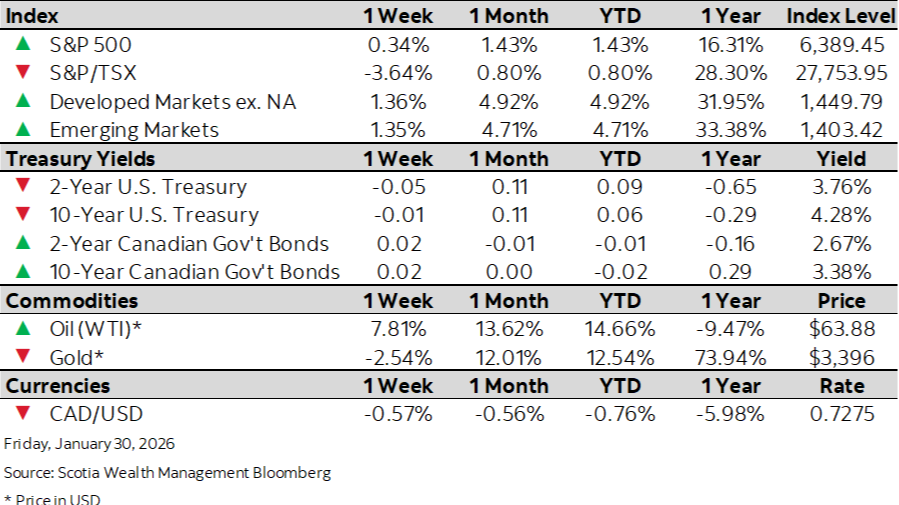
U.S. equities opened the week on firmer footing, supported by strong durable‑goods data and optimism ahead of a crowded tech‑earnings slate, though geopolitical tensions, renewed tariff threats, and uncertainty surrounding upcoming Fed and government‑funding decisions kept risk appetite subdued. Momentum improved into mid‑week on solid results from several mega‑cap tech names and China’s approval for Nvidia chip sales, but sentiment softened again after the Fed held rates steady and investors digested mixed guidance from Microsoft and broader caution around policy direction. In Canada, equities were more subdued but tracked global gains before weakening on softer GDP data and a Bank of Canada (BoC) hold that highlighted ongoing economic slack. European markets fluctuated as trade‑sensitive sectors lagged early in the week, while stronger‑than‑expected eurozone GDP later helped stabilize performance. Chinese and broader EM equities had a strong week, with Hong Kong surging mid‑week on tech catalysts before giving up some gains on Friday alongside renewed risk aversion.

Highlights:

  • U.S. equities returned 0.34%1 with a strong start to the week on durable-goods and strong tech earnings, wavering later in the week after the Fed hold, wavering guidance, renewed tariff threats and the nomination of Kevin Warsh to be the next Fed Chair.
  • Canadian equities returned -3.64%2, initially riding the coattails of global tech strength, but softening throughout the week as the BoC held rates steady, GDP weakness, and tariff headlines that added to trade uncertainty.
  • European stocks returned 1.36%3 with early‑week trade sensitivities weighing on autos and chemicals, but sentiment steadied later with stronger‑than‑forecast eurozone GDP and broad macro resilience.
  • Emerging markets saw strong performance, returning 1.35%4, with Hong Kong and mainland China supported by chip-sector tailwinds – including approval of Nvidia H200 sales – before risk sentiment deteriorated amid global earnings volatility and a stronger U.S. dollar.

Sovereign curves anchored by Federal Reserve and Bank of Canada holds

Stronger‑than‑expected durable‑goods data initially flattened the U.S. curve, followed by a drift higher in yields ahead of a large Treasury auction and the US Federal Reserve (Fed) decision, before stabilizing after the Fed held its monetary policy rate steady and emphasized solid economic activity. Canadian yields generally edged lower early in the week alongside softer GDP signals and fell modestly after the Bank of Canada left rates unchanged, while highlighting persistent economic slack. European bond markets saw mild declines in core yields early on, before later steadying as eurozone GDP surprised to the upside even as inflation trends remained mixed across major economies. In Asia and broader emerging markets, moves were relatively contained, with Japan’s yields fluctuating slightly around central‑bank‑sensitive levels.

Highlights:

  • The 2- and 10-year U.S. Treasury yields fell 5 basis points (bps) and 1 bps, respectively. In Canada, the 2- and 10-year yields were both up 2 bps. Bond yields and prices move inversely to one another.
  • Sovereign yields shifted in response to strong U.S. durable goods data, large Treasury auctions, and steady Fed and BoC policy decisions, while eurozone bonds firmed on stronger than expected GDP and Japan’s yields moved narrowly around central bank sensitive levels.
  • Corporate bond sentiment reflected the week’s heavy earnings cycle, with strong mega cap tech results improving tone early on, while renewed geopolitical tensions, tariff headlines, and shifting Fed expectations kept spreads sensitive to broader risk appetite.

Weekly dashboard


Bank of Canada holds benchmark interest rate steady amid trade uncertainty

The Bank of Canada (BoC) announced this week that it is keeping its benchmark interest rate steady and offered little guidance about where monetary policy will go next as U.S. protectionism continues to reshape the Canadian economy. As widely anticipated, the bank’s governing council kept the policy rate at 2.25%, where it has been since October. Governor Tiff Macklem said this level “remains appropriate” given the bank’s outlook for slow, but positive economic growth, and subdued inflation.

Highlights:

  • “Uncertainty around our forecast is heightened and the range of possible outcomes is wider than usual. U.S. Trade policy remains unpredictable, and geopolitical risks are elevated,” Macklem said.
  • The bank’s new forecast sees muted growth going forward. Gross domestic product is expected to grow 1.1% in 2026 and 1.5% in 2027, largely unchanged from the last projection in October.
  • This forecast remains highly conditional on U.S. trade policy, particularly the outcome of the upcoming review of the North American free trade pact, which Macklem flagged as an “important risk to the outlook.”

    Federal Reserve holds rates steady, citing still-high inflation and solid growth

    The U.S. Federal Reserve (Fed) held interest rates steady, citing still-elevated inflation alongside solid economic growth, and giving little indication in its latest policy statement of when borrowing costs might fall again. “Economic activity has been expanding at a solid pace,” Fed policymakers said in the statement after voting 10-2 to hold the U.S. central bank’s benchmark interest rate in the 3.50% to 3.75% range after a two-day meeting.

    Highlights:

    • The Fed’s statement offered no hint about when another reduction in borrowing costs might come, noting that “the extent and timing of additional adjustments” to the policy rate would depend on incoming data and the economic outlook.
    • Meanwhile, inflation “remains somewhat elevated,” the central bank said, while the job market has “shown some signs of stabilization.”
    • Though the Fed noted that “job gains have remained low,” it also removed language from its prior statement saying that downside risks to employment had risen, an indication that policymakers as a group are becoming less worried about a rapid downturn in the labour market.

      Eurozone business confidence jumps at start of year
      Confidence among businesses in the eurozone jumped more than expected in January, in line with a rise in consumer confidence at the start of the year. The European Commission reported that its Economic Sentiment Indicator, which measures attitudes of businesses across multiple sectors of the economy as well as consumers, rose to 99.4 in the month compared with an upwardly revised 97.2 in December. This marks the highest level since January 2023.

      Highlights:

      • The data follows a rise in consumer confidence in January, though economic and income expectations were clouded by rising geopolitical concerns.
      • Activity in the manufacturing and services sectors also held steady at the start of the year. Activity slipped in France, though this was offset by an acceleration in Germany.
      • Meanwhile, the employment expectations index pointed to a loosening labour market, which could contribute to slowing wage growth ahead.

        1  S&P 500 Index USD2 S&P/TSX Composite Index USD3 Bloomberg Developed Markets ex N. America Large & Mid Cap Price Return Index USD4 Bloomberg EM Large & Mid Cap Price Return Index USD